
Share your views on robots
Tell us whether you would use a robot at home, which tasks should be automated and what worries you. Your answers are combined with other people's and reported only as totals.
Start the robots and automation surveyAbout 5 minutes. No account needed. You can stop at any time.
What robots and automation are
Automation means using machines or software to do tasks that people once did by hand. Robots are one kind of automation: machines that sense their surroundings, make decisions and move or act in the physical world. Not all automation involves robots. Self-checkouts, automatic payments, online booking systems and software that sorts emails are automation without a physical robot.
Robots range from simple to complex:
- Industrial robots that weld, paint and assemble products in factories.
- Warehouse robots that move shelves and sort parcels.
- Service robots that clean floors, deliver items in hospitals or hotels, or guide visitors.
- Home robots such as robot vacuums, lawn mowers and pool cleaners.
- Medical robots that assist surgeons or help patients with rehabilitation.
- Care and companion robots that remind people to take medicine or offer conversation.
- Vehicles with automated driving features, and delivery drones.
Robots at home
Home robots are mostly used for cleaning and garden work. People who own them often say they save time, while others find them noisy, expensive or not good enough to replace manual work. Smart home devices that switch lights, heating and appliances on schedules are a related form of home automation.
Example
A couple with two young children buy a robot vacuum. They say it keeps crumbs under control between weekly cleans but gets stuck on toys and cables, so they tidy the floor before it runs. After a year they still use it daily and would buy another, but not a robot mop, which they found less useful.
Robots and automation at work
At work, automation often takes over tasks rather than whole jobs. Common examples include:
- factory assembly, packing and quality checks;
- warehouse picking and sorting;
- self-service checkouts and ordering kiosks;
- automated phone menus and chat assistants in customer service;
- software that processes invoices, claims or forms;
- automated farm machinery and milking systems.
Workers' experiences vary. Some say automation removes boring, dirty or dangerous tasks; others say it speeds up work, increases monitoring or reduces hours.
Example
A warehouse worker used to walk many kilometres a shift picking items. Now shelves are brought to her by robots, and she picks from a fixed station. She says the work is less tiring physically but more repetitive, and her pick rate is tracked more closely than before.
Which tasks people want automated
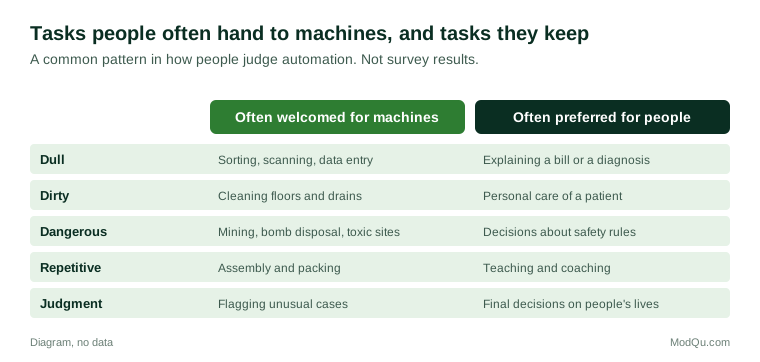
People tend to welcome automation for tasks that are dull, dirty, dangerous or very repetitive, and to prefer people for tasks that involve judgment, care or trust. The figure below shows this pattern as a grid of examples. Views also depend on how well the machine works and whether a person can step in when something goes wrong.
Worries about jobs
A frequent concern is that robots and automation will replace jobs. Economists debate how large and how fast this effect will be. Past waves of automation removed some jobs and created others, but the new jobs were not always in the same places or for the same people. Concerns include:
- loss of jobs in factories, warehouses, transport and retail;
- lower wages or fewer hours for people whose tasks are partly automated;
- the need to retrain in mid-career;
- benefits going mainly to owners rather than workers.
Example (hypothetical figures)
A supermarket with 12 staffed checkouts replaces 8 with 24 self-checkouts watched by 2 staff. Staff hours at the tills fall from 12 people per shift to 6 (4 staffed checkouts plus 2 supervisors). The company moves 3 of the 6 staff to online order picking and does not refill 3 posts when people leave.
Safety and trust
People want robots that are safe, reliable and easy to stop. Questions include who is responsible when an automated system causes harm, how systems are tested, and whether people know when they are dealing with a machine. Rules on robot safety exist for factories and are being developed for robots in public spaces and for automated vehicles.
Care and companion robots
In some countries with ageing populations, robots are being tested in care homes and private homes for reminders, lifting and company. Supporters say they can help stretched care workers and let older people stay at home longer. Critics worry they will be used to cut human contact and that older people may not be asked what they want.
What people disagree about
- Whether automation will create more jobs than it removes.
- Who should pay for retraining workers.
- Whether self-service should replace staffed service.
- Whether robots should be used in care for older people and children.
- How to share the gains from higher productivity.
Why surveys ask about robots
Questions that technology firms, universities, research bodies and public agencies want answered include whether people would use a robot at home, which tasks they think should be automated, how worried they are about jobs and what would make them trust automated systems. Answers are grouped and every question can be skipped.
Working with robots
As robots and automated systems spread, many workers now share tasks with machines. This can mean supervising several machines at once, fixing them when they stop, checking their work or handling the unusual cases they cannot manage. Workers often say good training, clear safety rules and a say in how machines are introduced make a large difference to how they feel about automation. Some workplaces involve staff in choosing and testing new systems before they are rolled out; others introduce them with little notice. Trade unions and works councils in some countries negotiate over how automation is introduced and how affected staff are retrained or redeployed.
Key terms
- AutomationUsing machines or software to do tasks people once did by hand.
- RobotA machine that senses its surroundings and acts in the physical world.
- Industrial robotA robot arm or machine used in manufacturing.
- Collaborative robotA robot designed to work safely alongside people.
- Self-serviceSystems where customers do tasks themselves, such as self-checkouts.
- Task automationAutomating parts of a job rather than the whole job.
- ReskillingLearning new skills for a different kind of work.
- Emergency stopA control that halts a machine at once for safety.
Full glossary: robotics terms on EditingTests.com.
Robots and automation vocabulary test
How well do you know the language of this topic? Try 8 quick questions. Your score is shown straight away and is not saved.
What the robots and automation survey asks
This survey is part of ModQu's Science and Technology Attitudes survey. The robots and automation part takes about five minutes and covers:
- Whether you use or would use a robot at home, and for what.
- Which tasks at work or in daily life you think should be automated.
- Which tasks you think should always be done by people.
- How worried you are that robots or automation will affect jobs.
- Your experience of self-service and automated systems.
- What would make you trust robots and automated systems more.
After that you can choose to continue with other short parts of the Science and Technology Attitudes survey, such as trust in science or space exploration, or stop.
Ready to take part?
Your answers help show what people really think and do. Results are only ever reported as totals; no one can see your individual answers.
Start the surveyQuestions about this survey
Who can take part?
Adults.
Do I have to give my name?
No. You may be asked for your age group, region and similar details so results can be broken down, but not your name. ModQu never asks for passwords, card numbers or account numbers.
How are the results used?
Answers are combined into totals and percentages and published in ModQu reports. Individual answers are never shown.
Is the vocabulary test part of the survey?
No. It is optional and separate, and your score is not stored.
Does the survey ask about artificial intelligence too?
It focuses on robots and automation. A separate topic covers artificial intelligence in daily life.
Do I need to own a robot to take part?
No. The survey is for everyone, including people who have never used one.