
Share your views on space
Tell us how interested you are in space, whether you think spending on it is worth it and whether you would travel there. Your answers are combined with other people's and reported only as totals.
Start the space exploration surveyAbout 5 minutes. No account needed. You can stop at any time.
What space exploration covers
Space exploration is the study and use of space through telescopes, robotic spacecraft and human spaceflight. It includes:
- Space science: studying planets, stars, galaxies and the origins of the universe.
- Robotic missions: probes, landers and rovers sent to the Moon, planets, asteroids and comets.
- Human spaceflight: astronauts on space stations and missions beyond Earth orbit.
- Earth observation: satellites that monitor weather, climate, oceans, forests and disasters.
- Communications and navigation: satellites for phone, internet, television and positioning.
- Commercial space: private companies launching satellites, cargo and, increasingly, paying passengers.
Space activity is carried out by national space agencies, international partnerships, universities and private firms. Many countries now have space programmes, and several work together on shared missions.
Space in everyday life
Many people do not realize how much daily life depends on space. Satellite services include:
- weather forecasts and storm warnings;
- navigation on phones and in vehicles;
- timing signals used by banks, power grids and phone networks;
- television broadcasts and internet in remote areas;
- maps and images used in farming, fishing and city planning;
- monitoring of floods, wildfires and crop failures.
Example
A farmer checks a phone app that uses satellite images to show which parts of a field are dry. The app also gives a forecast based on weather satellites. The farmer had not thought of either as "space technology" until a neighbour's child mentioned it after a school science project.
Public interest
Interest in space is often high during major events, such as a launch, a Moon landing, a rover reaching another planet or a total solar eclipse. People follow missions through news, live streams, social media accounts of space agencies and visits to planetariums and science museums. Interest can fade between big events. Researchers ask how interested people are, which missions they have heard of and where they follow space news.
Paying for space
Most space science is funded by governments through national budgets. People hold different views on whether this spending is worth it:
- Arguments for: scientific discovery, new technology, jobs in high-skill industries, national pride, inspiring young people, and satellites that serve daily life and safety.
- Arguments against: money could be spent on health, education or poverty; missions can be very costly; benefits seem distant.
Many people support spending on Earth observation and weather satellites more strongly than on human missions to other planets. Space agency budgets are usually a small share of total public spending, but people often guess they are much larger.
Example (hypothetical figures)
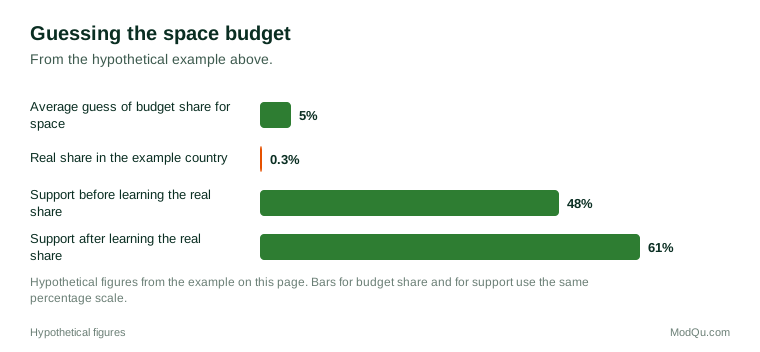
A survey asks people to guess what share of their national budget goes to space. The average guess is 5 percent. In the hypothetical country used in the example, the real figure is 0.3 percent. When people are told the real share, support for keeping or raising spending goes up from 48 percent to 61 percent.
The figure below charts these hypothetical results.
Space tourism
Private companies now sell short trips to the edge of space and, for a few people, longer stays in orbit. Prices are currently far beyond the reach of most people. Views on space tourism differ:
- some see it as an exciting step that will make space travel cheaper over time;
- some see it as a luxury for the very wealthy with a high environmental cost;
- some worry about safety and about rules for private spaceflight.
Surveys often ask whether people would travel to space if it were safe and affordable. Answers depend heavily on age, health and attitudes to risk.
Example
A teenager says she would go to space "tomorrow" if she could. Her grandfather says he would not go at any price because of the risk. Her mother would go only if the trip were as safe as a long-haul flight, and only to see the Earth from orbit, not to travel further.
Risks and responsibilities
Space activity raises shared issues:
- Space debris: broken satellites and rocket parts that can damage other spacecraft.
- Crowding of orbits as the number of satellites grows.
- Light pollution affecting astronomers' views of the night sky.
- Planetary protection: avoiding contamination of other worlds and of Earth.
- International rules: treaties set basic rules, such as that no nation may claim the Moon, but new issues such as mining are still being discussed.
Careers and education
Space missions are often used to encourage young people to study science, technology, engineering and mathematics. Space work involves engineers, scientists, technicians, doctors, lawyers and many other careers. Countries with growing space industries often invest in university programmes and training.
What people disagree about
- Whether public money should go to human missions or robotic ones.
- Whether private companies or governments should lead.
- How space resources should be shared.
- Whether space tourism is a good use of money and fuel.
- How to deal with space debris and crowded orbits.
Why surveys ask about space
Questions that research bodies, universities, science communicators and public agencies want answered include how interested people are, whether they think space spending is worth it, which missions they support, and whether they would travel to space. Answers are grouped and every question can be skipped.
Space and the night sky
For many people, interest in space begins with looking up. Stargazing clubs, public observatories and planetariums let people see planets, the Moon and distant galaxies. Events such as meteor showers and eclipses draw crowds, and dark-sky parks in several countries protect places with little light pollution. Some astronomers and stargazers worry that large numbers of new satellites will make the night sky harder to study, and companies and agencies are discussing ways to make satellites less bright.
Key terms
- OrbitThe curved path of an object around a planet or star.
- SatelliteAn object that orbits a planet; often a spacecraft that collects data or relays signals.
- RoverA robotic vehicle that drives on the surface of another world.
- Space stationA crewed spacecraft that stays in orbit for long periods.
- Space debrisUnused or broken objects in orbit, such as old satellites and rocket parts.
- Earth observationStudying the Earth's surface and atmosphere from space.
- Launch vehicleA rocket that carries a spacecraft into space.
- Space tourismPaid travel to space for leisure.
Full glossary: space science terms on EditingTests.com.
Space exploration vocabulary test
How well do you know the language of this topic? Try 8 quick questions. Your score is shown straight away and is not saved.
What the space exploration survey asks
This survey is part of ModQu's Science and Technology Attitudes survey. The space exploration part takes about five minutes and covers:
- How interested you are in space exploration and missions.
- Where you follow space news.
- Whether public spending on space is worth it, and on which kinds of missions.
- Whether governments or private companies should lead.
- Whether you would travel to space if it were safe and affordable.
- Your concerns, such as cost, debris or the environment.
After that you can choose to continue with other short parts of the Science and Technology Attitudes survey, such as trust in science or genetic testing, or stop.
Ready to take part?
Your answers help show what people really think and do. Results are only ever reported as totals; no one can see your individual answers.
Start the surveyQuestions about this survey
Who can take part?
Adults.
Do I have to give my name?
No. You may be asked for your age group, region and similar details so results can be broken down, but not your name. ModQu never asks for passwords, card numbers or account numbers.
How are the results used?
Answers are combined into totals and percentages and published in ModQu reports. Individual answers are never shown.
Is the vocabulary test part of the survey?
No. It is optional and separate, and your score is not stored.
Do I need to know about space to take the survey?
No. The survey asks about your interest and views, not your knowledge.
Will the survey ask which space companies I like?
No. Questions are about kinds of activity, not about brands.