
Share your views on biotechnology
Tell us whether you would eat genetically modified food, whether you check labels and how you feel about gene editing in medicine. Your answers are combined with other people's and reported only as totals.
Start the biotechnology and gmos surveyAbout 5 minutes. No account needed. You can stop at any time.
What biotechnology is
Biotechnology means using living organisms, cells or their parts to make products or solve problems. Some forms are very old, such as using yeast to make bread and beer or breeding plants and animals for useful traits. Modern biotechnology works directly with genes. It includes:
- Genetic modification: adding, removing or changing genes in an organism, sometimes using a gene from another species.
- Gene editing: making precise changes to an organism's own DNA, using newer tools.
- Biopharmaceuticals: medicines made using living cells, such as insulin and many vaccines.
- Industrial biotechnology: enzymes and microbes used to make detergents, fuels and materials.
- Diagnostics: tests that detect genes or proteins.
GMOs in food and farming
A genetically modified organism, or GMO, is a plant, animal or microbe whose genes have been changed in a way that does not happen through natural breeding. Common genetically modified crops include varieties of maize, soy, cotton and canola, often modified to resist insects or tolerate certain herbicides. Others have been developed to resist plant diseases, survive drought or add nutrients.
Many processed foods contain ingredients from such crops, such as oils, sugars and starches, and much animal feed in some countries comes from them. Where GM crops are grown and sold depends on national rules, which vary greatly.
How rules and labels differ
Countries regulate GM food in different ways:
- some require safety assessment before approval and labelling of GM ingredients above a threshold;
- some approve many GM crops and do not require labels unless the food is materially different;
- some ban or strictly limit growing GM crops, while still allowing some imports;
- rules for gene-edited crops are newer and differ again: some treat them like GMOs, others like conventional breeding when no foreign DNA is added.
Major international scientific and health bodies have stated that approved GM foods on the market have been assessed as safe to eat as their conventional counterparts. Debate continues about environmental effects, farming practices and who controls seeds.
Example
A shopper on holiday notices that food labels in the country she is visiting mark GM ingredients, while labels at home do not. She realizes that many foods she buys at home may contain GM ingredients and starts reading about how each country's rules work.
Why people support it
Reasons people give for supporting biotechnology in food include:
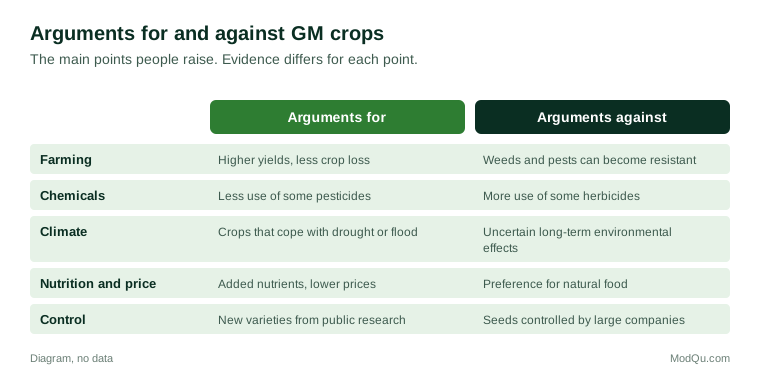
- higher yields or less crop loss to pests and disease;
- less use of some pesticides;
- crops that survive drought or flood;
- foods with added nutrients for people with poor diets;
- lower prices.
Why people oppose or worry
Reasons people give for opposing or doubting it include:
- worry about long-term effects on health, even after safety assessments;
- environmental concerns, such as effects on insects, weeds becoming resistant to herbicides or cross-pollination with other crops;
- concern about large companies controlling seeds and farmers paying for patented varieties;
- a preference for food seen as natural;
- religious or ethical views about changing living things;
- distrust of the companies and regulators involved.
The figure below sets out the main arguments side by side.
Biotechnology in medicine
People tend to be more accepting of biotechnology in medicine than in food. Insulin, many vaccines and some cancer treatments are made with genetically modified cells. Gene therapies, which treat some inherited diseases by adding or correcting genes, have been approved in several countries. Gene editing of human embryos, which would pass changes to future generations, is widely opposed or banned, and is the subject of international discussion.
Example
A man who avoids GM food says he would accept a gene therapy for his daughter's inherited eye disease without hesitation. He explains that in medicine he can see a clear benefit for one person, while in food he sees less benefit and more uncertainty.
Organic and non-GMO choices
Some shoppers seek out organic food, which in many countries cannot use GM crops, or products labelled as non-GMO. These choices can cost more. Shoppers' reasons include health, environment, taste and support for certain kinds of farming.
Example (hypothetical figures)
A family compares a weekly shop of 120 for conventional products with 156 for the same items as organic or non-GMO. The extra cost is 36 a week, or 30 percent. They decide to buy organic versions of a few items they eat most and keep the rest conventional.
What people disagree about
- Whether GM foods should carry labels.
- Whether gene-edited crops should be regulated like GMOs.
- Who should own and profit from new crop varieties.
- Whether biotechnology helps or harms small farmers in poorer countries.
- Where the limits of gene editing in humans should be.
Why surveys ask about biotechnology
Questions that research bodies, universities, food firms, science communicators and public agencies want answered include whether people would eat GM food, whether they check labels, how much they know, and how they feel about gene editing for food and medicine. Answers are grouped and every question can be skipped.
Biotechnology in developing countries
Debates about biotechnology often focus on farming in lower-income countries, where crop losses to pests, disease and drought can be severe. Supporters point to public research programmes that have developed crops resistant to local diseases or enriched with vitamins, and to farmers who have adopted such crops. Critics argue that the main problems are often poverty, land rights, storage and access to markets rather than seed varieties, and that farmers can become dependent on costly seeds and chemicals. Governments in different regions have reached different decisions, some approving GM crops for local farming and others banning them.
Key terms
- BiotechnologyUsing living organisms or their parts to make products or solve problems.
- GMOA genetically modified organism, whose genes have been changed in a way not found in natural breeding.
- Gene editingMaking precise changes to an organism's own DNA.
- TransgenicContaining a gene from a different species.
- Herbicide-tolerant cropA crop modified to survive a weed-killing chemical.
- Gene therapyA treatment that adds or corrects genes to treat a disease.
- Labelling thresholdThe level of GM content above which a label is required.
- OrganicFood produced under rules that limit synthetic inputs and, in many countries, ban GM crops.
Full glossary: agricultural biotechnology terms on EditingTests.com.
Biotechnology and GMOs vocabulary test
How well do you know the language of this topic? Try 8 quick questions. Your score is shown straight away and is not saved.
What the biotechnology and gmos survey asks
This survey is part of ModQu's Science and Technology Attitudes survey. The biotechnology and gmos part takes about five minutes and covers:
- Whether you would eat genetically modified or gene-edited food.
- Whether you check labels for GM ingredients or buy organic or non-GMO.
- How much you feel you know about biotechnology.
- Your views on gene editing in medicine and in food.
- Whether GM foods should be labelled.
- Which sources you trust on this topic.
After that you can choose to continue with other short parts of the Science and Technology Attitudes survey, such as trust in science or space exploration, or stop.
Ready to take part?
Your answers help show what people really think and do. Results are only ever reported as totals; no one can see your individual answers.
Start the surveyQuestions about this survey
Who can take part?
Adults.
Do I have to give my name?
No. You may be asked for your age group, region and similar details so results can be broken down, but not your name. ModQu never asks for passwords, card numbers or account numbers.
How are the results used?
Answers are combined into totals and percentages and published in ModQu reports. Individual answers are never shown.
Is the vocabulary test part of the survey?
No. It is optional and separate, and your score is not stored.
Is the survey for or against GMOs?
Neither. It records what people think and treats every view the same way.
Do I need to know the science to take part?
No. You can say you are unsure, and that answer is useful too.