
Share your views on science education
Tell us how good your science education was, whether schools should teach more science and what you would like to learn. Your answers are combined with other people's and reported only as totals.
Start the science education surveyAbout 5 minutes. No account needed. You can stop at any time.
How science is taught at school
School science usually starts with general lessons about nature, the body and simple experiments, and later divides into subjects such as biology, chemistry, physics and earth science. Many systems also teach environmental science, computing and engineering. How much science pupils study, and at what age they can drop it, varies between countries and school systems.
Common teaching approaches include:
- Direct teaching of facts, laws and theories;
- Practical work in laboratories and fieldwork outdoors;
- Inquiry-based learning, where pupils ask questions, plan investigations and analyse results;
- Project work linking science to real problems such as local water quality;
- Demonstrations by teachers of experiments too complex or risky for pupils.
How adults look back
Adults' memories of school science vary widely. Some recall inspiring teachers, exciting experiments and a sense of wonder. Others remember memorizing formulas, feeling that science was "not for them" or having little access to laboratories. Survey questions often ask adults to rate their science education, say which subjects they enjoyed and whether they felt encouraged to continue.
Example
A hairdresser says she was told at 14 that she was "not a science person" after a poor chemistry test and dropped the subject the next year. Now in her forties, she watches documentaries about the brain and wishes she had kept studying biology.
What people feel they know
People's confidence in their own science knowledge often differs from their actual knowledge. Some underestimate what they know; others overestimate it. Surveys sometimes include a few simple knowledge questions alongside questions about confidence, and look at how both relate to views on topics such as health, energy and technology. Knowledge alone does not always predict attitudes: people with similar knowledge can hold very different views, shaped by values and trust.
Learning science after school
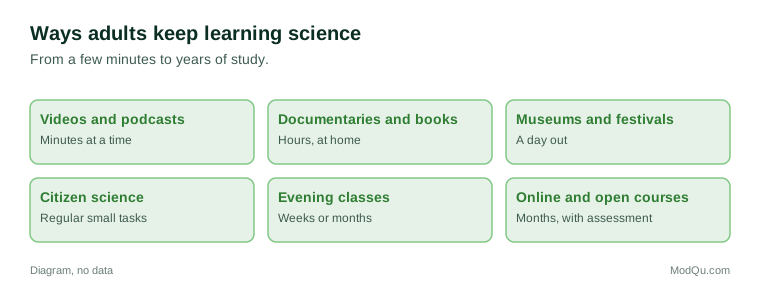
Adults continue to learn science in many ways:
- museums, science centres, zoos, botanical gardens and planetariums;
- television documentaries, podcasts and online videos;
- books and magazines;
- evening classes, open university courses and free online courses;
- citizen science projects, such as counting birds or recording weather;
- public lectures and science festivals;
- learning alongside their children's homework.
The figure below groups these by how much time and commitment they take.
Example
A father helping his daughter with a school project on plants joins a citizen science project that records the first flowering dates of trees in their area. Two years later they still submit observations every spring, and he says he has learned more botany than he did at school.
Who goes on to study science
Choices about studying science after compulsory school are shaped by interest, results, teachers, family expectations, career information and confidence. Researchers have long studied gaps in who chooses science subjects, for example between girls and boys in some subjects, or between pupils from different income groups and regions. Programmes to widen participation include mentoring, role models, summer schools and outreach visits by scientists.
Example (hypothetical figures)
A school of 200 final-year pupils finds that 70 choose at least one advanced science subject: 42 boys and 28 girls. After a mentoring programme with local scientists, the next year 84 choose science, including 40 girls. The share of girls among science students rises from 40 percent to about 48 percent.
What makes good science teaching
Teachers, researchers and pupils often point to:
- qualified, confident teachers with time to plan;
- hands-on practical work and fieldwork;
- linking science to everyday life and local issues;
- teaching how science works, including uncertainty and evidence, not only facts;
- encouraging questions and discussion;
- good equipment and safe laboratories.
Shortages of specialist science teachers and laboratory equipment are reported in many countries.
Science education and public life
Science education is often linked to how people handle health information, understand risks, judge claims in the news and take part in public debates on issues such as energy, food and technology. Many educators argue that teaching how to evaluate evidence matters as much as teaching facts.
What people disagree about
- Whether schools should teach more science, or more of other subjects.
- How much time to give to facts versus inquiry and practical work.
- How to teach topics that some families find controversial.
- Whether all pupils should study science until the end of school.
- How to close gaps in who chooses science.
Why surveys ask about science education
Questions that universities, research bodies, science communicators and public agencies want answered include how adults rate their science education, how confident they feel about science, whether schools should teach more and which topics people would like to learn about. Answers are grouped and every question can be skipped.
Science education for everyone
Many educators argue that science education is not only for future scientists. Everyone uses science when they read a medicine label, judge a health claim, compare energy bills, follow a weather warning or decide how to vote on an environmental issue. For this reason, some school systems teach a broad science course to all pupils, separate from the specialist courses for those who want to go further. Topics often include how evidence is gathered, how to read graphs and numbers, risk and probability, and how science and society affect each other.
Access also matters. Pupils in rural areas, small schools and lower-income communities may have fewer specialist teachers and less equipment. Mobile science labs, online lessons, partnerships with universities and teacher training programmes are some of the ways countries try to close these gaps.
Key terms
- Inquiry-based learningTeaching where pupils ask questions, plan investigations and draw conclusions.
- Practical workHands-on activities such as experiments in a laboratory.
- FieldworkScientific study carried out outdoors, such as surveying plants.
- Science literacyThe knowledge and skills to understand and judge scientific information.
- Citizen scienceResearch in which members of the public collect or analyse data.
- STEMScience, technology, engineering and mathematics.
- HypothesisA testable statement predicting the result of an investigation.
- OutreachActivities by scientists and institutions to engage the public and schools.
Full glossary: higher education terms on EditingTests.com.
Science education vocabulary test
How well do you know the language of this topic? Try 8 quick questions. Your score is shown straight away and is not saved.
What the science education survey asks
This survey is part of ModQu's Science and Technology Attitudes survey. The science education part takes about five minutes and covers:
- How good you think your own science education was.
- Which science subjects you enjoyed or disliked, and why.
- How confident you feel about science today.
- Whether schools should teach more, less or the same amount of science.
- How you learn about science now, if at all.
- Which science topic you would like to learn more about.
After that you can choose to continue with other short parts of the Science and Technology Attitudes survey, such as trust in science or space exploration, or stop.
Ready to take part?
Your answers help show what people really think and do. Results are only ever reported as totals; no one can see your individual answers.
Start the surveyQuestions about this survey
Who can take part?
Adults.
Do I have to give my name?
No. You may be asked for your age group, region and similar details so results can be broken down, but not your name. ModQu never asks for passwords, card numbers or account numbers.
How are the results used?
Answers are combined into totals and percentages and published in ModQu reports. Individual answers are never shown.
Is the vocabulary test part of the survey?
No. It is optional and separate, and your score is not stored.
Will the survey test my science knowledge?
There may be a few optional knowledge questions, but there is no pass or fail and every question can be skipped.
Can I take part if I left school early?
Yes. The survey is for adults with any level of education.