
Share how you follow science news
Tell us how often you read science news, whether you trust science headlines and whether you have changed a habit because of a study. Your answers are combined with other people's and reported only as totals.
Start the science in the news surveyAbout 5 minutes. No account needed. You can stop at any time.
How a study becomes news
Most science news starts with research published in a journal or presented at a conference. The usual path is:
- Researchers complete a study and submit it to a journal.
- Other experts review it, and it may be revised or rejected.
- The journal publishes it, sometimes with a press release from the journal or the researchers' university.
- Journalists pick up the press release, interview researchers and write a story.
- The story is shared on websites and social media, often with a shorter headline.
Some findings are reported before peer review, as preprints. At each step details can be lost and claims can become stronger than the study supports.
Why headlines can mislead
Common problems include:
- Correlation reported as cause: a study finds that two things occur together, and the headline says one causes the other.
- Animal or lab studies reported as human results: a finding in mice or cells is presented as if it applies to people.
- Small studies presented as definitive: one study with few participants is reported as settling the question.
- Relative risk without absolute risk: "doubles the risk" can mean a rise from 1 in 10,000 to 2 in 10,000.
- Missing context: no mention of earlier studies that found different results.
- Exaggerated press releases: overstatement that begins before journalists are involved.
The figure below lists questions readers can ask when they see a science headline.
Example (hypothetical figures)
A headline says a food "raises cancer risk by 20 percent". The study found that out of 10,000 people who rarely eat the food, 50 develop the cancer over ten years; among 10,000 people who eat it often, 60 do. The absolute increase is 10 extra cases per 10,000 people, or 0.1 percentage points. The relative increase is 20 percent.
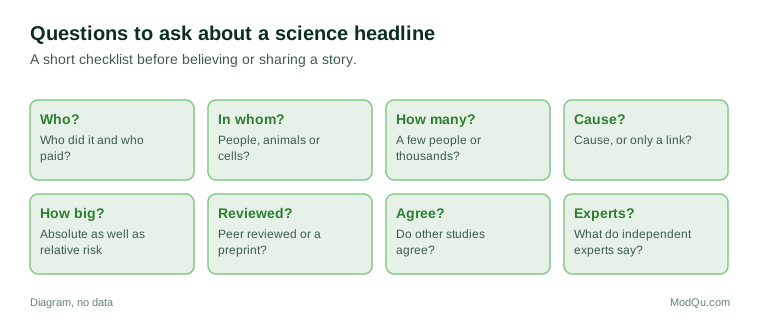
How to read a science report
Helpful questions include:
- Who did the study, and who paid for it?
- Was it in people, animals or cells?
- How many people took part?
- Did it show cause, or only a link?
- How big is the effect in absolute terms?
- Has it been peer reviewed?
- Do other studies agree?
- What do independent experts say?
Many news organizations now include links to the original study and comments from experts who were not involved.
How people follow science news
People get science news from television, radio, newspapers and news websites, social media, podcasts and videos, friends and family, and health workers. Some follow science closely; others only see it when a major story breaks. People often say they find health and environment stories most relevant and space and technology stories most exciting.
Example
A teacher scrolls past many science headlines each week but reads only those about health or children. When a post claims that a common drink damages memory, she clicks through and sees the study was done in rats over two weeks. She decides not to share it.
Changing habits because of a study
Some people change what they eat, how they exercise or which products they buy because of a news story about a study. Others say they ignore such stories because advice seems to change often. Health agencies in many countries base advice on reviews of many studies rather than on single findings, and they usually update advice more slowly than headlines change.
Example
A man reads that standing desks improve health and buys one for his home office. A few months later he reads a report that sitting less helps but that standing all day has its own problems. He now switches between sitting and standing, and says he has learned to wait for "the second story".
Misinformation and science
False or misleading science claims can spread quickly online, sometimes faster than corrections. They may come from misunderstanding, from selling products or from deliberate campaigns. Fact-checking organizations, science journalists and public health bodies try to correct false claims, and some platforms add labels or links to reliable sources.
The role of science journalists
Specialist science journalists have training or experience in reading research and know which experts to call. Many newsrooms have cut specialist posts, so general reporters often cover science under time pressure. Science media centres in some countries help journalists reach experts quickly when big stories break.
What people disagree about
- Whether science news overstates findings or reports them fairly.
- Whether preprints should be reported before peer review.
- How platforms should deal with misleading science content.
- Whether scientists should speak directly to the public on social media.
- How much detail readers want in science stories.
Why surveys ask about science in the news
Questions that media organizations, universities, research bodies and science communicators want answered include how often people read science news, where they get it, how much they trust headlines and whether they have changed a habit because of a study. Answers are grouped and every question can be skipped.
Science news in different formats
Science stories now come in many formats: long articles, short news items, explainer videos, animated graphics, podcasts and posts on social media. Each format has strengths and limits. Short videos can reach large audiences but often leave out detail. Long articles can explain methods and uncertainty but reach fewer readers. Many people meet science news first as a headline or a post shared by a friend, and only some click through to read more. Researchers study which formats help people understand and remember science, and which ones spread misleading claims.
Key terms
- Press releaseA statement written to announce a study or event to journalists.
- PreprintA research paper shared publicly before peer review.
- CorrelationA relationship in which two things tend to occur together, without proving cause.
- CausationA relationship in which one thing directly produces an effect in another.
- Relative riskHow much more or less likely an outcome is in one group compared with another.
- Absolute riskThe actual chance of an outcome in a group, such as 5 in 1,000.
- Sample sizeThe number of people or items studied.
- Fact-checkAn independent check of whether a claim is accurate.
Full glossary: journalism terms on EditingTests.com.
Science in the news vocabulary test
How well do you know the language of this topic? Try 8 quick questions. Your score is shown straight away and is not saved.
What the science in the news survey asks
This survey is part of ModQu's Science and Technology Attitudes survey. The science in the news part takes about five minutes and covers:
- How often you read, watch or listen to science news.
- Where you get science news.
- How much you trust science headlines.
- How you check a science claim you are unsure about.
- Whether you have changed a habit because of a study you read about.
- Which science topics you most want to see covered.
After that you can choose to continue with other short parts of the Science and Technology Attitudes survey, such as trust in science or space exploration, or stop.
Ready to take part?
Your answers help show what people really think and do. Results are only ever reported as totals; no one can see your individual answers.
Start the surveyQuestions about this survey
Who can take part?
Adults.
Do I have to give my name?
No. You may be asked for your age group, region and similar details so results can be broken down, but not your name. ModQu never asks for passwords, card numbers or account numbers.
How are the results used?
Answers are combined into totals and percentages and published in ModQu reports. Individual answers are never shown.
Is the vocabulary test part of the survey?
No. It is optional and separate, and your score is not stored.
Do I need to read science news regularly to take part?
No. People who rarely follow science news are an important part of the results.
Will the survey ask which news outlets I use?
It may ask about kinds of source, such as television or social media, not about specific outlets.