
Inquiry · Inquiry in practice
Inquiry Methods in the Natural and Social Sciences
The natural and social sciences share a commitment to evidence and testing, but they study very different subjects. This article compares their main methods of inquiry, from experiments and observational studies to interpretive and mixed methods, and explains what each can and cannot establish.
Physicists, biologists, economists, sociologists and psychologists all claim to produce knowledge through inquiry, but their working methods differ considerably. A chemist can repeat an experiment thousands of times under controlled conditions. An economist studying a recession cannot rerun it, and a sociologist studying a community must contend with people who read the research and change their behaviour in response. Yet beneath the differences lies a shared logic: ask a clear question, propose possible answers, gather evidence that could tell them apart, and remain open to being wrong. This article explains the main methods used across the sciences, how they differ between the study of nature and the study of society, and what each can establish.
A shared logic
Philosophers of science have described the basic logic of inquiry in several ways. Carl Hempel (1966) illustrated the hypothetico-deductive method with the work of Ignaz Semmelweis, a physician in Vienna in the 1840s who sought the cause of the high death rate from childbed fever in one maternity ward. Semmelweis proposed and tested a series of hypotheses, rejecting each when its predictions failed, until he found that the deaths fell sharply when doctors washed their hands in a chlorine solution before examining patients. Karl Popper (1959) argued that the mark of a scientific claim is that it can be falsified: it must forbid some possible observations, so that evidence could show it to be wrong.
Thomas Chamberlin (1890) recommended the method of multiple working hypotheses: rather than becoming attached to a single explanation, the inquirer should hold several in mind and design observations to distinguish them. John Platt (1964) developed this into strong inference, arguing that the fastest-advancing fields were those that systematically devised alternative hypotheses and crucial experiments to exclude them. Thomas Kuhn (1962) added a historical dimension, showing that most research takes place within a paradigm, a shared framework of assumptions and methods, which shapes which questions are asked and which answers seem acceptable.
These principles apply in both the natural and social sciences. The differences lie in what can be controlled, what can be measured and how the subject of study responds to being studied.
Methods of the natural sciences
Controlled experiments
The controlled experiment is the most powerful tool for establishing cause and effect. The researcher changes one factor while holding others constant and observes the result. Ronald Fisher (1935) added a crucial element: randomisation. By assigning treatments at random, the researcher ensures that unknown factors are, on average, balanced between groups, so that a difference in outcomes can be attributed to the treatment. Randomised experiments are now the standard for testing medicines and many other interventions.
The philosopher Ian Hacking (1983) emphasised that experimentation is not merely a way of testing theories but a form of intervention in the world. Scientists come to trust the reality of entities such as electrons, he argued, when they can use them reliably to produce effects in other things.
Observational studies
Many important questions in the natural sciences cannot be answered by experiment. Astronomers cannot manipulate stars, and epidemiologists cannot ethically expose people to suspected causes of disease. In such cases, inquiry relies on careful observation and comparison. In 1854, John Snow investigated an outbreak of cholera in London, mapped the deaths around a public water pump, and compared death rates among households supplied by two water companies, one drawing water from a polluted stretch of the River Thames. His evidence strongly supported the view that cholera was spread by contaminated water, decades before the bacterium responsible was identified (Snow, 1855).
A century later, Richard Doll and Austin Bradford Hill (1950) compared the smoking habits of patients with lung cancer with those of patients without it and found a strong association between smoking and the disease. Because the evidence came from observation rather than experiment, Hill (1965) later proposed a set of considerations for judging whether an observed association is likely to be causal, including the strength of the association, its consistency across studies, the order of cause and effect in time, a dose-response relationship and plausibility in the light of other knowledge.
Methods of the social sciences
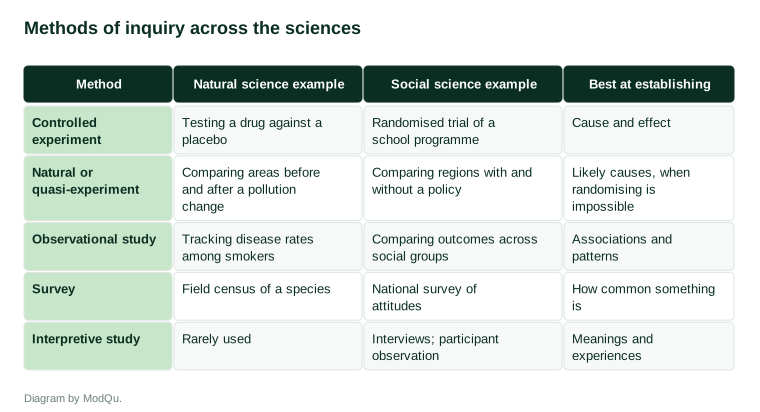
The social sciences use many of the same methods, but face particular challenges. People are diverse, their behaviour depends on context, and they interpret their own actions. Figure 1 compares the main methods used across the sciences.
Experiments and quasi-experiments
Experiments are increasingly used in the social sciences. Abhijit Banerjee and Esther Duflo (2011) described how randomised trials have been used to test policies aimed at reducing poverty, such as different ways of encouraging immunisation or improving school attendance. Where randomisation is impossible, researchers look for natural experiments, situations in which some people were exposed to a change and comparable others were not. David Card and Alan Krueger (1994) studied the effect of an increase in the minimum wage in New Jersey by comparing employment in fast-food restaurants there with restaurants in neighbouring eastern Pennsylvania, where the minimum wage did not change. They found no evidence that the increase reduced employment, a finding that prompted a long debate among economists.
Donald Campbell and Julian Stanley (1963) catalogued the threats to valid causal conclusions in studies that lack full randomisation, such as differences between groups at the start, other events occurring at the same time, and changes in measurement. Shadish et al. (2002) extended this work, setting out designs that can approach the strength of experiments when random assignment is not possible.
Surveys and statistical analysis
The social survey allows researchers to describe populations and to study relationships between variables. Émile Durkheim (1951), in a study first published in 1897, used official statistics to show that suicide rates varied systematically between social groups, being higher, for example, among Protestants than Catholics in the regions he studied. He argued that these differences reflected the degree of social integration, demonstrating that even an apparently individual act has social patterns. Paul Lazarsfeld and colleagues (1944) pioneered the panel survey, interviewing the same people repeatedly during the 1940 presidential election campaign in one Ohio county. They found that relatively few voters changed their minds during the campaign, and that personal contacts influenced voters more than had been expected.
Interpretive and qualitative methods
Social life has a dimension that natural phenomena lack: meaning. Max Weber (1978) argued that sociology must seek interpretive understanding of social action, grasping the meaning that actions have for the people who perform them, as well as explaining their causes. This calls for methods such as interviews, participant observation and the analysis of documents. Barney Glaser and Anselm Strauss (1967) proposed grounded theory, in which researchers develop theories from qualitative data through systematic comparison, rather than testing theories formulated in advance.
Gary King, Robert Keohane and Sidney Verba (1994) argued that qualitative and quantitative research share the same underlying logic of inference, and that qualitative researchers should be as explicit as quantitative ones about how their evidence supports their conclusions. Others have argued that interpretive research has its own standards. The debate continues, but most researchers now accept that the two approaches answer different kinds of question and can complement each other.
Case studies
Some questions are best answered by studying one or a few cases in depth. Robert Yin (2018) describes the case study as an inquiry into a contemporary phenomenon in its real-world context, especially when the boundaries between the phenomenon and its context are not clear. A case study of a single company's turnaround, a city's response to a flood or a hospital's adoption of a new procedure can trace causal processes in detail, drawing on documents, interviews, observation and numerical data together. The natural sciences use case studies too: geologists reconstruct the history of a single landscape, and physicians publish detailed reports of unusual patients. The strength of a case study lies in depth and context; its limitation is that one case may not represent others. Yin argues that case studies generalise not to populations, as surveys do, but to theories: a well-studied case can confirm, challenge or extend a general explanation.
The problem of measurement
All sciences depend on measurement, but what is measured differs. A physicist measuring temperature uses an instrument whose readings can be calibrated against physical standards. A psychologist measuring anxiety, or an economist measuring consumer confidence, is measuring a concept that cannot be observed directly. Lee Cronbach and Paul Meehl (1955) called such concepts constructs and argued that a measure of a construct is valid only if it behaves as the theory of that construct predicts: scores on an anxiety questionnaire should rise in stressful situations, relate to physiological signs of stress and differ from scores on measures of unrelated traits. Establishing this takes a programme of research, not a single study.
Social measurement is also affected by the act of asking. The wording of a survey question, the order of questions and the presence of an interviewer can all change the answers. Natural scientists face measurement problems too, but rarely ones in which the thing measured reads the question and decides how to respond. Careful design, testing and transparency about methods are therefore especially important in social research.
When the subject answers back
A distinctive problem in the social sciences is that the people studied can be affected by the research. Anthony Giddens (1976) described a double hermeneutic: social scientists interpret a world that is already interpreted by the people in it, and their concepts can in turn enter everyday use and change the world they describe. Robert Merton (1948) described the self-fulfilling prophecy, in which a false belief leads people to act in ways that make it come true, as when rumours of a bank's insolvency lead depositors to withdraw their money and cause the bank to fail.
Observation itself can change behaviour. Studies at the Hawthorne Works of the Western Electric Company in the 1920s and 1930s (Roethlisberger & Dickson, 1939) gave rise to the idea of the Hawthorne effect: that people change their behaviour because they know they are being studied. Later reanalysis of the original data by Steven Levitt and John List (2011) found that the evidence for the effect in the original illumination experiments was much weaker than commonly believed, though the general concern about reactivity remains important.
Reliability across the sciences
All sciences face the question of whether their findings are reliable. John Ioannidis (2005) argued that in fields where studies are small, effects are modest and analysis is flexible, many published findings are likely to be false. The Open Science Collaboration (2015) attempted to replicate 100 psychology studies and found that fewer than half produced statistically significant results again. Replication problems have been reported in medicine, economics and other fields as well. The response, including the pre-registration of studies and the sharing of data, applies equally across the natural and social sciences.
Ethics and the limits of method
Ethical constraints shape method in every science, but most of all where living beings are studied. Many experiments that would answer causal questions cleanly cannot be done, because they would expose people to harm, deceive them or deny them help they need. Much of the ingenuity of epidemiology and the social sciences lies in finding ways to answer causal questions without such experiments: natural experiments, careful comparisons and the accumulation of evidence from many imperfect studies that point in the same direction.
Social research raises further ethical questions about consent, privacy and the use of findings. People who take part in research have a right to know what they are agreeing to, to have their information protected and to withdraw. Findings about groups can stigmatise them if reported carelessly. These obligations are not obstacles to good inquiry but part of it, because research that loses the trust of the people it studies soon loses access to them, and with it the ability to learn anything at all.
Combining methods
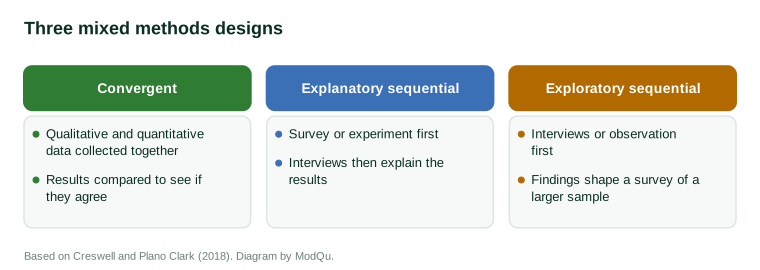
Increasingly, researchers combine methods to offset their individual weaknesses. John Creswell and Vicki Plano Clark (2018) describe mixed methods designs in which qualitative and quantitative approaches are used together: for example, using interviews to explore a topic and develop survey questions, then surveying a larger sample to measure how widespread the patterns are, or following a survey with interviews to explain surprising results. Figure 2 shows three common designs.
Lessons for applied research
For organisations conducting their own research, the methods of the sciences offer several lessons. Match the method to the question: experiments for questions about cause and effect, surveys for questions about how common something is, interviews and observation for questions about meaning and experience. Consider alternative explanations before accepting the first. Be cautious about causal claims from observational data, using Hill's considerations as a guide. Remember that people respond to being studied. And treat any single study as provisional until its findings have been confirmed.
Consider a hypothetical example. A retailer observes that stores that introduced self-service checkouts saw higher customer satisfaction. Before concluding that the checkouts caused the improvement, the research team asks what else differed: the stores chosen first were newer and larger, and had also been refurbished. A planned rollout in which comparable stores receive the checkouts at randomly chosen times would allow a much stronger conclusion. Interviews with customers could then explain why satisfaction changed, and for whom. The combination follows the logic of the sciences as a whole: an experiment to establish whether the checkouts made a difference, a survey to measure how large the difference was across the customer base, and qualitative work to understand the reasons. Each method contributes what it does best, and the conclusions are stronger than any one method could provide. If the trial showed no effect, the retailer would have saved the cost of a full rollout; if it showed a strong effect, the retailer could proceed with confidence and know which customers benefited most.
Conclusion
The natural and social sciences share a logic of inquiry based on clear questions, competing hypotheses and evidence that could prove them wrong. They differ in what they can control and in the nature of what they study. The natural sciences can often isolate causes through experiment; the social sciences must more often rely on comparison, statistical analysis and interpretation, and must account for the fact that people understand and respond to research about them. Each method answers some questions well and others poorly. Good researchers in every field choose methods to fit their questions, combine methods when one is not enough and state plainly what their evidence can and cannot show. Knowing which is which is the foundation of sound inquiry.
References
Banerjee, A. V., & Duflo, E. (2011). Poor economics: A radical rethinking of the way to fight global poverty. PublicAffairs.
Campbell, D. T., & Stanley, J. C. (1963). Experimental and quasi-experimental designs for research. Rand McNally.
Card, D., & Krueger, A. B. (1994). Minimum wages and employment: A case study of the fast-food industry in New Jersey and Pennsylvania. American Economic Review, 84(4), 772–793.
Chamberlin, T. C. (1890). The method of multiple working hypotheses. Science, 15(366), 92–96. https://doi.org/10.1126/science.ns-15.366.92
Creswell, J. W., & Plano Clark, V. L. (2018). Designing and conducting mixed methods research (3rd ed.). Sage.
Cronbach, L. J., & Meehl, P. E. (1955). Construct validity in psychological tests. Psychological Bulletin, 52(4), 281–302. https://doi.org/10.1037/h0040957
Doll, R., & Hill, A. B. (1950). Smoking and carcinoma of the lung: Preliminary report. British Medical Journal, 2(4682), 739–748. https://doi.org/10.1136/bmj.2.4682.739
Durkheim, É. (1951). Suicide: A study in sociology (J. A. Spaulding & G. Simpson, Trans.). Free Press. (Original work published 1897)
Fisher, R. A. (1935). The design of experiments. Oliver and Boyd.
Giddens, A. (1976). New rules of sociological method: A positive critique of interpretative sociologies. Hutchinson.
Glaser, B. G., & Strauss, A. L. (1967). The discovery of grounded theory: Strategies for qualitative research. Aldine.
Hacking, I. (1983). Representing and intervening: Introductory topics in the philosophy of natural science. Cambridge University Press.
Hempel, C. G. (1966). Philosophy of natural science. Prentice-Hall.
Hill, A. B. (1965). The environment and disease: Association or causation? Proceedings of the Royal Society of Medicine, 58(5), 295–300. https://doi.org/10.1177/003591576505800503
Ioannidis, J. P. A. (2005). Why most published research findings are false. PLoS Medicine, 2(8), Article e124. https://doi.org/10.1371/journal.pmed.0020124
King, G., Keohane, R. O., & Verba, S. (1994). Designing social inquiry: Scientific inference in qualitative research. Princeton University Press.
Kuhn, T. S. (1962). The structure of scientific revolutions. University of Chicago Press.
Lazarsfeld, P. F., Berelson, B., & Gaudet, H. (1944). The people's choice: How the voter makes up his mind in a presidential campaign. Duell, Sloan and Pearce.
Levitt, S. D., & List, J. A. (2011). Was there really a Hawthorne effect at the Hawthorne plant? An analysis of the original illumination experiments. American Economic Journal: Applied Economics, 3(1), 224–238. https://doi.org/10.1257/app.3.1.224
Merton, R. K. (1948). The self-fulfilling prophecy. The Antioch Review, 8(2), 193–210. https://doi.org/10.2307/4609267
Open Science Collaboration. (2015). Estimating the reproducibility of psychological science. Science, 349(6251), Article aac4716. https://doi.org/10.1126/science.aac4716
Platt, J. R. (1964). Strong inference. Science, 146(3642), 347–353. https://doi.org/10.1126/science.146.3642.347
Popper, K. R. (1959). The logic of scientific discovery. Hutchinson.
Roethlisberger, F. J., & Dickson, W. J. (1939). Management and the worker. Harvard University Press.
Shadish, W. R., Cook, T. D., & Campbell, D. T. (2002). Experimental and quasi-experimental designs for generalized causal inference. Houghton Mifflin.
Snow, J. (1855). On the mode of communication of cholera (2nd ed.). John Churchill.
Weber, M. (1978). Economy and society: An outline of interpretive sociology (G. Roth & C. Wittich, Eds.). University of California Press.
Yin, R. K. (2018). Case study research and applications: Design and methods (6th ed.). Sage.