
Inquiry · Inquiry in practice
Historical Inquiry and the Use of Primary Sources
Historians reconstruct the past from the traces it has left behind. This article explains how historical inquiry works, how historians question primary sources for authenticity and credibility, what the archive leaves out, and how the same disciplined reading of evidence applies to any organisation's records.
The past cannot be observed directly. What remains are traces: letters, ledgers, court records, photographs, buildings, newspapers, diaries and the memories of people still living. Historical inquiry is the disciplined practice of asking questions of those traces and reasoning from them to an account of what happened and why. Its methods were developed over centuries, often in response to forgeries, propaganda and honest mistakes. They offer a model of careful reasoning from incomplete evidence that is useful well beyond the study of history, wherever people must judge the reliability of documents and reconstruct events they did not witness.
History as inquiry
The word history comes from a Greek word for inquiry. The philosopher and historian R. G. Collingwood (1946) argued that history is not a matter of collecting statements made by authorities about the past, but of asking questions and finding evidence to answer them. The historian, in his view, works like a detective, treating every source as evidence to be interpreted rather than testimony to be believed. Collingwood also argued that historical understanding requires re-thinking the thoughts of past actors: understanding why a general chose to attack or a merchant chose to invest by reconstructing the situation as they saw it.
E. H. Carr (1961) emphasised the historian's role in selecting and interpreting facts. The facts of history, he wrote, do not speak for themselves; they speak only when the historian calls on them, and the historian decides which facts to call. History is therefore "an unending dialogue between the present and the past". Carr's argument was sometimes taken to mean that history is merely opinion. Richard Evans (1997) defended the possibility of reliable historical knowledge, arguing that although historians select and interpret, their accounts are constrained by evidence, and that some accounts are demonstrably better supported than others.
Starting with a question
Historical inquiry begins with a question, not with the sources. A historian who simply reads everything in an archive, hoping a story will emerge, is likely to be overwhelmed or to follow whatever the most abundant records happen to emphasise. Collingwood (1946) insisted that evidence becomes evidence only in relation to a question: a parish register is just a list of names until someone asks how long people lived, whom they married or how many children died young. Fischer (1970) warned against questions that are too vague to answer, questions that assume their own answer and questions that ask for a single cause when events had many. A good historical question is specific enough to guide the search for evidence, open enough to allow surprising answers, and answerable with the sources that survive.
Questions also change as evidence is found. A historian who sets out to explain why a business failed may discover that it did not fail at all but was deliberately wound up, and the question must be revised. This cycle of question, evidence and revised question is the working rhythm of historical inquiry.
Primary and secondary sources
Historians distinguish between primary sources, produced at or close to the time being studied by people involved in or witnessing events, and secondary sources, written later by people interpreting primary sources (Tosh, 2015). A merchant's account book from 1750 is a primary source for the eighteenth-century economy; a modern book about that economy is a secondary source. The distinction is not absolute. A newspaper report from 1914 is a secondary source for the events it describes but a primary source for how those events were reported at the time.
Marc Bloch (1953), writing during the Second World War, distinguished between sources produced intentionally to inform others, such as chronicles and memoirs, and evidence left unintentionally, such as account books, legal records and objects. He argued that the second kind, which he called the evidence of "witnesses in spite of themselves", is often more valuable, because it was not created to shape the views of later readers.
Questioning a source
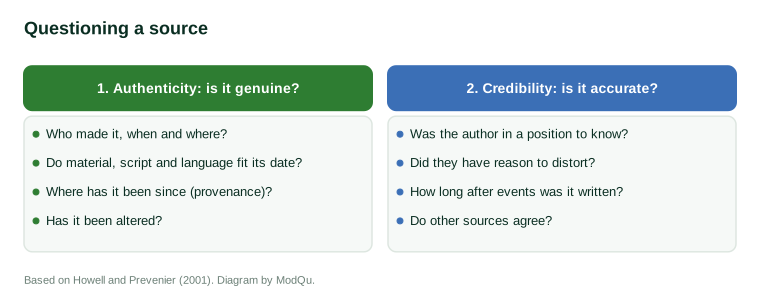
The core of historical method is source criticism: the systematic questioning of a source before relying on it. Martha Howell and Walter Prevenier (2001) describe it in two broad stages, shown in Figure 1. The first asks whether the source is authentic: is it what it claims to be, produced by whom it claims, when and where it claims? The second asks whether its content is credible: was the author in a position to know, did they have reasons to distort, and does the account agree with other evidence?
Authenticity
Forgeries have shaped history and the methods for detecting them. In about 1440, the Italian scholar Lorenzo Valla showed that the Donation of Constantine, a document in which the Roman emperor Constantine supposedly granted authority over the western empire to the pope, could not have been written in the fourth century. Its Latin contained words and expressions that did not exist in Constantine's time (Valla, 2007). Anachronism remains one of the strongest tests of authenticity.
A modern example shows that the tests still matter. In 1983, a German magazine announced that it had obtained diaries written by Adolf Hitler and paid millions of marks for them. A prominent historian initially vouched for their authenticity. Within weeks, forensic analysis showed that the paper, binding and ink contained materials not produced until after the war, and the diaries were exposed as forgeries (Harris, 1986). The episode showed how the desire for a sensational find can override caution, and how physical testing can settle what expert judgment could not.
Physical and textual evidence work together in testing authenticity. Historians and archivists examine the material of a document, such as its paper, parchment, ink, seals and watermarks; its handwriting and layout, which changed in datable ways over time; and its language, forms of address and conventions, which must match its claimed origin. Each test can rule a document out, but none alone proves it genuine. Confidence comes from several independent tests pointing the same way, and from a plausible account of how the document came to be where it was found, known as its provenance.
Credibility
An authentic source may still be inaccurate. Its author may have been mistaken, poorly informed or motivated to mislead. Historians ask how close the author was to the events, when the account was written, for whom and for what purpose. A general's report to his government after a defeat is authentic, but its account of why the battle was lost deserves scepticism.
Memory is a particular concern. The psychologist Frederic Bartlett (1932) showed that people recalling a story they had heard tended to reshape it to fit their own expectations and cultural assumptions, dropping unfamiliar details and adding familiar ones. Memoirs written long after events, and oral testimony, must be read with this in mind. The oral historian Alessandro Portelli (1991) argued, however, that such "errors" can themselves be evidence. In his study of the industrial town of Terni in Italy, many people remembered the death of a worker killed by police in 1949 as having occurred during a later and larger dispute in 1953. The shifted memory revealed how the community understood the meaning of the death, even though it was wrong about the date.
How historians read: the evidence from cognitive research
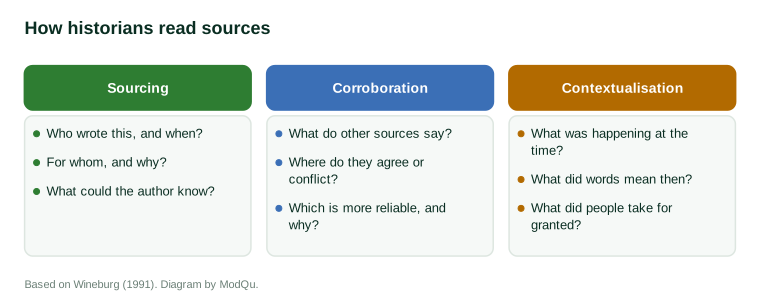
Sam Wineburg (1991) compared how professional historians and able high-school students read a set of documents about the opening battle of the American Revolution. The students tended to read each document as a neutral source of information and took textbooks as the most reliable account. The historians read differently. They looked first at who wrote each document and when, a practice Wineburg called sourcing; they compared documents with one another, corroboration; and they placed each document in the circumstances of its time, contextualisation. Wineburg (2001) argued that such historical thinking does not come naturally, but can be taught. Figure 2 summarises the habits he identified.
What the archive leaves out
Historians can only work with what survives, and what survives is not a random sample of the past. Michel-Rolph Trouillot (1995) argued that silences enter the historical record at every stage: when sources are created, since some people and events are never recorded; when archives are assembled, since some records are kept and others discarded; when historians select sources to build narratives; and when those narratives are given significance. The archive tends to preserve the records of the literate, the powerful and the institutions that kept files.
Archivists themselves have recognised this. Terry Cook and Joan Schwartz (2002) argued that archives are not neutral storehouses, since the decisions archivists make about what to keep and how to describe it shape what can later be known. Carolyn Steedman (2001) reflected on the experience of archival research and the partial, accidental nature of what the archive holds.
Historians have developed ways to recover voices that the archive neglects. E. P. Thompson (1963) wrote the history of English working people in the industrial revolution in part to rescue them, in his words, from "the enormous condescension of posterity", reading records of protest, religion and popular politics for evidence of their beliefs and experience. Carlo Ginzburg (1980) reconstructed the world view of Menocchio, a sixteenth-century Italian miller, from the records of his trials by the Inquisition. Emmanuel Le Roy Ladurie (1978) used the register of an inquisitor's interrogations to reconstruct daily life in a French village in the early fourteenth century. Natalie Zemon Davis (1983) used court records to reconstruct the case of a sixteenth-century French impostor who took the place of a peasant's missing husband. In each case, records created by powerful institutions for their own purposes became, read against the grain, evidence of the lives of ordinary people.
Oral history offers another route. Paul Thompson (2000) argued that interviewing people about their own past gives voice to those who left few written records and allows historians to ask questions that documents cannot answer, while recognising that memory has its own patterns and limits.
Building an account
Source criticism is the foundation, but the aim of historical inquiry is an account: an explanation of what happened and why. Historians build accounts by assembling many sources, each with its own strengths and limits, into a picture that fits the evidence as a whole. Where sources conflict, the historian must decide which is more reliable and explain why. Where evidence is missing, the historian must say so, rather than filling the gap with assumption. A good historical account distinguishes clearly between what the evidence shows, what it suggests and what remains uncertain.
Accounts are also tested against one another. Historians publish their interpretations with full references to their sources, so that others can check the evidence and propose alternatives. Long-running debates, about the causes of wars, the effects of economic policies or the motives of historical figures, are not failures of the method but the method working: competing accounts are tested against the evidence until the weaker ones give way.
Errors of reasoning
Historians, like other inquirers, can reason badly from good evidence. David Hackett Fischer (1970) catalogued historians' fallacies, including asking questions that assume their own answers, generalising from unrepresentative examples, and confusing sequence with cause, the assumption that because one event followed another, the first caused the second. Many of these fallacies are familiar from other fields, and Fischer's catalogue remains a useful checklist for anyone reasoning about the causes of past events.
The digital record
The digital age has changed the problems of historical inquiry. Roy Rosenzweig (2003) observed that historians of the recent past face both abundance, an overwhelming volume of digital records, and fragility, since digital files can be lost far more easily than paper as formats and systems change. Large digitised collections have also enabled new methods. Michel et al. (2011) analysed millions of digitised books to track changes in the use of words and names over two centuries, an approach they called culturomics. Such methods can reveal broad patterns, but they inherit the biases of the collections on which they are based, and they still require the historian's questions about what each source is and why it exists.
Historical method in organisations
The methods of historical inquiry apply wherever people must reconstruct past events from records. An organisation investigating why a project failed, a regulator reviewing a company's decisions, an auditor examining transactions and a researcher analysing old survey data all face the historian's questions. Is this record what it appears to be? Who created it, when and for what purpose? What does it leave out? Do other records agree?
Consider a hypothetical example. A company reviewing a failed product launch finds an internal report concluding that the launch failed because of an unexpected competitor. Read critically, the report raises questions. It was written by the team that ran the launch, three months afterwards, for the board. Earlier records tell a different story: emails from the launch period show the team was aware of the competitor months before launch, and customer research from the time recorded concerns about price that the report does not mention. Corroboration across sources, attention to who wrote each record and why, and awareness of what the final report left out together produce a more accurate account, and a more useful lesson. The same habits help in reading survey data from past years: knowing exactly how a question was worded, who was sampled and what was happening at the time of fieldwork is essential before comparing old results with new ones. A change in a figure over ten years may reflect a change in the world, or simply a change in how the question was asked.
Conclusion
Historical inquiry turns the incomplete traces of the past into reliable knowledge by asking disciplined questions of every source: is it authentic, is it credible, what does it leave out and what do other sources say? The methods developed to detect forgeries and weigh testimony are among the oldest tools of critical inquiry, and they remain essential wherever evidence comes in the form of documents. Every organisation is creating its own archive today, and the questions historians ask will one day be asked of it.
References
Bartlett, F. C. (1932). Remembering: A study in experimental and social psychology. Cambridge University Press.
Bloch, M. (1953). The historian's craft (P. Putnam, Trans.). Alfred A. Knopf.
Carr, E. H. (1961). What is history? Macmillan.
Collingwood, R. G. (1946). The idea of history. Clarendon Press.
Cook, T., & Schwartz, J. M. (2002). Archives, records, and power: From (postmodern) theory to (archival) performance. Archival Science, 2(3–4), 171–185. https://doi.org/10.1007/BF02435620
Davis, N. Z. (1983). The return of Martin Guerre. Harvard University Press.
Evans, R. J. (1997). In defence of history. Granta Books.
Fischer, D. H. (1970). Historians' fallacies: Toward a logic of historical thought. Harper & Row.
Ginzburg, C. (1980). The cheese and the worms: The cosmos of a sixteenth-century miller (J. Tedeschi & A. Tedeschi, Trans.). Johns Hopkins University Press.
Harris, R. (1986). Selling Hitler. Faber and Faber.
Howell, M., & Prevenier, W. (2001). From reliable sources: An introduction to historical methods. Cornell University Press.
Le Roy Ladurie, E. (1978). Montaillou: The promised land of error (B. Bray, Trans.). George Braziller.
Michel, J.-B., Shen, Y. K., Aiden, A. P., Veres, A., Gray, M. K., The Google Books Team, Pickett, J. P., Hoiberg, D., Clancy, D., Norvig, P., Orwant, J., Pinker, S., Nowak, M. A., & Aiden, E. L. (2011). Quantitative analysis of culture using millions of digitized books. Science, 331(6014), 176–182. https://doi.org/10.1126/science.1199644
Portelli, A. (1991). The death of Luigi Trastulli and other stories: Form and meaning in oral history. State University of New York Press.
Rosenzweig, R. (2003). Scarcity or abundance? Preserving the past in a digital era. American Historical Review, 108(3), 735–762. https://doi.org/10.1086/ahr/108.3.735
Steedman, C. (2001). Dust. Manchester University Press.
Thompson, E. P. (1963). The making of the English working class. Victor Gollancz.
Thompson, P. (2000). The voice of the past: Oral history (3rd ed.). Oxford University Press.
Tosh, J. (2015). The pursuit of history: Aims, methods and new directions in the study of history (6th ed.). Routledge.
Trouillot, M.-R. (1995). Silencing the past: Power and the production of history. Beacon Press.
Valla, L. (2007). On the Donation of Constantine (G. W. Bowersock, Trans.). Harvard University Press.
Wineburg, S. (2001). Historical thinking and other unnatural acts: Charting the future of teaching the past. Temple University Press.
Wineburg, S. S. (1991). Historical problem solving: A study of the cognitive processes used in the evaluation of documentary and pictorial evidence. Journal of Educational Psychology, 83(1), 73–87. https://doi.org/10.1037/0022-0663.83.1.73