
Inquiry · Inquiry in practice
Interviewing as Inquiry: Listening for Meaning
A research interview is a structured conversation designed to understand how other people see their world. This article explains interviewing as a method of inquiry, the kinds of questions that elicit rich answers, the discipline of listening and how interviews are analysed.
An interview is one of the oldest ways of finding something out: ask someone who knows. As a research method, however, it is more demanding than ordinary conversation. Steinar Kvale and Svend Brinkmann (2009) describe the qualitative research interview as an attempt to understand the world from the participant's point of view, to unfold the meaning of their experiences. That aim shapes everything about how a good interview is conducted. The interviewer's main task is not to ask questions but to listen for meaning, and to ask questions that make listening productive.
Kinds of interview
Interviews range from fully structured, in which every participant is asked the same questions in the same order, to unstructured, in which the conversation follows the participant's lead. Most research interviews are semi-structured: the interviewer works from a guide of topics and questions but follows up on what the participant says. Robert Merton and Patricia Kendall (1946) described the focused interview, in which people who have shared a particular experience, such as seeing a film or reading a pamphlet, are interviewed about their responses to it. The approach influenced the later development of focus groups and is still a model for interviews about specific products, services or events.
Asking questions that open up answers
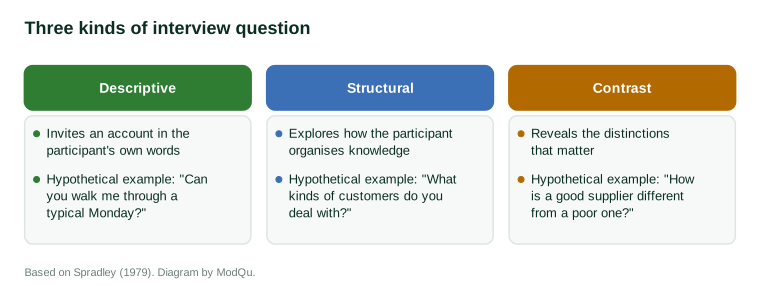
The ethnographer James Spradley (1979) distinguished several kinds of question, three of which are shown in Figure 1. Descriptive questions invite the participant to describe their experience in their own words. Structural questions explore how the participant organises their knowledge. Contrast questions ask how things differ, revealing the distinctions that matter to the participant.
Good interview questions are open, short and concrete. Asking about specific occasions usually produces richer and more accurate answers than asking for generalisations. John Flanagan (1954) developed the critical incident technique, in which participants describe specific events in which something went notably well or badly. Concrete incidents reveal what people actually did and why it mattered, whereas general questions tend to produce general opinions. In investigative settings, Ronald Fisher and Edward Geiselman (1992) developed the cognitive interview, which helps people recall events more completely by encouraging them to reinstate the context, report everything without filtering and recall events in different orders. Several of its techniques are useful in research interviews too.
Listening for meaning
Carl Rogers and Richard Farson (1957) described active listening: listening for the total meaning of what is said, including feelings as well as content, and responding in ways that show the speaker they have been understood. In research interviews, this means attending not only to answers but to the words participants choose, the examples they give and what they leave out. Herbert Rubin and Irene Rubin (2012) call qualitative interviewing "the art of hearing data", and emphasise follow-up questions and probes that ask the participant to explain, illustrate or go further.
Silence is also a tool. A short pause after an answer often prompts a participant to add the most important part. Inexperienced interviewers tend to fill silences, move quickly to the next question and steer participants towards the answers they expect. Robert Weiss (1994) advises interviewers to establish a partnership with the participant, in which both work together to produce a full and accurate account.
Common pitfalls
Several habits weaken interviews. Leading questions signal the expected answer, as in "Wouldn't you agree that the new layout is easier?" Double-barrelled questions ask about two things at once, such as "Was the service fast and friendly?", so the answer cannot be interpreted. Closed questions that invite a yes or no close down the conversation just when it could open up. Asking "why" too directly can make people defensive or prompt them to offer a tidy rationalisation; asking "how did that come about?" or "what happened next?" usually produces a fuller account.
Interviewers also tend to hear what confirms their expectations. A product manager interviewing customers about a feature they designed may notice praise and pass quickly over complaints. Two practical safeguards help: write down beforehand what you expect to hear, so you can notice when you hear something different, and where possible have a colleague review the transcripts independently.
The interview as a joint product
Elliot Mishler (1986) argued that interview answers are not simply retrieved from the participant's mind, but produced in the interaction between interviewer and participant. The way a question is asked, the interviewer's reactions and the relationship between them all shape what is said. James Holstein and Jaber Gubrium (1995) developed this into the idea of the active interview, in which both parties are understood to be constructing meaning together. This does not make interviews unreliable. It means that interviewers should be aware of their influence and report how the interviews were conducted, so that others can judge the findings.
How many interviews?
Qualitative interviews are not designed to estimate how common something is, but to understand what matters and why. The usual aim is to continue until new interviews add little that is new, a point called saturation. Guest et al. (2006) analysed sixty interviews from a study of women in two West African countries and found that most of the themes they eventually identified had appeared within the first twelve. In product development, Griffin and Hauser (1993) estimated that interviews with twenty to thirty customers were enough to identify around 90% or more of customer needs for a product category. The right number depends on how varied the participants are and how focused the questions.
From conversation to findings
Interviews are usually recorded and transcribed, then analysed for patterns. Braun and Clarke (2006) describe thematic analysis in six phases: becoming familiar with the data, generating initial codes, searching for themes, reviewing them, defining and naming them, and writing up. Irving Seidman (2013) stresses that the participant's own words should remain central in the analysis and reporting. Well-chosen quotations allow readers to hear the voices behind the findings.
Consider a hypothetical example. A software company interviews twelve customers who cancelled their subscriptions. Asked in general terms why they left, most mention price. Asked to describe the week they decided to cancel, many tell a different story: a failed data import, an unanswered support request, a colleague who recommended a competitor. Price was the reason they gave; the incident was the reason they left. Only careful questioning and listening revealed the difference. The company's response changed accordingly: instead of a discount, it invested in faster support and a more reliable import tool, the problems that had actually driven customers away.
Interviewing well
Interviewing is a skill that improves with practice and reflection. Prepare a guide but be ready to depart from it. Ask about specific experiences. Listen more than you speak. Probe gently for detail and meaning. Record how each interview went, and review recordings to see where questions led or limited the answers. Done well, an interview reveals not only what people think but how they think, in their own terms.
References
Braun, V., & Clarke, V. (2006). Using thematic analysis in psychology. Qualitative Research in Psychology, 3(2), 77–101. https://doi.org/10.1191/1478088706qp063oa
Fisher, R. P., & Geiselman, R. E. (1992). Memory-enhancing techniques for investigative interviewing: The cognitive interview. Charles C Thomas.
Flanagan, J. C. (1954). The critical incident technique. Psychological Bulletin, 51(4), 327–358. https://doi.org/10.1037/h0061470
Griffin, A., & Hauser, J. R. (1993). The voice of the customer. Marketing Science, 12(1), 1–27. https://doi.org/10.1287/mksc.12.1.1
Guest, G., Bunce, A., & Johnson, L. (2006). How many interviews are enough? An experiment with data saturation and variability. Field Methods, 18(1), 59–82. https://doi.org/10.1177/1525822X05279903
Holstein, J. A., & Gubrium, J. F. (1995). The active interview. Sage.
Kvale, S., & Brinkmann, S. (2009). InterViews: Learning the craft of qualitative research interviewing (2nd ed.). Sage.
Merton, R. K., & Kendall, P. L. (1946). The focused interview. American Journal of Sociology, 51(6), 541–557. https://doi.org/10.1086/219886
Mishler, E. G. (1986). Research interviewing: Context and narrative. Harvard University Press.
Rogers, C. R., & Farson, R. E. (1957). Active listening. Industrial Relations Center, University of Chicago.
Rubin, H. J., & Rubin, I. S. (2012). Qualitative interviewing: The art of hearing data (3rd ed.). Sage.
Seidman, I. (2013). Interviewing as qualitative research: A guide for researchers in education and the social sciences (4th ed.). Teachers College Press.
Spradley, J. P. (1979). The ethnographic interview. Holt, Rinehart and Winston.
Weiss, R. S. (1994). Learning from strangers: The art and method of qualitative interview studies. Free Press.