
Inquiry · Inquiry in practice
Market Inquiry: Asking the Questions Businesses Need Answered
Market inquiry is the disciplined practice of asking the questions a business needs answered before it commits money, time and reputation. This article sets out the main families of business questions, explains how to start from the decision rather than the data, and reviews the research on measuring markets, forecasting demand and getting research used.
Every significant business decision rests on assumptions about the market: that enough people want the product, that they will pay the price, that competitors will not respond too quickly, that the message will reach the right buyers. Market inquiry is the practice of turning those assumptions into questions and answering them with evidence before the commitment is made. Done well, it reduces costly surprises. Done badly, it produces reports full of numbers that answer questions nobody needed to ask. The difference lies less in methods than in the questions themselves: which questions are asked, how they are framed, and whether the answers can change what the business does.
Why businesses need to ask
Peter Drucker (1954) argued that the purpose of a business is to create a customer, which means that the business must know who its customers are, what they value and what they will buy. Research on market orientation has since given this idea an empirical footing. Ajay Kohli and Bernard Jaworski (1990) defined market orientation as the generation of market intelligence across the organisation, its dissemination between departments and the organisation's responsiveness to it. John Narver and Stanley Slater (1990) found that businesses with a stronger market orientation tended to be more profitable. George Day (1994) described the ability to sense and learn about markets as a distinctive capability of the most successful firms, one that is difficult for competitors to copy. Market inquiry is how that capability is exercised.
Start from the decision
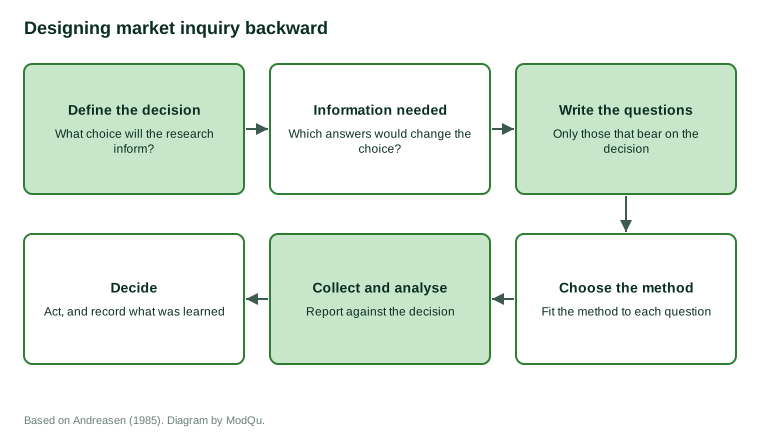
The most common failure in market research is to begin with the data rather than the decision. Alan Andreasen (1985) proposed backward market research: begin by identifying the decision the research is meant to inform, specify what the final report should look like and what results would lead to which actions, and only then design the questions and the sample. Working backward ensures that every question earns its place.
Decision analysis supports the same discipline. Ronald Howard (1966) showed that information has value only insofar as it might change a decision, and that this value can be estimated before any data are collected. If no plausible answer would alter the course of action, the research is not worth doing. Douglas Hubbard (2014) applied this idea to business measurement and observed that organisations often spend most of their measurement effort on variables that have little effect on their decisions, while neglecting the uncertain variables that matter most. Figure 1 shows the backward approach as a sequence.
Six families of business questions
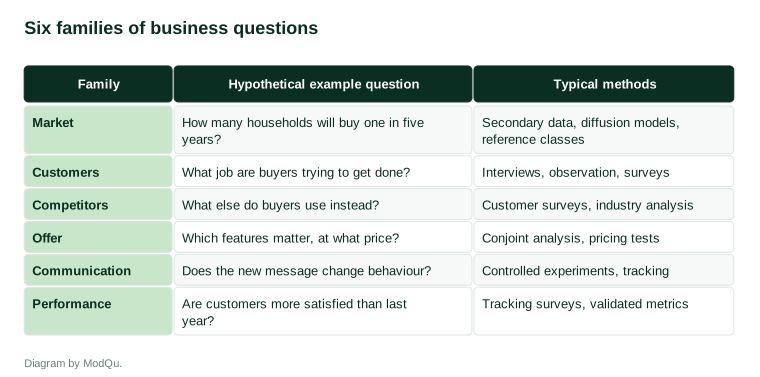
The questions businesses need answered fall into a small number of families, summarised in Figure 2. Each family has its own typical methods and its own common mistakes.
The market: how big, how fast?
Questions about the size and growth of a market underpin decisions to enter, invest or withdraw. For new products, the speed of adoption matters as much as the eventual size. Frank Bass (1969) developed a model of how new consumer durables spread, in which some buyers adopt independently, influenced by external information, while others adopt by imitating earlier buyers. The model produced reasonable forecasts of the timing and height of sales peaks for products such as televisions and refrigerators, and it remains widely used.
Forecasts of market size are especially prone to optimism. Dan Lovallo and Daniel Kahneman (2003) argued that executives routinely overestimate the benefits and underestimate the costs of new initiatives, because they build forecasts from the details of their own plans. They recommended taking an outside view: comparing the plan with a reference class of similar past projects and using their actual outcomes as a starting point. A market forecast should therefore be tested against what happened to comparable products, not only built up from the company's own assumptions.
Customers: who are they, and what do they need?
Questions about customers concern who buys, why and what they value. Abbie Griffin and John Hauser (1993) showed that a modest number of well-conducted interviews can identify most of the needs in a product category. Christensen et al. (2016) argued that the most useful way to understand customers is to ask what job they are trying to get done in a given situation, since the same person may choose very differently in different circumstances. Customer questions are best answered with a combination of qualitative work, which discovers needs in customers' own words, and surveys, which measure how widespread and important they are.
Competitors: who else answers the same need?
Michael Porter (1980) proposed that the profitability of an industry depends on five forces: rivalry among existing competitors, the threat of new entrants, the threat of substitutes, and the bargaining power of buyers and of suppliers. Competitive questions should therefore extend beyond direct rivals to substitutes, potential entrants and the balance of power in the supply chain. Customers define the competition: anything they might choose instead is a competitor, whether or not it is in the same industry.
The offer: what features, at what price?
Questions about the product and its price require understanding trade-offs. People asked directly whether they want a feature tend to say yes; asked what they will pay, they tend to give unreliable answers. Conjoint analysis addresses this by asking people to choose between product profiles that vary systematically in features and price, and inferring from their choices how much each attribute is worth to them. Paul Green and V. Srinivasan (1990) reviewed the method's development and its wide use in product design, pricing and market segmentation.
A related question is whether stated intentions will become purchases. Morwitz et al. (2007) analysed many studies and found that purchase intentions predict sales better for existing products than for new ones, for durable goods than for non-durables, over short time horizons than long ones, and when people are asked about specific brands or models rather than whole product categories. Intentions are useful evidence, but they need adjustment, particularly for new products.
Communication: does the message reach and persuade?
Questions about advertising and messaging concern awareness, understanding and persuasion. The most reliable answers come from experiments, in which some people see a message and others do not, rather than from asking people whether a message would influence them. In digital channels, controlled experiments have become routine. Kohavi et al. (2020) describe how large online businesses test changes through randomised experiments and report that only a minority of ideas tested improve the metrics they were designed to improve, a finding that underlines how unreliable confident intuitions about customer response can be.
Performance: how are we doing?
Finally, businesses need to know how they are performing in customers' eyes. Frederick Reichheld (2003) proposed that a single question, how likely a customer is to recommend the company to a friend or colleague, was the best predictor of growth, and the resulting Net Promoter Score became widely used. Keiningham et al. (2007) tested this claim using data from Norwegian companies and found no evidence that the recommendation question predicted growth better than other measures of customer satisfaction. The lesson is not that the question is useless, but that no single number should be trusted without evidence that it predicts the outcomes the business cares about.
Asking well
Whatever the family, the quality of the answer depends on the quality of measurement. Gilbert Churchill (1979) set out a procedure for developing marketing measures: define the concept precisely, generate candidate questions, test and refine them, and check that the resulting measure is reliable and valid. A survey question about "brand trust" or "satisfaction" is only useful if it measures what it claims to measure and does so consistently. Testing questions with members of the target group before the main survey catches many problems that are invisible to the people who wrote them.
Experiments offer a further discipline. Eric Ries (2011) popularised the practice of testing a business idea with a minimal version of the product and measuring real behaviour, rather than relying on stated preferences. The principle applies broadly: where it is possible to observe what people actually do, that evidence should be weighed more heavily than what they say they would do.
Common mistakes in framing questions
Several mistakes recur in how businesses frame their questions. The first is asking customers to do the company's job. Questions such as "What new product should we make?" or "What features would you like?" invite speculation from people who have not thought about the problem and do not know what is technically possible. Customers are expert in their own needs and experiences, so questions should ask about those.
The second is asking about the future when the past would serve better. "Would you use this service?" invites a polite yes; "When did you last need something like this, and what did you do?" produces evidence about real behaviour.
The third is asking a question that cannot fail. A study designed so that every result supports the planned course of action is not inquiry but decoration. Before the research begins, the team should be able to say what result would lead it to change its plan.
The fourth is asking only existing customers. They can explain why they buy, but not why others do not. Non-customers, former customers and the customers of competitors often hold the answers to the questions that matter most for growth.
The fifth is treating one answer as final. Markets change, and an answer that was accurate two years ago may no longer hold. The most important questions deserve to be asked again at regular intervals.
Getting research used
Research that is not used has no value. Rohit Deshpandé and Gerald Zaltman (1982) studied the use of market research in companies and found that managers were more likely to use research they considered technically sound and that came from researchers with whom they had worked closely. Moorman et al. (1992) found that trust between the users and providers of research, built through interaction and perceived integrity, strongly influenced how much research was used. Anil Menon and P. Rajan Varadarajan (1992) distinguished three ways in which research is used: instrumentally, to make a specific decision; conceptually, to change how managers understand a market; and symbolically, to justify a decision already made. The first two create value; the third mainly consumes it.
These findings point to practical habits. Involve decision makers in framing the questions. Agree in advance what results would lead to which actions. Present findings in terms of the decision, with clear statements of uncertainty. And be wary of research commissioned only after a decision has been taken.
An example
The following example is hypothetical. A company that makes outdoor clothing is considering a line of clothing for cycling commuters. Its first instinct is to commission a survey asking whether people would buy such a range. Working backward, the team instead identifies the decision: whether to invest in a full range, a small trial collection or nothing. It then identifies the key uncertainties: how many people commute by bicycle in its markets and how fast that number is growing, what problems they face with existing clothing, which competitors and substitutes they use, and what they would pay for clothing that solved those problems.
Interviews with commuters reveal that the main problem is not cycling performance but arriving at work looking presentable. A survey of a representative sample of commuters estimates how many share this concern and how strongly. A conjoint study tests trade-offs between price, appearance and weather protection. Comparison with the company's past product launches tempers the sales forecast. The evidence supports a small trial collection focused on appearance, with a plan to expand if sales in the first season reach an agreed level. Each question answered was one that could change the decision.
Conclusion
Market inquiry is not the collection of as much data as possible about a market. It is the disciplined asking of the questions a business needs answered, starting from the decisions those answers will inform. The main families of questions, about the market, customers, competitors, the offer, communication and performance, each have tested methods and known pitfalls. Measurement must be sound, forecasts must be checked against experience, and research must be designed to be used. Businesses that ask the right questions, and act on the answers, make fewer expensive mistakes.
References
Andreasen, A. R. (1985). "Backward" market research. Harvard Business Review, 63(3), 176–182.
Bass, F. M. (1969). A new product growth for model consumer durables. Management Science, 15(5), 215–227. https://doi.org/10.1287/mnsc.15.5.215
Christensen, C. M., Hall, T., Dillon, K., & Duncan, D. S. (2016). Competing against luck: The story of innovation and customer choice. Harper Business.
Churchill, G. A., Jr. (1979). A paradigm for developing better measures of marketing constructs. Journal of Marketing Research, 16(1), 64–73. https://doi.org/10.1177/002224377901600110
Day, G. S. (1994). The capabilities of market-driven organizations. Journal of Marketing, 58(4), 37–52. https://doi.org/10.1177/002224299405800404
Deshpandé, R., & Zaltman, G. (1982). Factors affecting the use of market research information: A path analysis. Journal of Marketing Research, 19(1), 14–31. https://doi.org/10.1177/002224378201900102
Drucker, P. F. (1954). The practice of management. Harper & Row.
Green, P. E., & Srinivasan, V. (1990). Conjoint analysis in marketing: New developments with implications for research and practice. Journal of Marketing, 54(4), 3–19. https://doi.org/10.1177/002224299005400402
Griffin, A., & Hauser, J. R. (1993). The voice of the customer. Marketing Science, 12(1), 1–27. https://doi.org/10.1287/mksc.12.1.1
Howard, R. A. (1966). Information value theory. IEEE Transactions on Systems Science and Cybernetics, 2(1), 22–26. https://doi.org/10.1109/TSSC.1966.300074
Hubbard, D. W. (2014). How to measure anything: Finding the value of intangibles in business (3rd ed.). Wiley.
Keiningham, T. L., Cooil, B., Andreassen, T. W., & Aksoy, L. (2007). A longitudinal examination of net promoter and firm revenue growth. Journal of Marketing, 71(3), 39–51. https://doi.org/10.1509/jmkg.71.3.039
Kohavi, R., Tang, D., & Xu, Y. (2020). Trustworthy online controlled experiments: A practical guide to A/B testing. Cambridge University Press. https://doi.org/10.1017/9781108653985
Kohli, A. K., & Jaworski, B. J. (1990). Market orientation: The construct, research propositions, and managerial implications. Journal of Marketing, 54(2), 1–18. https://doi.org/10.1177/002224299005400201
Lovallo, D., & Kahneman, D. (2003). Delusions of success: How optimism undermines executives' decisions. Harvard Business Review, 81(7), 56–63.
Menon, A., & Varadarajan, P. R. (1992). A model of marketing knowledge use within firms. Journal of Marketing, 56(4), 53–71. https://doi.org/10.1177/002224299205600405
Moorman, C., Zaltman, G., & Deshpandé, R. (1992). Relationships between providers and users of market research: The dynamics of trust within and between organizations. Journal of Marketing Research, 29(3), 314–328. https://doi.org/10.1177/002224379202900303
Morwitz, V. G., Steckel, J. H., & Gupta, A. (2007). When do purchase intentions predict sales? International Journal of Forecasting, 23(3), 347–364. https://doi.org/10.1016/j.ijforecast.2007.05.015
Narver, J. C., & Slater, S. F. (1990). The effect of a market orientation on business profitability. Journal of Marketing, 54(4), 20–35. https://doi.org/10.1177/002224299005400403
Porter, M. E. (1980). Competitive strategy: Techniques for analyzing industries and competitors. Free Press.
Reichheld, F. F. (2003). The one number you need to grow. Harvard Business Review, 81(12), 46–54.
Ries, E. (2011). The lean startup: How today's entrepreneurs use continuous innovation to create radically successful businesses. Crown Business.