
Inquiry · Inquiry in practice
Identifying the Questions a Market Is Asking
Every market is full of questions that buyers are trying to answer. This article explains how to identify those questions, from the jobs customers need done to the needs they cannot articulate, and reviews the research on methods ranging from interviews and observation to the analysis of reviews and search data.
Before people buy, they ask. What is wrong with my current way of doing this? What options exist? Which one suits me? Is it worth the price? Will it work for someone like me? Taken together, these questions describe what a market wants better than any sales figure. Sales record what people chose among the options available; questions reveal what they were looking for, including needs no current product meets. Identifying the questions a market is asking is therefore one of the most useful forms of business inquiry. This article explains what those questions are, where to find them and how to turn them into decisions.
Behind every purchase is a question
Theodore Levitt (1960) argued that companies often define their businesses too narrowly, around the products they make rather than the needs they serve. His example was the American railways, which declined, he argued, because they saw themselves as being in the railway business rather than the transportation business, and so failed to respond as customers turned to cars, lorries and aircraft. The lesson is that customers are not asking for a product. They are asking how to get something done.
Christensen et al. (2016) developed this idea into the theory of jobs to be done. People "hire" a product to make progress in a particular circumstance. Understanding the job, including its functional, social and emotional aspects, explains why people choose as they do and suggests where new offerings could succeed. Anthony Ulwick (2005) proposed a related method in which the job is broken down into the specific outcomes customers want, and customers rate each outcome by its importance and by how well current solutions satisfy it. Outcomes that are important but poorly satisfied indicate opportunities.
The questions change along the way
The questions a market asks depend on where people are in the process of buying. Figure 1 shows a typical sequence.
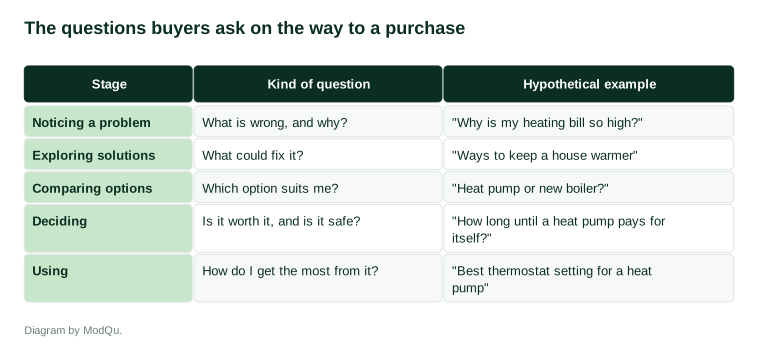
Early questions are about problems and possibilities. Middle questions compare options. Later questions concern risk, price and use. A business that understands only one stage will miss the others: it may answer comparison questions well while failing to reach people who do not yet know a solution exists.
Methods for finding the questions
Asking customers
The most direct method is to ask. Abbie Griffin and John Hauser (1993) studied how companies identify customer needs and found that interviews with twenty to thirty customers typically identified around 90% or more of the needs in a product category. One-to-one interviews were about as effective as focus groups, at lower cost per need identified. The interviews were most useful when they asked customers to describe their experiences with products, rather than to propose features.
Observing customers
What customers say is not always what they do. Dorothy Leonard and Jeffrey Rayport (1997) described empathic design: observing people using products in their own environments to discover needs they had not articulated, often because they had come to accept a problem as normal. Observation reveals workarounds, improvisations and frustrations that interviews miss.
Learning from lead users
Eric von Hippel (1986) noted that some users experience needs months or years before the rest of the market, and benefit enough from meeting them that they often develop their own solutions. Studying these lead users can reveal the questions the wider market will ask in future.
Listening to what customers write
Customers now leave a large written record of their questions and concerns in reviews, forums and online discussions. Netzer et al. (2012) showed that text mining of online discussions could reveal how consumers perceive and compare brands, producing maps of market structure similar to those obtained from traditional surveys. Artem Timoshenko and John Hauser (2019) found that machine learning could help analysts identify customer needs in large volumes of online reviews, efficiently filtering out uninformative content so that human analysts could focus on the passages likely to contain needs. Urban and Hauser (2004) proposed "listening in" on the conversations customers have with online advisers, to discover combinations of needs that no existing product met.
Reading search data
The questions people type into search engines form another record. Hyunyoung Choi and Hal Varian (2012) showed that data on search volumes could improve short-term forecasts of economic indicators such as car sales, unemployment claims and travel, because searches often precede the activity they concern. Rising searches for a topic can signal an emerging question before it appears in sales or surveys.
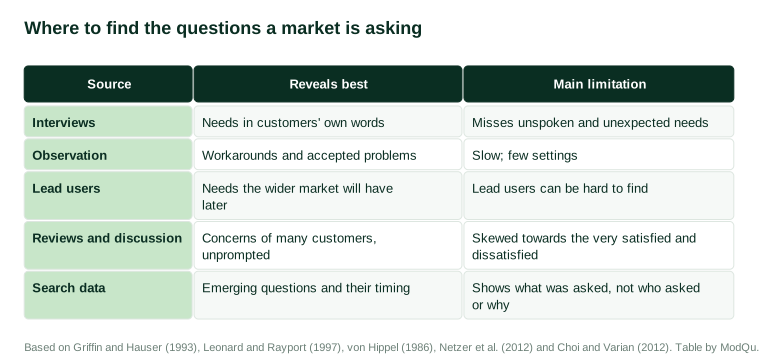
Figure 2 compares these sources.
Not all questions matter equally
Once questions and needs have been identified, they must be prioritised. Noriaki Kano and colleagues (1984) observed that product attributes relate to satisfaction in different ways. Some are must-be qualities, whose absence causes dissatisfaction but whose presence is taken for granted. Some are one-dimensional, with satisfaction rising steadily as performance improves. Others are attractive qualities that customers do not expect and seldom ask for, but which delight them when present. Questions about must-be qualities are rarely voiced until something goes wrong, and questions about attractive qualities are rarely voiced at all. Asking customers directly will therefore tend to surface the middle category and miss the others.
John Hauser and Don Clausing (1988) described the house of quality, a planning tool that links customer needs, expressed in customers' own words and weighted by importance, to the engineering characteristics that determine whether they are met. It ensures that the questions customers ask are carried through into design decisions.
The questions a market does not yet ask
Some of the most important questions are not yet being asked. Clayton Christensen (1997) showed that successful companies can fail precisely because they listen closely to their existing customers, who ask for better versions of current products, while new technologies serve different customers whose questions the incumbents ignore. Gerald Zaltman (2003) argued that much of what drives customer choice operates below conscious awareness, so that customers cannot simply report it. Identifying these unasked questions requires observation, attention to non-customers and willingness to consider needs that do not fit the current business.
From questions to evidence
Identifying a market's questions is the beginning of inquiry, not the end. A list of questions gathered from interviews, reviews and search data shows what people want to know, but not how many people share each concern, how strongly they feel it or how their answers vary between groups. That requires measurement. A practical sequence is to use qualitative sources to discover the questions, in the customers' own words, and then to use a structured survey of a representative sample to estimate how widespread each question is, how important it is to the people who ask it and how well current offerings answer it. The two stages complement each other. The qualitative stage keeps the survey grounded in real concerns rather than the company's assumptions; the survey stage prevents a vivid but unusual complaint from being mistaken for a common need.
Repeating the measurement over time adds a further dimension. Questions rise and fall with seasons, prices, regulation and news. Tracking them shows which concerns are growing, which are fading and which are permanent features of the market.
Building it into the organisation
Research on market orientation shows that the habit of identifying market questions pays off. Ajay Kohli and Bernard Jaworski (1990) defined market orientation as the organisation-wide generation of intelligence about current and future customer needs, its dissemination across departments and the organisation's responsiveness to it. John Narver and Stanley Slater (1990) found a positive relationship between market orientation and profitability in the businesses they studied. George Day (1994) described market sensing as a distinctive capability of market-driven organisations: the ability to learn about customers and competitors continuously and to act on what is learned.
An example
The following example is hypothetical. A company selling home insulation finds its sales flat. Its research team gathers evidence from several sources. Interviews with recent buyers reveal that most began not by looking for insulation but by asking why their heating bills had risen. Search data shows a sharp seasonal rise in questions about draughts and heating costs every autumn, with few searches mentioning insulation by name. Reviews of competitors' products repeatedly ask whether installation will be disruptive. The company concludes that the market's real questions are "why is my home so expensive to heat?" and "how much disruption will fixing it cause?" It changes its information and offer to answer those questions directly, starting with a free heat-loss assessment and a clear description of the installation day. A follow-up survey of homeowners confirms that heating costs are the most common concern, and that worry about disruption is the main reason people who are interested in insulation delay a decision. Six months later, enquiries have risen, and the company repeats the survey each autumn to see whether the questions are changing.
Conclusion
A market's questions are a direct expression of its needs. They can be found by asking, observing, studying lead users, reading what customers write and analysing what they search for. Each method has blind spots, so the most reliable picture comes from combining them. The most valuable questions are often the ones customers find hard to put into words or have not yet thought to ask, and organisations that develop the habit of looking for them are better placed to serve their markets as those markets change.
References
Choi, H., & Varian, H. (2012). Predicting the present with Google Trends. Economic Record, 88(s1), 2–9. https://doi.org/10.1111/j.1475-4932.2012.00809.x
Christensen, C. M. (1997). The innovator's dilemma: When new technologies cause great firms to fail. Harvard Business School Press.
Christensen, C. M., Hall, T., Dillon, K., & Duncan, D. S. (2016). Competing against luck: The story of innovation and customer choice. Harper Business.
Day, G. S. (1994). The capabilities of market-driven organizations. Journal of Marketing, 58(4), 37–52. https://doi.org/10.1177/002224299405800404
Griffin, A., & Hauser, J. R. (1993). The voice of the customer. Marketing Science, 12(1), 1–27. https://doi.org/10.1287/mksc.12.1.1
Hauser, J. R., & Clausing, D. (1988). The house of quality. Harvard Business Review, 66(3), 63–73.
Kano, N., Seraku, N., Takahashi, F., & Tsuji, S. (1984). Attractive quality and must-be quality. Journal of the Japanese Society for Quality Control, 14(2), 39–48.
Kohli, A. K., & Jaworski, B. J. (1990). Market orientation: The construct, research propositions, and managerial implications. Journal of Marketing, 54(2), 1–18. https://doi.org/10.1177/002224299005400201
Leonard, D., & Rayport, J. F. (1997). Spark innovation through empathic design. Harvard Business Review, 75(6), 102–113.
Levitt, T. (1960). Marketing myopia. Harvard Business Review, 38(4), 45–56.
Narver, J. C., & Slater, S. F. (1990). The effect of a market orientation on business profitability. Journal of Marketing, 54(4), 20–35. https://doi.org/10.1177/002224299005400403
Netzer, O., Feldman, R., Goldenberg, J., & Fresko, M. (2012). Mine your own business: Market-structure surveillance through text mining. Marketing Science, 31(3), 521–543. https://doi.org/10.1287/mksc.1120.0713
Timoshenko, A., & Hauser, J. R. (2019). Identifying customer needs from user-generated content. Marketing Science, 38(1), 1–20. https://doi.org/10.1287/mksc.2018.1123
Ulwick, A. W. (2005). What customers want: Using outcome-driven innovation to create breakthrough products and services. McGraw-Hill.
Urban, G. L., & Hauser, J. R. (2004). "Listening in" to find and explore new combinations of customer needs. Journal of Marketing, 68(2), 72–87. https://doi.org/10.1509/jmkg.68.2.72.27793
von Hippel, E. (1986). Lead users: A source of novel product concepts. Management Science, 32(7), 791–805. https://doi.org/10.1287/mnsc.32.7.791
Zaltman, G. (2003). How customers think: Essential insights into the mind of the market. Harvard Business School Press.