
Inquiry · Inquiry in practice
Modern Queries: How Digital Search Changed the Way People Ask
Digital search changed how people ask questions: shorter, more frequent, more private and more exploratory. This article explains what research on search behaviour shows about modern queries and what they reveal about how people look for knowledge.
For most of history, asking a question meant asking a person: a teacher, a librarian, a doctor, a neighbour. Today, for many questions, the first move is to type a few words into a search box. This change has altered not only where people look for answers but how they form and express their questions. Research on information seeking, much of it older than the web, helps explain what has changed and what has not.
From negotiated questions to typed queries
Robert Taylor (1968) studied how people asked questions at library reference desks. He described four levels of an information need: a visceral need, an unexpressed sense that something is missing; a conscious need, a vague description in the person's own mind; a formalised need, a clear statement of the question; and a compromised need, the question as it is finally put to the library system. Taylor found that the librarian's skill lay in a conversation, the reference interview, that helped people move from a vague need to a question the library could answer.
Nicholas Belkin (1980) made a related point. People seek information because they are in an anomalous state of knowledge: they know that their understanding is incomplete, but they often cannot say exactly what they need, because specifying it would require the knowledge they lack.
A search box removes the librarian from the conversation. The person must compress a vague need directly into a few words. Early studies of web search logs showed how short those words were. Jansen et al. (2000) analysed queries submitted to a major search engine and found that the average query contained just over two terms, that most people looked at only the first page of results, and that advanced search features were rarely used. The negotiated question of the reference desk had become a terse, repeated query, refined by trial and error.
What people are asking for
Andrei Broder (2002) proposed that web queries fall into three broad types, shown in Figure 1. Some are navigational: the person wants to reach a particular site. Some are informational: the person wants to learn something. Some are transactional: the person wants to do something, such as buy, download or book.
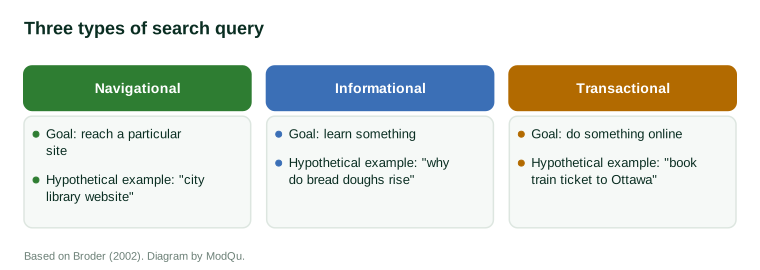
The distinction matters because the same words can carry different intentions. A query for a product name may come from someone who wants to buy it, someone who wants to read reviews or someone who wants to find a support page.
Search as exploration
Not every search seeks a single answer. Gary Marchionini (2006) distinguished lookup searches, in which the person knows what they want and simply needs to find it, from exploratory searches, in which the person is learning about a topic, comparing options or investigating something unfamiliar. Exploratory search unfolds over many queries, each shaped by what the last one revealed. In this sense, a sequence of queries is itself a form of inquiry: the person refines the question as their understanding grows.
Changes in how people remember
Easy access to answers may also change what people try to remember. Sparrow et al. (2011) found that when people expected to be able to look information up later, they were less likely to remember the information itself, though more likely to remember where it could be found. The authors suggested that people treat search engines as a form of external memory, much as they rely on colleagues or reference books for knowledge they do not hold themselves.
What modern queries reveal
Because queries are short, frequent and typed in private, they often record questions people would hesitate to ask aloud: about health worries, money troubles or unfamiliar terms. Taken together, the questions that large numbers of people ask reveal what they want to know, what puzzles them and how their concerns change over time. A query is the compromised need that Taylor described, but it is also a direct trace of a real question, put in the asker's own words.
Understanding modern queries therefore means reading them as the visible end of a longer process of inquiry, one that begins with a sense that something is missing and continues until the person finds, or gives up on, an answer.
References
Belkin, N. J. (1980). Anomalous states of knowledge as a basis for information retrieval. Canadian Journal of Information Science, 5, 133–143.
Broder, A. (2002). A taxonomy of web search. ACM SIGIR Forum, 36(2), 3–10. https://doi.org/10.1145/792550.792552
Jansen, B. J., Spink, A., & Saracevic, T. (2000). Real life, real users, and real needs: A study and analysis of user queries on the web. Information Processing & Management, 36(2), 207–227. https://doi.org/10.1016/S0306-4573(99)00056-4
Marchionini, G. (2006). Exploratory search: From finding to understanding. Communications of the ACM, 49(4), 41–46. https://doi.org/10.1145/1121949.1121979
Sparrow, B., Liu, J., & Wegner, D. M. (2011). Google effects on memory: Cognitive consequences of having information at our fingertips. Science, 333(6043), 776–778. https://doi.org/10.1126/science.1207745
Taylor, R. S. (1968). Question-negotiation and information seeking in libraries. College & Research Libraries, 29(3), 178–194. https://doi.org/10.5860/crl_29_03_178