
Inquiry · Inquiry in practice
Inquiry Journals and Reflective Documentation as Knowledge Artifacts
Notebooks, field diaries, research journals and decision logs record not only what an inquiry found but how it got there. This article explains why reflective documentation matters, what history and research show about its value, and how to keep records that serve both thinking and accountability.
Published findings show the destination of an inquiry. The route usually disappears: the false starts, the hunches that did not work out, the moment when a puzzling result suggested a new direction. Inquiry journals, laboratory notebooks, field diaries and decision logs preserve that route. They are working tools for the person doing the inquiry, and they are also knowledge artefacts: records that allow others, and the inquirer at a later date, to understand, check and build on what was done.
What notebooks reveal
Historians of science have learned a great deal from researchers' private records. The notebooks Charles Darwin kept between 1836 and 1844, published in a scholarly edition by Barrett et al. (1987), show his ideas about the transformation of species developing over several years. In one notebook, beneath the words "I think", he sketched a small branching tree of descent. The finished theory appeared in print only two decades later. The historian Frederic Lawrence Holmes (2004) studied the laboratory notebooks of scientists such as Antoine Lavoisier and Hans Krebs and found that their discoveries emerged through long sequences of small experiments, adjustments and changes of plan. The published papers presented tidy logical arguments; the notebooks showed the actual investigative pathway, with its detours and uncertainties.
This difference matters beyond history. A record of how a conclusion was reached allows others to judge it, to repeat the work, and to see what else was tried. Without such records, the reasoning behind a finding is lost, even to the person who produced it.
Kinds of inquiry record
Different fields have developed different forms of record, summarised in Figure 1.
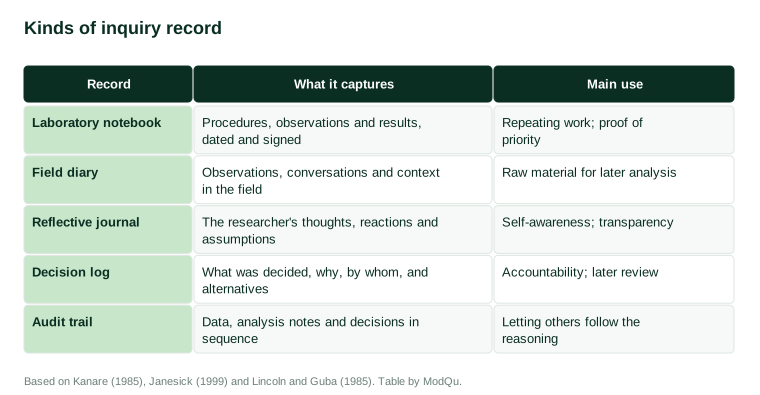
In laboratory science, the notebook is a formal record. Howard Kanare (1985) set out the conventions that make it trustworthy: bound pages numbered in advance, entries in ink, dated and signed, with nothing removed. Such notebooks serve as legal evidence of when a discovery was made, as well as a scientific record. In qualitative research, the reflective journal plays a different role. Valerie Janesick (1999) describes journal writing as a way for researchers to examine their own role, assumptions and reactions during a study. Maria Ortlipp (2008) argues that keeping such a journal makes the researcher's thinking visible and makes the research process more transparent to readers.
Writing as a way of thinking
Records are not only for others. The act of writing helps the inquirer think. John Dewey (1933) described reflective thought as the active and careful consideration of a belief in the light of the grounds that support it. Writing slows thought down enough for that consideration to happen. Donald Schön (1983) showed how skilled professionals reflect on their practice, both during action and afterwards. A journal provides a place for reflection after the event, where surprises can be noticed and examined rather than forgotten.
David Kolb (1984) described learning from experience as a cycle, shown in Figure 2: concrete experience, reflective observation, abstract conceptualisation and active experimentation. A journal supports each stage, but especially the move from experience to reflection, which is the step most easily skipped when people are busy.
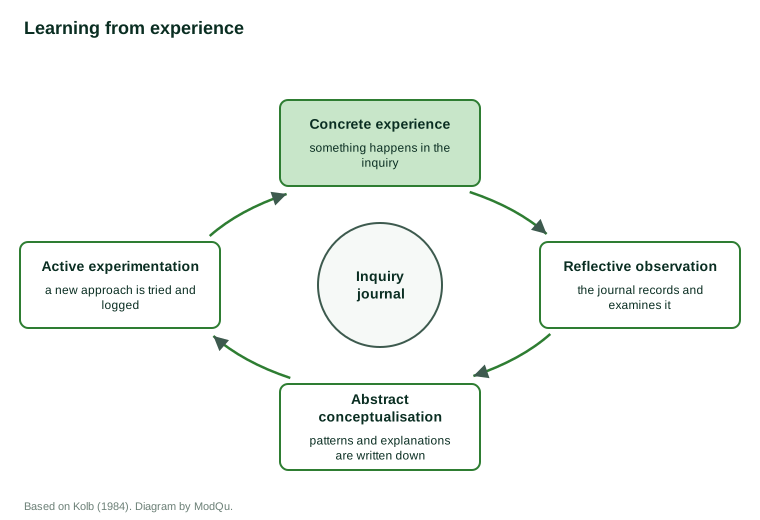
Boud et al. (1985) emphasised that reflection involves returning to an experience, attending to the feelings it produced and re-evaluating it in the light of new understanding. Jennifer Moon (2006) reviewed the uses of learning journals in education and professional development and found that they help people integrate new material with existing knowledge, notice their own assumptions and develop the habit of reflection. Writing can also help people process difficult experiences. James Pennebaker (1997) found that people who wrote about emotionally significant experiences for a few short sessions later showed improvements in health and well-being compared with those who wrote about neutral topics.
Capturing what would otherwise be lost
Michael Polanyi (1966) observed that "we can know more than we can tell": much expertise is tacit, held in skills and judgment that are difficult to put into words. Ikujiro Nonaka and Hirotaka Takeuchi (1995) argued that organisations create knowledge partly by converting tacit knowledge into explicit form, a process they called externalisation, so that it can be shared. Reflective records are one of the simplest ways to do this. A note explaining why an analyst chose one method over another, or why a team dropped a promising line of inquiry, turns private judgment into a resource others can use.
Vannevar Bush (1945) imagined the memex, a desk-sized device in which a person could store all their books, records and communications, and link them by associative trails that could be followed and shared. Modern digital notebooks and shared documents fulfil part of that vision. They make records searchable and linkable, though they also make it easy to accumulate notes no one reads again.
Records as accountability
In qualitative research, Yvonna Lincoln and Egon Guba (1985) proposed the audit trail as a way of establishing that findings are dependable: a record of raw data, analysis notes, decisions and reflections that would allow an outside auditor to follow how conclusions were reached. The same principle applies in any organisation. A decision log that records what was decided, on what evidence, by whom and with what alternatives considered allows later reviewers to judge whether a decision was reasonable at the time, rather than only whether it turned out well.
Consider a hypothetical example. A market research team keeps a simple project journal for a customer study. Over six weeks it records each change to the questionnaire and the reason, a puzzling result in the pilot, a decision to exclude an unreliable sample source and the team's first interpretation of the findings. A year later, a new analyst repeating the study can see why the questionnaire looks as it does, avoid the sample source that caused trouble, and compare the new findings with the original interpretation. Without the journal, much of that knowledge would have left with the original team.
Shared records in teams
Most inquiry in organisations is done by teams rather than individuals, and team records raise their own questions. A shared project journal works best when it has a clear owner, a simple structure and an agreed rhythm, such as a short entry at the end of each working day or after each meeting. Entries should be written for a reader who was not present: naming the data, the analysis and the people involved, and explaining abbreviations that seem obvious at the time.
Team records also need to be honest to be useful. If people expect their entries to be used to assign blame, they will record only what is safe, and the record will lose its value as a source of learning. The aim is a record that describes what happened and why, including mistakes, in a setting where admitting a mistake is treated as a contribution. Some teams separate a formal decision log, which is reviewed by managers, from a working journal that is shared only within the team, so that the working journal can remain candid.
Finally, records must outlast the people who wrote them. Staff move on, software changes and files are reorganised. Choosing durable formats, storing records with the data and outputs they describe, and including a brief summary at the start of each project record all help ensure that the next person to pick up the inquiry can understand what was done.
Keeping useful records
Several practices make inquiry records more useful:
- Write at the time. Memory is reshaped by later events; contemporaneous notes are more accurate.
- Record reasons, not only actions. The why behind a decision is what others most need and what is most quickly forgotten.
- Include doubts and failures. Abandoned approaches and unexpected results are often the most informative entries.
- Date everything and keep entries in order, so the sequence of thinking can be reconstructed.
- Review the record. Periodically reread entries to notice patterns, recurring problems and changes in thinking.
- Make it findable. Store records where colleagues can locate them, with enough context to be understood by someone new.
An inquiry journal costs a few minutes a day. In return, it improves the inquirer's thinking, preserves knowledge that would otherwise vanish and allows others to trust, check and continue the work.
References
Barrett, P. H., Gautrey, P. J., Herbert, S., Kohn, D., & Smith, S. (Eds.). (1987). Charles Darwin's notebooks, 1836–1844: Geology, transmutation of species, metaphysical enquiries. Cambridge University Press.
Boud, D., Keogh, R., & Walker, D. (Eds.). (1985). Reflection: Turning experience into learning. Kogan Page.
Bush, V. (1945). As we may think. The Atlantic Monthly, 176(1), 101–108.
Dewey, J. (1933). How we think: A restatement of the relation of reflective thinking to the educative process (Rev. ed.). D. C. Heath.
Holmes, F. L. (2004). Investigative pathways: Patterns and stages in the careers of experimental scientists. Yale University Press.
Janesick, V. J. (1999). A journal about journal writing as a qualitative research technique: History, issues, and reflections. Qualitative Inquiry, 5(4), 505–524. https://doi.org/10.1177/107780049900500404
Kanare, H. M. (1985). Writing the laboratory notebook. American Chemical Society.
Kolb, D. A. (1984). Experiential learning: Experience as the source of learning and development. Prentice-Hall.
Lincoln, Y. S., & Guba, E. G. (1985). Naturalistic inquiry. Sage.
Moon, J. A. (2006). Learning journals: A handbook for reflective practice and professional development (2nd ed.). Routledge.
Nonaka, I., & Takeuchi, H. (1995). The knowledge-creating company: How Japanese companies create the dynamics of innovation. Oxford University Press.
Ortlipp, M. (2008). Keeping and using reflective journals in the qualitative research process. The Qualitative Report, 13(4), 695–705.
Pennebaker, J. W. (1997). Writing about emotional experiences as a therapeutic process. Psychological Science, 8(3), 162–166. https://doi.org/10.1111/j.1467-9280.1997.tb00403.x
Polanyi, M. (1966). The tacit dimension. Doubleday.
Schön, D. A. (1983). The reflective practitioner: How professionals think in action. Basic Books.