
Research · Research integrity
Conflicts of Interest in Commissioned Research
What a conflict of interest is in commissioned research, the evidence that funding can shape results and conclusions, why disclosure alone is not enough, and practical safeguards for commissioning and conducting research.
Much research is paid for by someone with an interest in the answer. A company commissions a study of its product, an industry body funds research on its sector, a campaign group pays for a survey on its cause. None of this is wrong in itself, and much valuable research would not exist without such funding. But it creates a conflict of interest: a situation in which a researcher's judgement may be influenced by something other than the pursuit of an accurate answer. This article explains what conflicts of interest are, what the evidence shows about their effects and how to manage them.
What a conflict of interest is
Thompson (1993) defined a conflict of interest as a set of conditions in which professional judgement concerning a primary interest, such as the validity of research, tends to be unduly influenced by a secondary interest, such as financial gain. The definition concerns the situation, not the outcome. A researcher has a conflict of interest whenever the conditions exist, whether or not their judgement is actually affected. This matters because the influence is often impossible to detect, even for the researcher.
Lo and Field (2009), in a report for the Institute of Medicine, made the same point and argued that policies should aim to prevent situations that create a risk of undue influence, not only to punish proven bias.
Conflicts can be financial, such as funding, consultancy fees, shares or the prospect of future contracts, or non-financial, such as personal relationships, career ambitions or strong prior commitments to a theory.
What the evidence shows
There is extensive evidence that the source of funding is associated with the results and conclusions of research.
Bekelman et al. (2003) systematically reviewed studies of biomedical research and found that industry-sponsored studies were significantly more likely to reach conclusions favourable to the sponsor. Lundh et al. (2017), in a later Cochrane review, found that drug and device studies sponsored by manufacturers more often reported favourable efficacy results and conclusions than studies with other sponsors, and that the difference was not explained by standard measures of risk of bias.
The pattern extends beyond medicine. Barnes and Bero (1998) examined review articles on the health effects of passive smoking and found that the only factor predicting a conclusion that passive smoking was not harmful was whether the author had links to the tobacco industry. Bes-Rastrollo et al. (2013) found that systematic reviews of sugar-sweetened drinks and weight gain that disclosed financial ties to the food or drink industry were much more likely to conclude that the evidence of harm was insufficient.
Historical documents show how such effects can arise. Kearns et al. (2016) examined internal sugar industry documents and found that an industry group had funded a review of research on diet and heart disease in the 1960s, set its objective and reviewed drafts, and that the published review played down evidence on sugar while emphasising dietary fat. The funding was not disclosed at the time.
How conflicts influence research
Conflicts can affect research at every stage, as shown below.
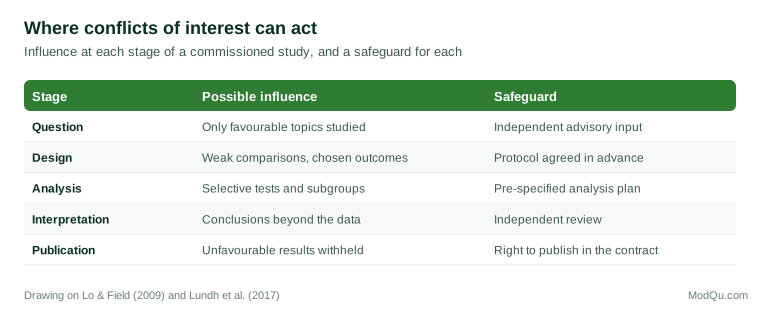
A sponsor may choose the question, so that only favourable topics are studied; shape the design, for example by choosing a weak comparison; influence the analysis and interpretation; or decide whether results are published at all. Much of this influence need not involve deliberate dishonesty. Moore and Loewenstein (2004) argued that self-interest affects judgement automatically and without awareness, while professional responsibilities are weighed more deliberately. Researchers who sincerely believe they are objective may still be swayed. Dana and Loewenstein (2003) noted that even small gifts can create a sense of obligation that influences decisions, and that people who receive them generally believe they are not affected.
Why disclosure is not enough
The most common response to conflicts of interest is disclosure: authors declare their funding and ties, and readers take them into account. Disclosure is necessary, but research suggests it is not sufficient.
Cain et al. (2005) found in experiments that advisers who disclosed a conflict of interest gave more biased advice than those who did not, apparently because disclosure made them feel licensed to exaggerate, while the people receiving the advice did not discount it enough. Loewenstein et al. (2012) summarised this and later work, concluding that disclosure can have unintended consequences and should be combined with other safeguards rather than relied on alone.
Safeguards
Good practice combines several measures:
- Independence in contracts. Agreements should give researchers control over design, analysis and the right to publish, whatever the results.
- Agreed protocols. The question, method and analysis plan should be set and recorded before data collection, so that later changes are visible.
- Full reporting. All results should be reported, including those unfavourable to the sponsor.
- Separation of roles. Where possible, people with a financial stake should not analyse the data or write the conclusions.
- Clear disclosure. Funding and other ties should be stated prominently, not hidden in small print.
- Independent review. Advisory panels or external reviewers can check that methods and conclusions are sound.
Professional codes in market and social research make similar demands. The international code of the International Chamber of Commerce and ESOMAR requires researchers to be transparent about their work, to ensure that findings are not misrepresented and to keep research distinct from selling or promotion (ICC & ESOMAR, 2016).
Commissioned research in business
Conflicts of interest are especially common in business research, where clients pay for studies and often hope for particular findings. A company may want evidence that customers love a new product, or a trade association may want a survey showing public support for its position. Researchers who depend on repeat business may feel pressure, rarely stated, to deliver welcome results. Protecting the independence of the method is the best way to protect the value of the findings, for the client as much as for anyone else: research that tells a client only what it wants to hear is of little use for real decisions.
Reading commissioned research
For readers, the presence of a sponsor is a reason to look harder, not to dismiss the work. Useful questions include: who paid, and what did they stand to gain? Who controlled the design, analysis and decision to publish? Was the method set out in advance? Are all results reported? Do the conclusions follow from the data, or go beyond them in the sponsor's favour?
Conclusion
Conflicts of interest are a normal feature of research that is commissioned and paid for. The evidence shows that they are associated with results and conclusions that favour the funder, often without any deliberate wrongdoing. Disclosure helps but does not solve the problem. Independence in design and publication, protocols set in advance and full reporting are the safeguards that allow commissioned research to be trusted.
References
Barnes, D. E., & Bero, L. A. (1998). Why review articles on the health effects of passive smoking reach different conclusions. JAMA, 279(19), 1566–1570. https://doi.org/10.1001/jama.279.19.1566
Bekelman, J. E., Li, Y., & Gross, C. P. (2003). Scope and impact of financial conflicts of interest in biomedical research: A systematic review. JAMA, 289(4), 454–465. https://doi.org/10.1001/jama.289.4.454
Bes-Rastrollo, M., Schulze, M. B., Ruiz-Canela, M., & Martinez-Gonzalez, M. A. (2013). Financial conflicts of interest and reporting bias regarding the association between sugar-sweetened beverages and weight gain: A systematic review of systematic reviews. PLoS Medicine, 10(12), Article e1001578. https://doi.org/10.1371/journal.pmed.1001578
Cain, D. M., Loewenstein, G., & Moore, D. A. (2005). The dirt on coming clean: Perverse effects of disclosing conflicts of interest. The Journal of Legal Studies, 34(1), 1–25. https://doi.org/10.1086/426699
Dana, J., & Loewenstein, G. (2003). A social science perspective on gifts to physicians from industry. JAMA, 290(2), 252–255. https://doi.org/10.1001/jama.290.2.252
ICC & ESOMAR. (2016). ICC/ESOMAR international code on market, opinion and social research and data analytics. ESOMAR.
Kearns, C. E., Schmidt, L. A., & Glantz, S. A. (2016). Sugar industry and coronary heart disease research: A historical analysis of internal industry documents. JAMA Internal Medicine, 176(11), 1680–1685. https://doi.org/10.1001/jamainternmed.2016.5394
Lo, B., & Field, M. J. (Eds.). (2009). Conflict of interest in medical research, education, and practice. National Academies Press. https://doi.org/10.17226/12598
Loewenstein, G., Sah, S., & Cain, D. M. (2012). The unintended consequences of conflict of interest disclosure. JAMA, 307(7), 669–670. https://doi.org/10.1001/jama.2012.154
Lundh, A., Lexchin, J., Mintzes, B., Schroll, J. B., & Bero, L. (2017). Industry sponsorship and research outcome. Cochrane Database of Systematic Reviews, (2), Article MR000033. https://doi.org/10.1002/14651858.MR000033.pub3
Moore, D. A., & Loewenstein, G. (2004). Self-interest, automaticity, and the psychology of conflict of interest. Social Justice Research, 17(2), 189–202. https://doi.org/10.1023/B:SORE.0000027409.88372.b4
Thompson, D. F. (1993). Understanding financial conflicts of interest. New England Journal of Medicine, 329(8), 573–576. https://doi.org/10.1056/NEJM199308193290812