
Research · Research integrity
Research Misconduct: Fabrication, Falsification and Plagiarism
What counts as research misconduct, the three core forms of fabrication, falsification and plagiarism, how common misconduct is, how it is detected and investigated, its causes and consequences, and how institutions and researchers can prevent it.
Research depends on trust. Readers assume that reported data were actually collected, that results were not altered and that the words and ideas in a paper belong to its authors or are properly credited. Research misconduct is the deliberate violation of that trust. Although rare compared with honest error and questionable practices, it has caused serious harm, from wasted research funding to public health scares. This article explains how misconduct is defined, how common it appears to be, how it is detected, what causes it and how it can be prevented.
Definitions
The most widely used definition comes from United States federal policy, which defines research misconduct as fabrication, falsification or plagiarism in proposing, performing or reviewing research, or in reporting research results (Office of Science and Technology Policy, 2000):
- Fabrication is making up data or results and recording or reporting them.
- Falsification is manipulating research materials, equipment or processes, or changing or omitting data or results, so that the research is not accurately represented in the research record.
- Plagiarism is the appropriation of another person's ideas, processes, results or words without giving appropriate credit.
The policy explicitly excludes honest error and differences of opinion. To count as misconduct, the act must be a significant departure from accepted practice, committed intentionally, knowingly or recklessly, and proven by a preponderance of evidence.
Other codes take a broader view. The European Code of Conduct for Research Integrity treats fabrication, falsification and plagiarism as the most serious violations, but also lists a range of other unacceptable practices, such as manipulating authorship, citing selectively, withholding results and misusing seniority to encourage violations of integrity (ALLEA, 2023). The Singapore Statement on Research Integrity (2010), agreed at an international conference, set out shared principles of honesty, accountability, professional courtesy and good stewardship, and responsibilities that follow from them.
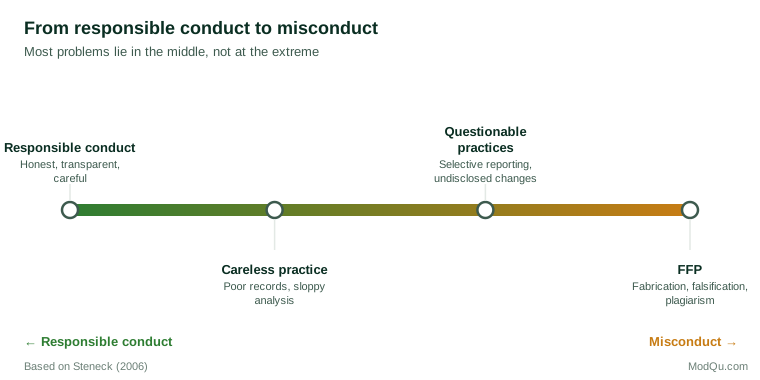
Steneck (2006) suggested thinking of research behaviour as a spectrum. At one end lies responsible conduct; at the other, fabrication, falsification and plagiarism. Between them lie questionable research practices, such as selective reporting or inadequate record keeping, which fall short of misconduct but can still damage the reliability of research.
The three forms in practice
Fabrication
Fabrication is the most blatant form. Perhaps the best documented recent case in the social sciences is that of the Dutch social psychologist Diederik Stapel. Investigating committees found that he had fabricated data in dozens of publications over many years, often designing studies with colleagues and then supplying invented data sets himself (Levelt Committee et al., 2012). The committees also criticised the research culture that allowed the fraud to go undetected: co-authors, reviewers and editors had accepted results that were, in hindsight, too good to be true.
Falsification
Falsification includes altering data, selectively removing inconvenient observations, manipulating images and misrepresenting methods. A notorious example is the 1998 paper by Andrew Wakefield and colleagues that suggested a link between the MMR vaccine and autism. An investigation by the journalist Brian Deer found that details of the children's cases had been altered in the published report (Deer, 2011). The paper was retracted, and the BMJ concluded that it was fraudulent (Godlee et al., 2011). Its effects on public confidence in vaccination lasted long after the retraction.
Image manipulation is a common form of falsification in laboratory science. Bik et al. (2016) visually screened more than 20,000 papers in biomedical journals and found that about 4 per cent contained problematic duplicated images, at least half of which showed features suggesting deliberate manipulation.
Plagiarism
Plagiarism ranges from copying whole papers to using passages, ideas or data without credit. Self-plagiarism, or reusing one's own previously published text or data without disclosure, is generally treated as a lesser offence, but it can mislead readers and editors, for example when the same results are published twice as if they were independent studies (Roig, 2015). Not every textual overlap is plagiarism: standard descriptions of methods may legitimately be similar across papers, and inexperienced writers sometimes produce close paraphrases without intent to deceive (Pecorari, 2003). Intent and extent matter.
How common is misconduct?
Measuring misconduct is difficult because it is, by design, hidden. Surveys provide one estimate. Fanelli (2009) pooled surveys of scientists and found that about 2 per cent admitted to having fabricated or falsified data at least once, while about 14 per cent said they had observed colleagues doing so. Admission rates for questionable practices were much higher. Martinson et al. (2005) surveyed several thousand scientists funded by the United States National Institutes of Health and found that a third admitted to at least one of ten serious misbehaviours in the previous three years, although very few admitted to outright falsification.
Retractions offer another view. Fang et al. (2012) examined more than 2,000 retracted biomedical articles and found that about two-thirds had been retracted because of misconduct, including fraud or suspected fraud, duplicate publication and plagiarism, while about a fifth were retracted because of error. Steen (2011) found that retractions had been increasing, but noted that this could reflect better detection and greater willingness to retract as much as more misconduct.
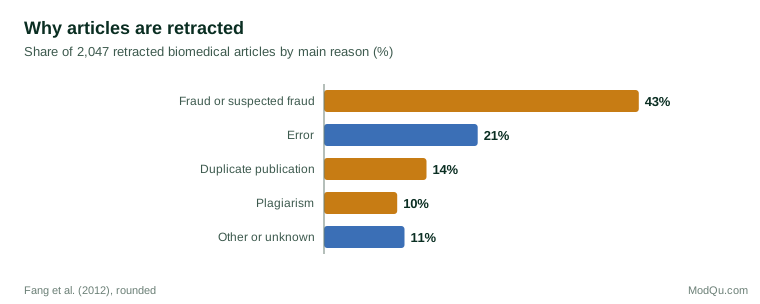
Both measures probably understate the problem. People under-report their own misconduct, and only a fraction of fraudulent papers are ever detected and retracted.
The grey zone
Many problems fall short of the formal definition of misconduct but still damage research. John et al. (2012) found that substantial shares of psychologists admitted to questionable practices such as failing to report all measures or reporting only studies that worked. Other recurring problems include:
- Authorship abuses, such as adding senior colleagues who did not contribute (gift authorship) or leaving out people who did (ghost authorship).
- Duplicate publication, presenting the same results in more than one journal without disclosure, which can lead reviewers to count one study twice.
- Salami slicing, splitting one study into several thin papers to increase publication counts.
- Poor data stewardship, such as failing to keep raw data, which makes it impossible to check results later.
- Undisclosed conflicts of interest, which hide information readers need to judge the work.
Institutions differ in how they handle such cases. Some treat serious or repeated examples as misconduct; others deal with them through correction, training or local discipline. Because these practices are much more common than fabrication or falsification, they probably do more total damage to the reliability of research (Steneck, 2006).
How misconduct is detected
Most misconduct comes to light through a few routes:
- Colleagues and students, who notice irregularities and report them. In the Stapel case, junior researchers raised the alarm (Levelt Committee et al., 2012).
- Failed replications, when others cannot reproduce results and begin to ask why.
- Statistical forensics. Simonsohn (2013) showed that fabricated data can sometimes be detected statistically, because invented numbers tend to be too similar or too regular. Carlisle (2017) examined the baseline characteristics reported in more than 5,000 randomised trials and found distributions in some trials that were unlikely to have arisen from genuine random allocation, a pattern that can indicate fabrication or error.
- Image screening, by trained reviewers and increasingly by software (Bik et al., 2016).
- Text-matching software, which compares submitted manuscripts with published work to detect plagiarism.
Detection is uneven across fields. Laboratory images and clinical trial data now receive systematic scrutiny, but survey and interview data are harder to check, because invented responses can look much like real ones. Requiring raw data to be deposited, with clear records of when and how they were collected, is one of the few general defences.
Investigation and consequences
Allegations are usually investigated by the researcher's institution, sometimes with oversight from a national body such as the Office of Research Integrity in the United States. A typical process involves an initial assessment, a formal inquiry to decide whether an investigation is warranted, and a full investigation with the right of the accused to respond. Findings of misconduct can lead to retraction of papers, dismissal, exclusion from funding and, in some cases, criminal prosecution.
Journals play a separate role. The Committee on Publication Ethics recommends that editors retract articles when there is clear evidence that findings are unreliable, whether through misconduct or honest error, and that retraction notices state the reason clearly (Committee on Publication Ethics, 2019).
Retraction does not undo all the damage. Budd et al. (1998) found that retracted articles continued to be cited after retraction, usually without acknowledgement that they had been withdrawn.
Error is not misconduct
It is important to distinguish misconduct from honest error. Mistakes in coding, calculation or data entry are common, and researchers who find and correct them are behaving responsibly. Treating every error as a sign of fraud discourages people from admitting mistakes, which makes the research record worse, not better. Journals increasingly distinguish retractions for misconduct from corrections or retractions requested by authors who discovered their own errors, and some have argued that the latter should be seen as a mark of integrity rather than shame (Committee on Publication Ethics, 2019).
The costs of misconduct
The costs of misconduct extend well beyond the researcher responsible. Co-authors may find their own work tainted. Students and junior colleagues may lose years of work built on fabricated foundations. Other researchers waste time and funding trying to replicate or extend false results. Reviews and meta-analyses that include fraudulent studies give misleading answers. In applied fields, practitioners and policymakers may act on false evidence, as the long aftermath of the MMR paper showed. And each prominent case reduces public trust in research more generally.
Why misconduct happens
Explanations range from individual character to the research system.
Individual factors. Davis et al. (2007) analysed case files from the United States Office of Research Integrity and identified recurring factors, including personal and professional stress, job insecurity, and rationalisations that allowed researchers to justify their actions to themselves.
Pressure and incentives. Careers depend on publications, grants and prominence. Martinson et al. (2005) found that some problematic behaviours were associated with perceived pressure and injustice in the research environment.
Weak oversight. Stapel's fraud continued for years partly because no one checked raw data and collaborators accepted results without question (Levelt Committee et al., 2012).
Normative dissonance. Anderson et al. (2007) found that scientists strongly endorsed traditional norms of science, such as openness and disinterestedness, but believed that their colleagues' behaviour often fell short of them. This gap between ideals and perceived practice can make violations seem normal.
Gross (2016), reviewing research on scientific misconduct, concluded that both individual and systemic factors contribute, and that prevention requires attention to both.
Prevention
Preventing misconduct involves making it harder to commit, easier to detect and less tempting.
- Transparency. Open data, code and materials allow others to check results, and make fabrication riskier.
- Supervision and shared data. Research teams should routinely share and inspect raw data, rather than leaving one person in control.
- Training. Researchers at all stages need clear guidance on what counts as misconduct and on good practice in record keeping, authorship and citation.
- Protection for whistle-blowers. People who report concerns need safe channels and protection from retaliation.
- Fair, prompt investigations. Institutions need clear procedures that protect both the accused and those raising concerns.
- Healthier incentives. Evaluating researchers on the quality and openness of their work, not only on the number of publications, reduces the pressure that can push people toward misconduct.
If you suspect misconduct
Anyone who suspects misconduct faces a difficult situation, especially if the person concerned is a supervisor or senior colleague. General guidance is to keep a careful record of what was observed, to check whether there might be an innocent explanation, and to seek confidential advice, for example from a research integrity officer, before making a formal allegation. Most institutions have designated contacts and procedures for this purpose. Allegations should be made in good faith and through proper channels, so that the person accused has a fair chance to respond and the person raising the concern is protected.
Misconduct in business and applied research
Commercial research faces the same risks. Interviewers who invent survey responses to meet quotas, analysts who adjust figures to match a client's expectations, and consultants who copy material without credit are committing forms of fabrication, falsification and plagiarism. Professional codes in market and social research prohibit such conduct, and quality checks on fieldwork, such as back-checking a sample of interviews and analysing response patterns for signs of invented data, are standard defences. Organisations that commission research should ask how such checks are carried out.
Conclusion
Research misconduct, defined at its core as fabrication, falsification and plagiarism, is relatively rare, but its effects can be severe and long-lasting. Surveys and retraction data suggest it is more common than detected cases reveal. It arises from a mix of individual choices and systemic pressures, and it persists where oversight is weak. Transparency, shared responsibility for data, training, fair procedures and better incentives make it harder to commit and easier to detect. Above all, a research culture in which checking results is normal, rather than an insult, is the strongest protection of the trust on which research depends.
References
ALLEA. (2023). The European code of conduct for research integrity (Rev. ed.). ALLEA – All European Academies. https://doi.org/10.26356/ECOC
Anderson, M. S., Martinson, B. C., & De Vries, R. (2007). Normative dissonance in science: Results from a national survey of U.S. scientists. Journal of Empirical Research on Human Research Ethics, 2(4), 3–14. https://doi.org/10.1525/jer.2007.2.4.3
Bik, E. M., Casadevall, A., & Fang, F. C. (2016). The prevalence of inappropriate image duplication in biomedical research publications. mBio, 7(3), Article e00809-16. https://doi.org/10.1128/mBio.00809-16
Budd, J. M., Sievert, M., & Schultz, T. R. (1998). Phenomena of retraction: Reasons for retraction and citations to the publications. JAMA, 280(3), 296–297. https://doi.org/10.1001/jama.280.3.296
Carlisle, J. B. (2017). Data fabrication and other reasons for non-random sampling in 5087 randomised, controlled trials in anaesthetic and general medical journals. Anaesthesia, 72(8), 944–952. https://doi.org/10.1111/anae.13938
Committee on Publication Ethics. (2019). Retraction guidelines. https://doi.org/10.24318/cope.2019.1.4
Davis, M. S., Riske-Morris, M., & Diaz, S. R. (2007). Causal factors implicated in research misconduct: Evidence from ORI case files. Science and Engineering Ethics, 13(4), 395–414. https://doi.org/10.1007/s11948-007-9045-2
Deer, B. (2011). How the case against the MMR vaccine was fixed. BMJ, 342, Article c5347. https://doi.org/10.1136/bmj.c5347
Fanelli, D. (2009). How many scientists fabricate and falsify research? A systematic review and meta-analysis of survey data. PLoS ONE, 4(5), Article e5738. https://doi.org/10.1371/journal.pone.0005738
Fang, F. C., Steen, R. G., & Casadevall, A. (2012). Misconduct accounts for the majority of retracted scientific publications. Proceedings of the National Academy of Sciences, 109(42), 17028–17033. https://doi.org/10.1073/pnas.1212247109
Godlee, F., Smith, J., & Marcovitch, H. (2011). Wakefield's article linking MMR vaccine and autism was fraudulent. BMJ, 342, Article c7452. https://doi.org/10.1136/bmj.c7452
Gross, C. (2016). Scientific misconduct. Annual Review of Psychology, 67, 693–711. https://doi.org/10.1146/annurev-psych-122414-033437
John, L. K., Loewenstein, G., & Prelec, D. (2012). Measuring the prevalence of questionable research practices with incentives for truth telling. Psychological Science, 23(5), 524–532. https://doi.org/10.1177/0956797611430953
Levelt Committee, Noort Committee, & Drenth Committee. (2012). Flawed science: The fraudulent research practices of social psychologist Diederik Stapel. Tilburg University.
Martinson, B. C., Anderson, M. S., & de Vries, R. (2005). Scientists behaving badly. Nature, 435(7043), 737–738. https://doi.org/10.1038/435737a
Office of Science and Technology Policy. (2000). Federal policy on research misconduct. Federal Register, 65(235), 76260–76264.
Pecorari, D. (2003). Good and original: Plagiarism and patchwriting in academic second-language writing. Journal of Second Language Writing, 12(4), 317–345. https://doi.org/10.1016/j.jslw.2003.08.004
Roig, M. (2015). Avoiding plagiarism, self-plagiarism, and other questionable writing practices: A guide to ethical writing. Office of Research Integrity, U.S. Department of Health and Human Services.
Simonsohn, U. (2013). Just post it: The lesson from two cases of fabricated data detected by statistics alone. Psychological Science, 24(10), 1875–1888. https://doi.org/10.1177/0956797613480366
Singapore Statement on Research Integrity. (2010). Second World Conference on Research Integrity. https://www.wcrif.org/guidance/singapore-statement
Steen, R. G. (2011). Retractions in the scientific literature: Is the incidence of research fraud increasing? Journal of Medical Ethics, 37(4), 249–253. https://doi.org/10.1136/jme.2010.040923
Steneck, N. H. (2006). Fostering integrity in research: Definitions, current knowledge, and future directions. Science and Engineering Ethics, 12(1), 53–74. https://doi.org/10.1007/PL00022268