
Research · Research integrity
Research Ethics Committees and Institutional Review Boards
What research ethics committees and institutional review boards do, why they exist, how ethics review works in practice, the criticisms made of it, and how researchers can prepare a strong application.
Before most research involving people can begin, an independent group must agree that it is ethical. In the United States this group is called an institutional review board (IRB); in Canada, a research ethics board (REB); in the United Kingdom and much of Europe, a research ethics committee (REC). The names differ, but the purpose is the same: to protect the rights, safety and well-being of the people who take part in research. This article explains why these bodies exist, how they work, what they look for and the debates about their role.
Why independent review exists
Ethics review grew out of a history of harm. During the twentieth century, a series of studies exposed participants to serious risks without their knowledge or consent. In the Tuskegee study, which ran in the United States from 1932 to 1972, hundreds of Black men with syphilis were observed without treatment, and were not offered penicillin even after it became the standard cure (Brandt, 1978). Beecher (1966) published an article describing 22 examples of studies, published in leading journals, in which patients had been put at risk without consent, showing that ethically questionable research was not confined to a few notorious cases.
Social and behavioural research raised its own concerns. Milgram (1963) led participants to believe they were giving painful electric shocks to another person, causing many of them visible distress. Humphreys (1970) observed men in public toilets and then traced them to their homes to interview them under a false pretext. These studies prompted debate about deception, privacy and the limits of what researchers may do in the name of knowledge.
The response was to require that research be reviewed in advance by people other than the researchers themselves. The Declaration of Helsinki, adopted by the World Medical Association in 1964 and revised many times since, requires that research protocols be submitted to an independent research ethics committee before a study begins (World Medical Association, 2013). In the United States, the National Commission for the Protection of Human Subjects of Biomedical and Behavioral Research set out the ethical principles of respect for persons, beneficence and justice in the Belmont Report (National Commission, 1979). Federal regulations, known as the Common Rule, require IRB review of most federally funded research involving human participants (U.S. Department of Health and Human Services, 2018). In Canada, the Tri-Council Policy Statement sets the standards that research ethics boards apply (Canadian Institutes of Health Research et al., 2022).
What committees look for
Committees assess whether a study meets accepted ethical requirements. Emanuel et al. (2000) summarised seven requirements that make clinical research ethical, and most apply to research of any kind:
- Social or scientific value. The research should address a question worth answering.
- Scientific validity. The design must be capable of answering the question; poorly designed research wastes participants' time and may expose them to risk for nothing.
- Fair selection of participants. People should be selected for reasons related to the research question, not because they are convenient or vulnerable.
- Favourable balance of risks and benefits. Risks should be minimised and justified by the expected benefits.
- Independent review. People with no stake in the study should assess it.
- Informed consent. Participants should understand what taking part involves and agree freely.
- Respect for participants. This includes protecting privacy, allowing withdrawal and monitoring welfare during the study.
In practice, committees examine the study protocol, recruitment materials, information sheets, consent forms, data collection instruments and plans for storing and protecting data. They pay particular attention to research involving children, people who may lack capacity to consent, people in dependent relationships with the researchers, and sensitive topics.
How review works
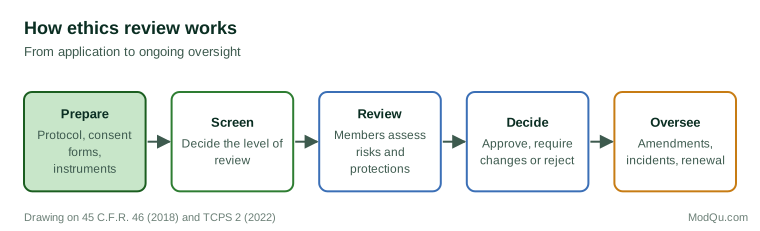
The process typically follows the steps shown below.
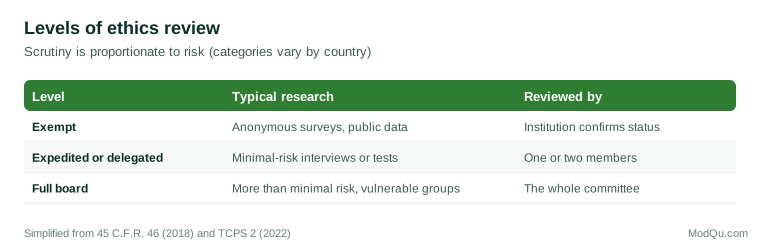
Most systems now practise proportionate review: the level of scrutiny matches the level of risk. Under the Common Rule, some low-risk research is exempt from full review, some qualifies for expedited review by one or two experienced members, and research involving more than minimal risk goes to the full board (U.S. Department of Health and Human Services, 2018). The Tri-Council Policy Statement in Canada takes a similar approach, allowing delegated review for minimal-risk research (Canadian Institutes of Health Research et al., 2022).
A committee usually includes people with scientific expertise, people with knowledge of ethics or law, and at least one member of the public with no affiliation to the institution. It may approve a study, require changes before approval, or reject it. Approval is usually not the end of oversight: researchers must report changes to the protocol and any adverse events, and long studies are reviewed periodically. Internationally, the Council for International Organizations of Medical Sciences (2016) has published guidelines that emphasise review in the country where research takes place, so that local values and conditions are taken into account.
How committees reach decisions
Stark (2012) observed IRB meetings in the United States and found that members drew heavily on their own experience and on the committee's past decisions, which she called local precedents, rather than applying rules mechanically. This helps explain why different committees can reach different conclusions about the same study. Abbott and Grady (2011) systematically reviewed the empirical research on IRBs and found considerable variation in their decisions and processes, and little direct evidence about how well they actually protect participants.
Criticisms
Ethics review is widely accepted in principle, but its practice has attracted criticism.
Burden and delay. Silberman and Kahn (2011) reviewed evidence that review can be slow and costly, particularly for studies conducted at many sites, each with its own committee. The 2018 revisions to the Common Rule responded partly to this problem by requiring a single IRB for most cooperative research in the United States.
Inconsistency. Different committees may reach different decisions about the same protocol, which is hard to justify if the underlying ethical standards are shared (Abbott & Grady, 2011).
A biomedical model applied to social research. Schrag (2010) argued that rules designed for medical experiments were extended to social science without adequate justification, imposing requirements, such as detailed advance protocols and signed consent forms, that fit poorly with interviews, ethnography and oral history. Haggerty (2004) described this expansion as ethics creep: a gradual widening of the activities subject to review and an intensifying of the regulation applied to them. Hedgecoe (2008), studying committees in the United Kingdom, found less evidence of hostility to qualitative research than critics claimed, suggesting that experience differs between countries and committees.
Focus on paperwork. Critics also argue that review can concentrate on documents, such as consent forms, rather than on how research is actually conducted. Ethical research depends on researchers' conduct throughout a study, not only on approval at the start.
Preparing a strong application
Researchers can make review smoother and more useful by:
- Engaging early. Contact the committee or its staff before submission, especially for unusual designs.
- Explaining the value and the design. Committees need to see that the study can answer its question.
- Writing for participants. Use plain language in information sheets and consent forms.
- Anticipating risks. Identify possible harms, including psychological distress and breaches of confidentiality, and explain how each will be minimised.
- Planning data protection. State how data will be stored, who will have access, how long they will be kept and whether they will be shared.
- Justifying any deception. If participants cannot be told the full purpose in advance, explain why, and describe how they will be debriefed.
Researchers should also treat the committee's questions as useful rather than obstructive. A request for changes often points to a real weakness in recruitment, consent or data handling that would have caused problems later.
Ethics review outside universities
Commercial research, including much market and consumer research, is often not subject to institutional ethics review. Professional codes of conduct fill part of the gap, and organisations increasingly set up their own review processes for sensitive projects. The questions a committee asks are useful whatever the setting: is the research worth doing, can it answer its question, are participants informed and protected, and are risks justified by benefits?
Conclusion
Research ethics committees exist because researchers, however well-intentioned, are not the best judges of their own work's risks. Independent review has become a standard part of research involving people, grounded in principles set out after serious abuses. Its practice can be slow, inconsistent and poorly suited to some kinds of research, and reforms continue. But the core idea, that someone without a stake in the study should ask whether it is ethical before it begins, remains sound.
References
Abbott, L., & Grady, C. (2011). A systematic review of the empirical literature evaluating IRBs: What we know and what we still need to learn. Journal of Empirical Research on Human Research Ethics, 6(1), 3–19. https://doi.org/10.1525/jer.2011.6.1.3
Beecher, H. K. (1966). Ethics and clinical research. New England Journal of Medicine, 274(24), 1354–1360. https://doi.org/10.1056/NEJM196606162742405
Brandt, A. M. (1978). Racism and research: The case of the Tuskegee syphilis study. Hastings Center Report, 8(6), 21–29. https://doi.org/10.2307/3561468
Canadian Institutes of Health Research, Natural Sciences and Engineering Research Council of Canada, & Social Sciences and Humanities Research Council of Canada. (2022). Tri-Council policy statement: Ethical conduct for research involving humans – TCPS 2 (2022). Government of Canada.
Council for International Organizations of Medical Sciences. (2016). International ethical guidelines for health-related research involving humans (4th ed.). CIOMS.
Emanuel, E. J., Wendler, D., & Grady, C. (2000). What makes clinical research ethical? JAMA, 283(20), 2701–2711. https://doi.org/10.1001/jama.283.20.2701
Haggerty, K. D. (2004). Ethics creep: Governing social science research in the name of ethics. Qualitative Sociology, 27(4), 391–414. https://doi.org/10.1023/B:QUAS.0000049239.15922.a3
Hedgecoe, A. (2008). Research ethics review and the sociological research relationship. Sociology, 42(5), 873–886. https://doi.org/10.1177/0038038508094567
Humphreys, L. (1970). Tearoom trade: Impersonal sex in public places. Aldine.
Milgram, S. (1963). Behavioral study of obedience. Journal of Abnormal and Social Psychology, 67(4), 371–378. https://doi.org/10.1037/h0040525
National Commission for the Protection of Human Subjects of Biomedical and Behavioral Research. (1979). The Belmont report: Ethical principles and guidelines for the protection of human subjects of research. U.S. Department of Health, Education, and Welfare.
Schrag, Z. M. (2010). Ethical imperialism: Institutional review boards and the social sciences, 1965–2009. Johns Hopkins University Press.
Silberman, G., & Kahn, K. L. (2011). Burdens on research imposed by institutional review boards: The state of the evidence and its implications for regulatory reform. The Milbank Quarterly, 89(4), 599–627. https://doi.org/10.1111/j.1468-0009.2011.00644.x
Stark, L. (2012). Behind closed doors: IRBs and the making of ethical research. University of Chicago Press.
U.S. Department of Health and Human Services. (2018). Protection of human subjects (45 C.F.R. pt. 46).
World Medical Association. (2013). World Medical Association Declaration of Helsinki: Ethical principles for medical research involving human subjects. JAMA, 310(20), 2191–2194. https://doi.org/10.1001/jama.2013.281053