
The Generation of Knowledge · Knowledge and decisions
Decision-Making Under Uncertainty
How decisions can be made when the future is uncertain, from the difference between risk and uncertainty and the theory of expected utility to the heuristics and biases that shape real choices, levels of uncertainty and practical tools such as scenarios and robust strategies.
Almost every important decision is made without full knowledge of what will happen. A company launching a product does not know how customers will respond; a government setting policy does not know how the economy will change. Decision-making under uncertainty is the study of how such choices can and should be made. This article introduces its main ideas, from classical theory to how people actually decide, and practical approaches that help when the future cannot be predicted.
Risk and uncertainty
Knight (1921) drew an influential distinction between risk and uncertainty. Under risk, the possible outcomes and their probabilities are known or can be estimated from experience, as with the chance of a house fire, which insurers can calculate. Under uncertainty, the probabilities cannot be measured, because the situation is new or unique. Knight argued that profit in business arises largely from bearing true uncertainty, which cannot be insured against.
Kay and King (2020) revived this distinction. They argued that many of the most important decisions in business, finance and policy involve radical uncertainty, where we do not know all the possible outcomes, let alone their probabilities, and that pretending otherwise by assigning precise numbers can be misleading.
The classical theory
Von Neumann and Morgenstern (1944) showed that if a person's preferences among risky options satisfy certain reasonable conditions, the person behaves as if choosing the option with the highest expected utility: the average of the values of the possible outcomes, weighted by their probabilities. Savage (1954) extended this to situations where probabilities are not given but represent the decision-maker's own degrees of belief, known as subjective probabilities.
This framework underlies decision analysis. It shows how to combine beliefs about what might happen with judgements about how good or bad each outcome would be, and how to calculate the value of gathering more information before deciding (Howard, 1966).
How people actually decide
Research has shown that real decisions often depart from the classical theory.
Ambiguity aversion. Ellsberg (1961) showed that people prefer bets with known probabilities to bets with unknown probabilities, even when this preference cannot be reconciled with any consistent set of subjective probabilities. People dislike ambiguity as well as risk.
Bounded rationality. Simon (1955) argued that people lack the information and computing capacity to maximise expected utility. Instead, they satisfice, choosing the first option that meets their requirements.
Heuristics and biases. Tversky and Kahneman (1974) showed that people judge probabilities using mental shortcuts, or heuristics, that are usually useful but lead to systematic errors. People judge events as more likely when examples come easily to mind, are swayed by irrelevant starting numbers and neglect base rates.
Prospect theory. Kahneman and Tversky (1979) found that people evaluate outcomes as gains and losses relative to a reference point rather than as final states, and that losses weigh more heavily than equivalent gains. People also overweight small probabilities and underweight moderate and high ones.
Not all departures from the classical theory are mistakes. Gigerenzer and Gaissmaier (2011) reviewed research showing that simple heuristics, which ignore some information, can make more accurate predictions than complex models in uncertain environments, because they are less likely to be misled by noise in limited data.
Levels of uncertainty
Courtney et al. (1997) argued that managers should match their approach to the level of uncertainty they face, and distinguished four levels, shown in Figure 1.
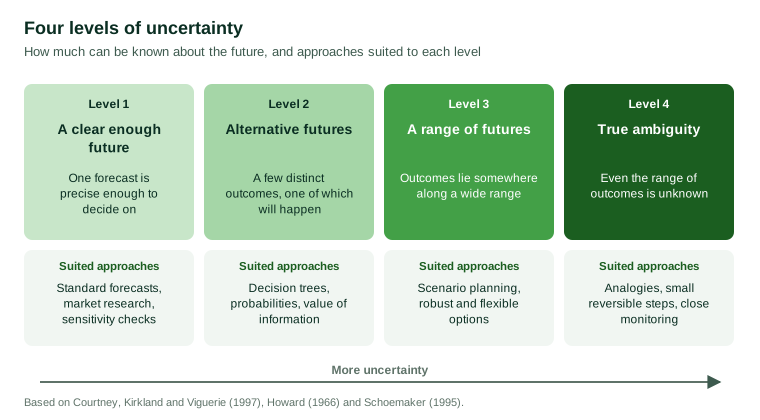
At the first level, a single forecast is precise enough to base a decision on, and standard market research and forecasting suffice. At the second, the future will take one of a few distinct forms, such as whether a regulation is passed, and decision analysis with probabilities is useful. At the third, outcomes lie somewhere within a wide range, and scenario planning helps. At the fourth, even the range of outcomes cannot be identified, and organisations must rely on analogies, small steps that can be reversed and close monitoring of developments.
Practical tools
Scenario planning. Schoemaker (1995) described scenario planning as constructing a small number of distinct, plausible stories about how the future might unfold, and testing strategies against each. Its value lies less in predicting the future than in widening the range of possibilities decision-makers consider.
Robust decision-making. Lempert et al. (2003) proposed choosing strategies that perform reasonably well across a wide range of possible futures, rather than optimally in the single most likely one. This approach is useful when probabilities cannot be estimated with confidence.
Preparing for surprise. Taleb (2007) warned that rare, high-impact events, which he called black swans, are systematically underestimated, and argued for reducing exposure to catastrophic losses rather than trying to predict such events. Klein (2007) proposed the premortem, in which a team imagines that a decision has failed and works out why, as a way of surfacing risks that optimism hides.
Gathering information. Where uncertainty can be reduced, research is valuable. The decision-analytic approach shows that information is worth most when uncertainty is high, the stakes are large and the information could change the decision.
Communicating uncertainty
Decisions under uncertainty also depend on how uncertainty is described to those who make them. Spiegelhalter (2017) reviewed research on communicating risk and uncertainty and drew several lessons. Probabilities are better understood when expressed as natural frequencies, such as "3 in 100", than as percentages or verbal phrases alone. Words such as "likely" and "possible" mean very different things to different people, so they should be linked to numbers where possible. Ranges are more honest than single figures, and the quality of the evidence behind an estimate should be stated as well as the estimate itself. Spiegelhalter also distinguished uncertainty about the outcome, which can sometimes be expressed as a probability, from deeper uncertainty about whether the model or evidence is right at all, which may be better described in words.
These lessons matter because a decision-maker who misunderstands the uncertainty in the evidence may act with too much confidence or too little. A clear account of what is known, what is not known and how confident the analyst is allows the decision-maker to weigh the evidence properly.
Implications for research
Surveys and research reduce uncertainty, but they rarely remove it. Research is most useful when it is designed around the decision it informs and the level of uncertainty involved. At the first two levels, well-designed studies can provide estimates precise enough to guide action. At the third and fourth, research is better used to identify possibilities, track early signals and test assumptions than to produce a single forecast. In every case, results should be reported with honest statements of their own uncertainty, so that decision-makers do not mistake an estimate for certainty.
Conclusion
Decision-making under uncertainty combines the logic of expected utility with an understanding of how people actually judge and choose. The classical theory shows how beliefs and values can be combined, while research on heuristics, biases and ambiguity shows where judgement goes astray and where simple rules work well. Matching the approach to the level of uncertainty, using tools such as scenarios, robust strategies and premortems, and gathering information where it can change the decision all help organisations act well when the future cannot be known.
References
Courtney, H., Kirkland, J., & Viguerie, P. (1997). Strategy under uncertainty. Harvard Business Review, 75(6), 67–79.
Ellsberg, D. (1961). Risk, ambiguity, and the Savage axioms. Quarterly Journal of Economics, 75(4), 643–669. https://doi.org/10.2307/1884324
Gigerenzer, G., & Gaissmaier, W. (2011). Heuristic decision making. Annual Review of Psychology, 62, 451–482. https://doi.org/10.1146/annurev-psych-120709-145346
Howard, R. A. (1966). Information value theory. IEEE Transactions on Systems Science and Cybernetics, 2(1), 22–26. https://doi.org/10.1109/TSSC.1966.300074
Kahneman, D., & Tversky, A. (1979). Prospect theory: An analysis of decision under risk. Econometrica, 47(2), 263–291. https://doi.org/10.2307/1914185
Kay, J., & King, M. (2020). Radical uncertainty: Decision-making beyond the numbers. W. W. Norton.
Klein, G. (2007). Performing a project premortem. Harvard Business Review, 85(9), 18–19.
Knight, F. H. (1921). Risk, uncertainty and profit. Houghton Mifflin.
Lempert, R. J., Popper, S. W., & Bankes, S. C. (2003). Shaping the next one hundred years: New methods for quantitative, long-term policy analysis (MR-1626-RPC). RAND Corporation.
Savage, L. J. (1954). The foundations of statistics. Wiley.
Schoemaker, P. J. H. (1995). Scenario planning: A tool for strategic thinking. Sloan Management Review, 36(2), 25–40.
Simon, H. A. (1955). A behavioral model of rational choice. Quarterly Journal of Economics, 69(1), 99–118. https://doi.org/10.2307/1884852
Spiegelhalter, D. (2017). Risk and uncertainty communication. Annual Review of Statistics and Its Application, 4, 31–60. https://doi.org/10.1146/annurev-statistics-010814-020148
Taleb, N. N. (2007). The black swan: The impact of the highly improbable. Random House.
Tversky, A., & Kahneman, D. (1974). Judgment under uncertainty: Heuristics and biases. Science, 185(4157), 1124–1131. https://doi.org/10.1126/science.185.4157.1124
von Neumann, J., & Morgenstern, O. (1944). Theory of games and economic behavior. Princeton University Press.