
The Generation of Knowledge · Knowledge and decisions
Evidence-Based Management
What evidence-based management is, where it came from, the four sources of evidence it draws on, the steps it involves, the obstacles that keep managers from using evidence and how organisations can make better use of research and data in their decisions.
Managers make decisions every day about whom to hire, how to organise work, which products to launch and how to respond to change. Many of these decisions are based on habit, imitation of other organisations, the advice of consultants or the personal experience of senior people. Evidence-based management is the idea that such decisions should instead draw systematically on the best available evidence. This article explains what the idea means, where it came from, how it works in practice and why it is harder to achieve than it sounds.
Origins in medicine
Evidence-based management borrowed its name and much of its approach from medicine. Sackett et al. (1996) defined evidence-based medicine as the conscientious, explicit and judicious use of current best evidence in making decisions about the care of individual patients. They stressed that it meant integrating the best external evidence from systematic research with individual clinical expertise and the patient's own values. It was not, they insisted, "cookbook" medicine that replaced professional judgement with rules.
The movement grew from evidence that many medical practices were not supported by research, and that doctors often continued to use treatments long after studies had shown them to be ineffective. Systematic reviews, which bring together all the relevant studies on a question and assess their quality, became its central tool.
From medicine to management
Pfeffer and Sutton (2006a, 2006b) argued that management was in a similar position to medicine before the evidence-based movement. Managers, they wrote, often relied on obsolete knowledge, personal experience, specialist skills they happened to have, hype and dogma, and the uncritical copying of top performers. They described many popular management beliefs as "dangerous half-truths": ideas that were partly right but harmful when applied without regard to evidence.
Rousseau (2006) defined evidence-based management as translating principles based on the best evidence into organisational practices. She noted a large gap between what research showed and what managers did, and argued that closing this gap required managers to learn how to find and use research, and researchers to produce evidence that managers could use.
The gap is real. Rynes et al. (2002) surveyed human resource professionals in the United States about findings that were well established in research. They found that many respondents held beliefs contrary to the research evidence, particularly about selecting employees. For example, many believed that measures of values and personality were better predictors of job performance than measures of general mental ability, which is the reverse of what decades of research had found.
What counts as evidence
A common misunderstanding is that evidence-based management means relying only on academic research. Briner et al. (2009) set out a broader view. They described evidence-based management as making decisions through the conscientious, explicit and judicious use of four sources of information:
Scientific research. Findings from published studies, ideally brought together in systematic reviews rather than taken from single studies.
Organisational data. Facts and figures from the organisation itself, such as performance metrics, financial data, staff surveys and customer feedback.
Practitioner expertise. The professional experience and judgement of managers and specialists.
Stakeholder values and concerns. The views of those affected by the decision, including employees, customers and the wider community.
Each source has strengths and weaknesses. Research may be rigorous but not directly applicable to a particular organisation. Organisational data are specific but may be incomplete or biased. Expertise is valuable but prone to the biases of human judgement. Stakeholder views identify what matters but do not by themselves show what works. Evidence-based management means weighing all four critically.
Six steps
Barends and Rousseau (2018) set out a practical process in six steps, often called the six As, shown in Figure 1.
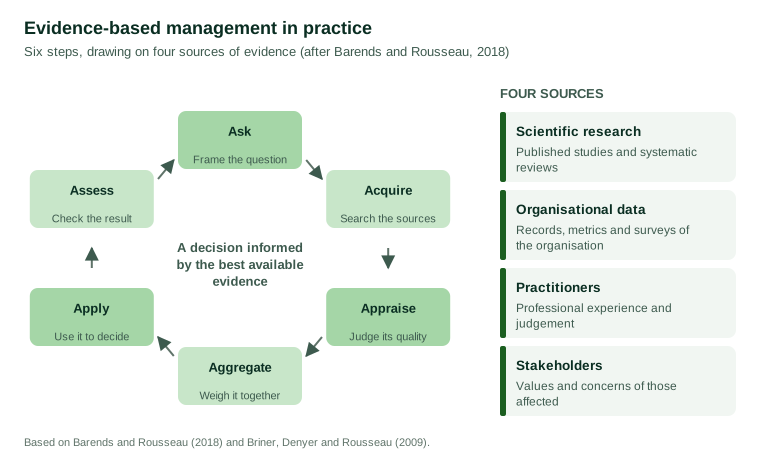
Ask. Turn a practical problem or opportunity into a clear, answerable question. A vague concern that "morale is low" becomes a question such as "what is driving the increase in staff turnover in our customer service teams, and what has been shown to reduce turnover in similar settings?"
Acquire. Search systematically for evidence from each of the four sources.
Appraise. Judge how trustworthy and relevant each piece of evidence is. A well-designed study with a large sample is more trustworthy than a single case study; data collected consistently are more trustworthy than anecdotes.
Aggregate. Weigh and bring together the evidence from different sources.
Apply. Incorporate the evidence into the decision.
Assess. Evaluate the outcome of the decision, so that the organisation learns from it.
Bringing research together
Single studies can mislead. Their results may reflect chance, particular circumstances or flaws in design. Rousseau et al. (2008) argued that management research needed to synthesise findings across studies, as medicine had done, and described several forms of research synthesis suitable for the different kinds of evidence found in management. Petticrew and Roberts (2006) provided a practical guide to systematic reviews in the social sciences, emphasising explicit methods for finding, selecting and assessing studies.
Kepes et al. (2014) warned that the published research base itself may be biased, because studies with striking or positive results are more likely to be published. They argued that evidence-based management depends on trustworthy research, and that practices such as publishing all results and replicating important findings are needed to make the cumulative evidence reliable.
Evidence from inside the organisation
Organisations can also generate their own evidence. Bloom and Van Reenen (2007) developed a survey method to measure management practices and found that better-managed firms were more productive. To test whether management practices actually caused better performance, Bloom et al. (2013) carried out a field experiment in which large textile firms in India were randomly assigned to receive intensive management consulting. Firms that adopted modern management practices substantially increased their productivity compared with similar firms that did not.
Experiments are increasingly used inside organisations. Kohavi et al. (2020) described how online businesses run large numbers of controlled experiments, often called A/B tests, in which customers are randomly assigned to different versions of a website or service so that the effect of each change can be measured. They reported that many ideas that managers expected to succeed had no effect or a negative effect when tested. Thomke (2020) argued that a culture of experimentation allows organisations to replace opinion with evidence across many kinds of decisions.
Why evidence is not used
If evidence improves decisions, why is it not used more? Research points to several obstacles.
Fashion and imitation. Abrahamson (1996) described how management fashions, techniques promoted by consultants, business schools and the business press, spread rapidly and then fade, often without evidence that they work. Organisations adopt them to appear modern and rational.
Overconfidence in judgement. Dawes et al. (1989) reviewed studies comparing expert judgement with simple statistical rules in tasks such as diagnosis and prediction, and found that the rules were generally at least as accurate as the experts, and often more so. Yet experts tend to trust their own judgement over formal methods.
Bias in the decision process. Kahneman et al. (2011) described how decisions are distorted by biases such as confirmation bias, the tendency to seek evidence that supports a preferred conclusion, and proposed a checklist that decision-makers can use to review recommendations before acting on them. Lovallo and Sibony (2010) surveyed managers about a large number of strategic decisions and found that the quality of the decision process, including whether debate was encouraged and uncertainty discussed, was more strongly related to outcomes than the amount of analysis performed.
Limited access and skills. Many managers lack access to research or the skills to judge it. Research is often written for other researchers, not for practitioners.
The role of surveys and research providers
Survey and research organisations have a natural place in evidence-based management. They produce much of the organisational and market data that managers rely on: employee surveys, customer satisfaction studies, market assessments and evaluations of programmes. The value of this evidence depends on its quality. A poorly designed staff survey or a customer study with a biased sample can mislead as easily as no evidence at all.
Research providers can support evidence-based decisions in several ways. They can help clients turn vague concerns into answerable questions. They can design studies that produce trustworthy evidence, using sound samples and well-tested questions. They can report findings with clear statements of confidence and limitations, so that clients can weigh them properly. And they can help clients compare their own data with wider research, so that organisational evidence is interpreted in the light of what is known elsewhere.
Building an evidence-based organisation
Individual managers can learn to use evidence, but lasting change depends on the organisation. Nutley et al. (2007) studied how research is used in public services and concluded that use depends less on the dissemination of findings than on the interaction between those who produce research and those who use it, and on organisational arrangements that make evidence part of routine work. They distinguished several models: research-based practitioners who seek out evidence themselves, organisations that embed evidence in guidelines and procedures, and organisational cultures in which evidence is discussed and tested as a normal part of decision-making.
In practice, organisations that make good use of evidence tend to share several features. Their leaders ask what the evidence shows before major decisions and accept findings that contradict their own views. They invest in the skills needed to find and appraise evidence. They collect reliable data on their own performance and use it to test whether decisions worked. And they treat unsuccessful decisions as opportunities to learn rather than as failures to conceal.
Criticisms and limits
Evidence-based management has its critics. Some argue that management problems are too varied and context-dependent for general research findings to apply. Others note that randomised experiments, the strongest form of evidence in medicine, are often impractical in organisations. Briner et al. (2009) responded that evidence-based management does not require any particular type of evidence, only the best available evidence for the question at hand, combined with judgement about how it applies.
Evidence also cannot settle questions of values. Whether an organisation should prioritise profit, employee welfare or environmental goals is not a question research can answer, though research can show the likely consequences of each choice. This is why stakeholder values are one of the four sources of evidence.
Conclusion
Evidence-based management asks managers to make decisions by drawing critically on the best available evidence from research, organisational data, professional expertise and the values of stakeholders. It follows a disciplined process of asking clear questions, acquiring and appraising evidence, bringing it together, applying it and assessing the results. It faces real obstacles, including management fashion, overconfidence, biased decision processes and limited access to research. But where it is practised, through systematic reviews, careful measurement, internal experiments and honest appraisal, it offers a way to make decisions that rest on more than habit and opinion. Survey and research providers, as producers of much of the evidence managers use, have a direct stake in its quality.
References
Abrahamson, E. (1996). Management fashion. Academy of Management Review, 21(1), 254–285. https://doi.org/10.5465/amr.1996.9602161572
Barends, E., & Rousseau, D. M. (2018). Evidence-based management: How to use evidence to make better organizational decisions. Kogan Page.
Bloom, N., Eifert, B., Mahajan, A., McKenzie, D., & Roberts, J. (2013). Does management matter? Evidence from India. Quarterly Journal of Economics, 128(1), 1–51. https://doi.org/10.1093/qje/qjs044
Bloom, N., & Van Reenen, J. (2007). Measuring and explaining management practices across firms and countries. Quarterly Journal of Economics, 122(4), 1351–1408. https://doi.org/10.1162/qjec.2007.122.4.1351
Briner, R. B., Denyer, D., & Rousseau, D. M. (2009). Evidence-based management: Concept cleanup time? Academy of Management Perspectives, 23(4), 19–32. https://doi.org/10.5465/amp.23.4.19
Dawes, R. M., Faust, D., & Meehl, P. E. (1989). Clinical versus actuarial judgment. Science, 243(4899), 1668–1674. https://doi.org/10.1126/science.2648573
Kahneman, D., Lovallo, D., & Sibony, O. (2011). Before you make that big decision… Harvard Business Review, 89(6), 50–60.
Kepes, S., Bennett, A. A., & McDaniel, M. A. (2014). Evidence-based management and the trustworthiness of our cumulative scientific knowledge: Implications for teaching, research, and practice. Academy of Management Learning & Education, 13(3), 446–466. https://doi.org/10.5465/amle.2013.0193
Kohavi, R., Tang, D., & Xu, Y. (2020). Trustworthy online controlled experiments: A practical guide to A/B testing. Cambridge University Press. https://doi.org/10.1017/9781108653985
Lovallo, D., & Sibony, O. (2010). The case for behavioral strategy. McKinsey Quarterly, (2), 30–43.
Nutley, S. M., Walter, I., & Davies, H. T. O. (2007). Using evidence: How research can inform public services. Policy Press.
Petticrew, M., & Roberts, H. (2006). Systematic reviews in the social sciences: A practical guide. Blackwell. https://doi.org/10.1002/9780470754887
Pfeffer, J., & Sutton, R. I. (2006a). Evidence-based management. Harvard Business Review, 84(1), 62–74.
Pfeffer, J., & Sutton, R. I. (2006b). Hard facts, dangerous half-truths, and total nonsense: Profiting from evidence-based management. Harvard Business School Press.
Rousseau, D. M. (2006). Is there such a thing as "evidence-based management"? Academy of Management Review, 31(2), 256–269. https://doi.org/10.5465/amr.2006.20208679
Rousseau, D. M., Manning, J., & Denyer, D. (2008). Evidence in management and organizational science: Assembling the field's full weight of scientific knowledge through syntheses. Academy of Management Annals, 2(1), 475–515. https://doi.org/10.5465/19416520802211651
Rynes, S. L., Colbert, A. E., & Brown, K. G. (2002). HR professionals' beliefs about effective human resource practices: Correspondence between research and practice. Human Resource Management, 41(2), 149–174. https://doi.org/10.1002/hrm.10029
Sackett, D. L., Rosenberg, W. M. C., Gray, J. A. M., Haynes, R. B., & Richardson, W. S. (1996). Evidence based medicine: What it is and what it isn't. BMJ, 312(7023), 71–72. https://doi.org/10.1136/bmj.312.7023.71
Thomke, S. H. (2020). Experimentation works: The surprising power of business experiments. Harvard Business Review Press.