
Share your view on natural beauty
Tell us whether you choose natural or organic beauty products, why, and how much you trust the labels. Your answers are combined with other people's and reported only as totals.
Start the natural and organic beauty surveyAbout 5 minutes. No account needed. You can stop at any time.
What natural and organic beauty means
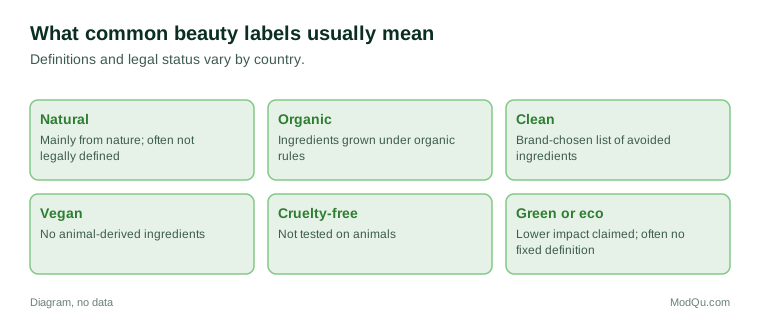
Natural and organic beauty refers to skin care, hair care, make-up and personal care products that emphasize ingredients from plants, minerals or other natural sources, and that avoid certain synthetic ingredients. The words used on packaging include:
- Natural: made mainly from ingredients found in nature, sometimes processed.
- Organic: containing ingredients grown under organic farming rules, without most synthetic pesticides and fertilizers.
- Clean: a marketing term, usually meaning free of a list of ingredients the brand chooses to avoid.
- Vegan: containing no animal-derived ingredients.
- Cruelty-free: not tested on animals, according to the brand or a certifying body.
- Green or eco: suggesting lower environmental impact, often without a fixed definition.
These words are not interchangeable. A product can be vegan but not organic, or natural but not cruelty-free.
Which terms are regulated
In many countries, the word "natural" on cosmetics has no legal definition. "Organic" is more often defined for food than for cosmetics, and the rules for cosmetics vary:
- Some countries apply their food organic rules to agricultural ingredients in cosmetics, so an "organic" claim must meet those standards.
- Some rely on private certification schemes that set their own rules for the share of organic and natural ingredients.
- Many have general rules that cosmetic claims must not mislead consumers, enforced by advertising or consumer protection bodies.
The International Organization for Standardization (ISO) has published a standard, ISO 16128, with guidelines for calculating how much of a cosmetic product comes from natural or organic sources. It sets out methods for calculating, not a label that consumers see.
Separately, many countries, as well as the European Union, ban or restrict cosmetics testing on animals, while others have required it for some imported products.
Example
A shopper picks up two face creams. One says "natural" in large letters on the front. The other has a smaller logo from a certification body and a statement that 95% of its ingredients are of natural origin. She reads the ingredient lists and chooses the certified one, though it costs more.
Certification schemes
Certification bodies check products against their own standards and allow certified products to carry a logo. Schemes differ in:
- The minimum share of natural or organic ingredients.
- Which synthetic ingredients are allowed, for example certain preservatives.
- Rules on packaging and environmental impact.
- Whether they check the whole product or only some ingredients.
- How often they inspect manufacturers.
Shoppers often find the number of logos confusing, and some cannot tell a certified logo from a brand's own design.
Why people choose these products
People give many reasons for choosing natural or organic beauty products:
- Concern about specific ingredients, such as certain preservatives, fragrances or colourings.
- Sensitive skin, and a belief that natural products are gentler.
- Environmental reasons, such as farming methods and biodegradability.
- Animal welfare, linked to vegan and cruelty-free claims.
- Personal values and lifestyle, including wider interest in organic food.
- Recommendations from friends, family or people they follow online.
Common misunderstandings
Some beliefs about natural beauty are widely held but not always accurate:
- "Natural means safe." Many natural ingredients, such as some essential oils, can cause irritation or allergies.
- "Synthetic means harmful." Many synthetic ingredients are well tested and widely used safely, and some are identical to substances found in nature.
- "Preservative-free is always better." Preservatives stop the growth of bacteria and mould in water-based products. Products without them may spoil faster.
- "Organic means all ingredients are organic." Many organic products contain a share of organic ingredients plus water and other ingredients.
In most countries, cosmetics must meet safety rules whatever their ingredients. Regulators such as those in the European Union, the United States, Japan and many other countries set lists of allowed and banned substances.
Example
A person with sensitive skin switches to a lotion labelled "all natural" and develops a rash. A pharmacist reads the ingredients and points out a plant extract that commonly causes reactions. The person learns to check ingredient lists rather than relying on the front label.
Price and value
Natural and organic beauty products are often priced higher than standard products. Reasons given by makers include more expensive ingredients, certification costs and smaller production runs. Shoppers weigh the price against what they believe they are getting.
Example (hypothetical figures)
A person buys shampoo, conditioner and body wash every month. Standard versions cost 4, 4 and 3 in their local currency, a total of 11. Certified organic versions cost 9, 9 and 7, a total of 25. Switching all three would cost 14 more a month, or 168 more a year.
Trust in labels
Trust in natural and organic labels varies. Common concerns include:
- Greenwashing, when a product is presented as more natural or environmentally friendly than it is.
- Vague words with no fixed meaning.
- Too many logos, which make comparison hard.
- Small print, such as ingredient percentages hidden on the back.
- Influencer marketing, where it may be unclear whether a recommendation is paid.
Consumer bodies in several countries have acted against misleading environmental and natural claims. Some shoppers rely on independent apps or websites that rate products, while others trust particular brands or shops.
Trends and debates
Current trends include:
- Ingredient transparency, with brands publishing full lists and sources.
- Refillable and low-waste packaging.
- Solid products, such as shampoo bars.
- Traditional ingredients and local brands from many regions.
- Debates about "clean beauty" lists, which some scientists criticize for causing unnecessary fear of safe ingredients.
What people and businesses want to know
Questions businesses want answered include how many people choose natural or organic beauty products, which products, why, how much more they will pay, which labels and logos they recognize, and how much they trust them.
Key terms
- NaturalMade mainly from ingredients found in nature; often not legally defined for cosmetics.
- OrganicContaining ingredients grown under organic farming rules.
- Clean beautyA marketing term for products free of ingredients a brand chooses to avoid.
- VeganContaining no animal-derived ingredients.
- Cruelty-freeNot tested on animals, according to the brand or a certifier.
- CertificationIndependent checking of a product against a published standard.
- PreservativeAn ingredient that stops bacteria and mould growing in a product.
- GreenwashingPresenting a product as more natural or eco-friendly than it is.
Full glossary: cosmetic science terms on EditingTests.com.
Natural and organic beauty vocabulary test
How well do you know the language of this topic? Try 8 quick questions. Your score is shown straight away and is not saved.
What the natural and organic beauty survey asks
This survey is part of ModQu's Beauty and Personal Care survey. The natural and organic beauty part takes about five minutes and covers:
- Whether you choose natural, organic, vegan or cruelty-free beauty and personal care products.
- Which products you buy in these versions, and why.
- How much more you are willing to pay for them.
- Which labels or certification logos you recognize and trust.
- How often you read ingredient lists.
- Whether a label has ever misled you, and what you did.
After that you can choose to continue with other short parts of the Beauty and Personal Care survey, such as skin care or hair care and salons, or stop.
Ready to take part?
Your answers help show what people really think and do. Results are only ever reported as totals; no one can see your individual answers.
Start the surveyQuestions about this survey
Who can take part?
Adults who buy beauty or personal care products.
Do I have to give my name?
No. You may be asked for your age group, region and similar details so results can be broken down, but not your name. ModQu never asks for passwords, card numbers or account numbers.
How are the results used?
Answers are combined into totals and percentages and published in ModQu reports. Individual answers are never shown.
Is the vocabulary test part of the survey?
No. It is optional and separate, and your score is not stored.
Are natural beauty products always better for the environment?
Not always. Environmental impact depends on how ingredients are grown or made, how far they travel and the packaging, not only on whether they are natural.
Why do some organic products still contain synthetic ingredients?
Many certification schemes allow a small share of approved synthetic ingredients, such as certain preservatives, so that products stay safe to use.