
Share your sun protection habits
Tell us how often you use sunscreen, which products you choose and whether you have been sunburned. Your answers are combined with other people's and reported only as totals.
Start the sun protection surveyAbout 5 minutes. No account needed. You can stop at any time.
Why sun protection matters
The sun gives off ultraviolet (UV) radiation, which cannot be seen or felt. Two kinds reach the ground in large amounts:
- UVB, which mainly affects the outer layer of skin and is the main cause of sunburn.
- UVA, which reaches deeper into the skin and is linked to skin ageing, such as wrinkles and dark spots.
Both kinds contribute to skin damage and to the risk of skin cancer, according to health bodies such as the World Health Organization. The amount of UV depends on the time of day, the season, the latitude, the altitude, cloud cover, and reflection from surfaces such as snow, sand and water. UV is usually strongest around the middle of the day and near the equator, but it can be high in mountains or on snow even when the air is cold.
Skin types also differ. People with fair skin that burns easily are more sensitive to sunburn, but people with darker skin can also burn and can develop sun damage and skin cancer.
The UV index
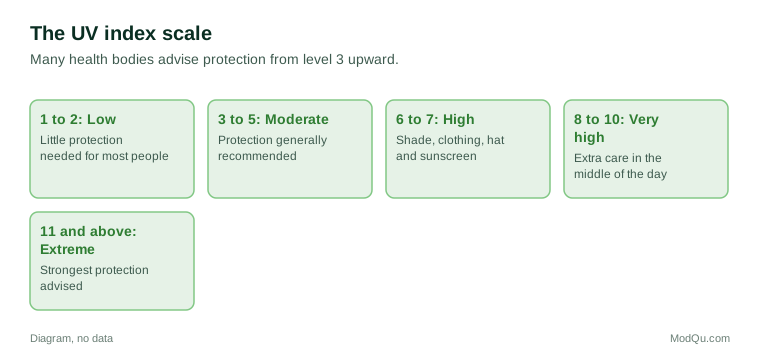
The UV index is an international scale, promoted by the World Health Organization and other bodies, that shows how strong UV radiation is on a given day. It is often included in weather forecasts and apps.
- 1 to 2: low. Little protection needed for most people.
- 3 to 5: moderate. Protection is generally recommended.
- 6 to 7: high.
- 8 to 10: very high.
- 11 and above: extreme.
Many health bodies advise extra protection, such as shade, clothing and sunscreen, when the index is 3 or above.
Sunscreen labels explained
Sunscreen labels can be confusing. The main terms are:
- SPF (sun protection factor): a measure of protection against UVB and sunburn in laboratory tests. Higher numbers give more protection, but the difference gets smaller at higher levels.
- Broad spectrum: in some countries, such as the United States, a label showing that the product also protects against UVA.
- UVA ratings: in other places, a UVA logo, a star rating or a PA rating (used in parts of Asia, such as Japan and South Korea) shows the level of UVA protection.
- Water resistant: the product keeps working for a set time, often 40 or 80 minutes, while swimming or sweating. No sunscreen is fully waterproof.
- Mineral and chemical filters: mineral sunscreens use ingredients such as zinc oxide or titanium dioxide; chemical or organic filters absorb UV. Many products combine both.
How sunscreen is tested and labelled is set by national or regional rules, so the same product may carry different labels in different countries.
Example
A traveller buys sunscreen abroad and finds the label shows "PA++++" instead of the UVA symbol they are used to at home. They look up the rating and learn it is a measure of UVA protection used in several Asian countries.
Using sunscreen
Studies have found that many people apply less sunscreen than the amount used in laboratory tests, which means they get less protection than the SPF suggests. Health bodies commonly give advice like:
- Apply a generous amount to all exposed skin.
- Apply before going out in the sun.
- Reapply regularly, especially after swimming, sweating or towelling.
- Do not use sunscreen to spend longer in the sun than you otherwise would.
- Check the expiry date.
Sunscreen is one part of protection, not a complete shield. Many health bodies describe it as a last line of defence after shade and clothing.
Example (hypothetical figures)
A family of four goes to the beach for a week. If each person uses about 30 millilitres a day on exposed skin, the family needs about 120 millilitres a day, or 840 millilitres for the week. They had packed one 200 millilitre bottle, which would last less than two days.
Other ways to protect the skin
Protection goes beyond sunscreen:
- Shade: under trees, umbrellas or shelters, especially in the middle of the day.
- Clothing: long sleeves, long trousers or skirts, and tightly woven fabrics. Some clothing carries an ultraviolet protection factor (UPF) rating.
- Hats: wide brims protect the face, ears and neck better than caps.
- Sunglasses: which protect the eyes from UV; look for labels that show UV protection.
- Timing: planning outdoor activities for the morning or later afternoon.
Several countries run public campaigns that combine these steps. Australia's long-running sun safety messages, for example, encourage people to cover up, apply sunscreen, wear a hat, seek shade and wear sunglasses.
Children and sun protection
Children's skin is generally more sensitive, and health bodies often recommend keeping babies out of direct sun. Schools in some countries have sun protection policies, such as "no hat, no play" rules, shaded play areas and time to apply sunscreen. Parents often find it hard to get children to wear hats and to reapply sunscreen, especially during long days outside.
Myths and disagreements
Several beliefs about the sun are common but not supported by health bodies:
- "You cannot burn on a cloudy day." UV can pass through clouds.
- "A tan protects you." A tan offers only limited protection and is itself a sign of skin damage.
- "Darker skin never needs protection." It is less likely to burn but is not immune to damage.
- "Sunscreen is only for the beach." Everyday activities, such as walking or gardening, add up.
People also discuss the balance between sun protection and vitamin D, which the body makes when skin is exposed to sunlight. Advice on this varies between countries and depends on climate, skin type and season. Some people raise concerns about sunscreen ingredients and their effects on coral reefs, and some places have restricted certain ingredients for that reason.
Example
A gardener spends several hours outside on a cloudy spring day and does not use sunscreen. By the evening the back of their neck is red and sore. They start wearing a wide-brimmed hat and keep a bottle of sunscreen in the garden shed.
What people and businesses want to know
Questions businesses and health bodies want answered include how often people use sunscreen, which SPF and type they choose, where they buy it, whether they reapply it, which other protection they use, how often they get sunburned, and what they believe about the sun and tanning.
Key terms
- Ultraviolet (UV) radiationInvisible energy from the sun that can burn and damage skin.
- UVAUltraviolet rays that reach deeper into the skin and are linked to ageing.
- UVBUltraviolet rays that are the main cause of sunburn.
- SPFSun protection factor, a measure of protection against UVB.
- Broad spectrumA label showing protection against both UVA and UVB.
- UV indexA scale showing how strong UV radiation is on a given day.
- Water resistantStill effective for a stated time while swimming or sweating.
- UPFUltraviolet protection factor, a rating for fabrics.
Full glossary: dermatology terms on EditingTests.com.
Sun protection vocabulary test
How well do you know the language of this topic? Try 8 quick questions. Your score is shown straight away and is not saved.
What the sun protection survey asks
This survey is part of ModQu's Beauty and Personal Care survey. The sun protection part takes about five minutes and covers:
- How often you use sunscreen, on your face and body, in different seasons.
- Which SPF and type of sunscreen you choose, and where you buy it.
- Whether you reapply sunscreen, and how often.
- Which other protection you use, such as shade, hats, clothing or sunglasses.
- Whether you have been sunburned in the last year.
- What you believe about tanning, vitamin D and sunscreen ingredients.
After that you can choose to continue with other short parts of the Beauty and Personal Care survey, such as skin care or hair care and salons, or stop.
Ready to take part?
Your answers help show what people really think and do. Results are only ever reported as totals; no one can see your individual answers.
Start the surveyQuestions about this survey
Who can take part?
Adults.
Do I have to give my name?
No. You may be asked for your age group, region and similar details so results can be broken down, but not your name. ModQu never asks for passwords, card numbers or account numbers.
How are the results used?
Answers are combined into totals and percentages and published in ModQu reports. Individual answers are never shown.
Is the vocabulary test part of the survey?
No. It is optional and separate, and your score is not stored.