
Share your experience of skin care
Tell us what you use on your skin, how you choose it and what you spend. Your answers are combined with other people's and reported only as totals.
Start the skin care surveyAbout 5 minutes. No account needed. You can stop at any time.
What skin care covers
Skin care is everything people do to clean, protect and treat the skin of the face and body. Most of it happens at home with products bought from pharmacies, supermarkets, department stores and online shops. A smaller part involves professionals: estheticians who give facials, and doctors who diagnose and treat skin conditions.
The products fall into a few broad groups:
- Cleansers, from plain soap to gels, foams, oils and micellar water.
- Moisturizers, which reduce water loss from the skin and come as lotions, creams and balms.
- Sunscreens, which protect against ultraviolet (UV) radiation from the sun.
- Treatment products, such as serums, toners, exfoliants and spot treatments, aimed at a particular concern like dryness, uneven tone or breakouts.
- Medicated products, some sold over the counter and some only on prescription, for conditions such as acne, eczema and rosacea.
In Canada, most skin care products are regulated as cosmetics by Health Canada, which requires ingredient labels and keeps a list of restricted and prohibited ingredients. Products that make a therapeutic claim, such as sunscreens and acne treatments, are regulated more strictly as drugs or natural health products. In the United States, the Food and Drug Administration (FDA) plays a similar role.
Routines: from one step to many
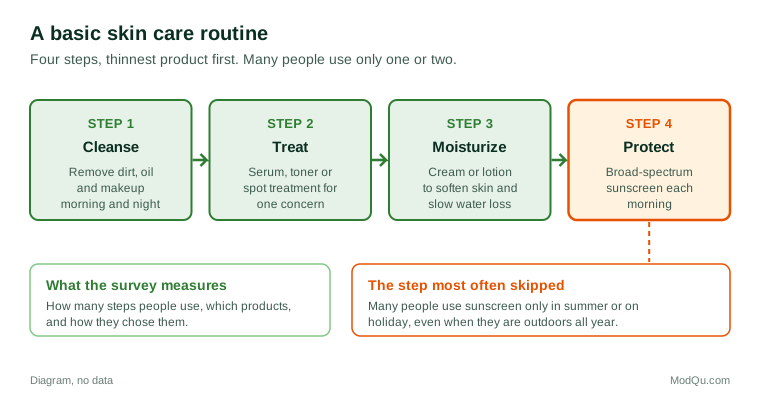
A skin care routine is the set of products a person uses, and the order in which they use them. Routines vary widely. Some people wash with whatever soap is in the shower and use nothing else. Others follow a morning and an evening routine with several steps, and change products with the seasons.
A common basic routine has three steps: cleanse, moisturize and, in the morning, apply sunscreen. Longer routines add products in between, often applied from the thinnest texture to the thickest.
Example
A university student uses a cleanser and moisturizer bought at a pharmacy, plus a spot treatment when they have a breakout. After watching skin care videos, they add a serum and a toner. Within a month their skin feels tight and irritated. They drop back to three products and add a daily sunscreen, which they had not used before.
The example shows something that comes up often in skin care surveys: more products do not always mean better results, and people often add and remove steps by trial and error.
How people choose products
People choose skin care products for many reasons, and the reasons change with age, budget and skin type. Common factors include:
- Skin type and concern: dry, oily, combination or sensitive skin, and goals such as fewer breakouts or less redness.
- Recommendations from friends, family, pharmacists, estheticians and dermatologists.
- Online content: reviews, tutorials and posts by people who share their routines.
- Ingredients: some people look for particular active ingredients, others avoid fragrance, alcohol or certain preservatives.
- Price and size: what a product costs and how long it lasts.
- Packaging and claims: words such as "gentle", "non-comedogenic" or "dermatologist tested" on the label.
Many claims on skin care packaging are marketing language rather than regulated terms. "Hypoallergenic", for example, has no single legal definition in Canada. Knowing which words carry a set meaning and which do not is part of what the vocabulary test on this page covers.
Ingredients and labels
Ingredient lists on cosmetics in Canada and the United States use the International Nomenclature of Cosmetic Ingredients (INCI), so the same ingredient has the same name on every label. Ingredients are listed in descending order by amount, down to those present at about one percent, after which they can be listed in any order.
Some ingredients appear often in discussions of skin care:
- Humectants such as glycerin and hyaluronic acid, which draw water into the outer layer of the skin.
- Emollients and occlusives such as oils, shea butter and petrolatum, which soften the skin and slow water loss.
- Exfoliants, including alpha hydroxy acids (AHAs) such as glycolic and lactic acid, and beta hydroxy acid (BHA), usually salicylic acid.
- Retinoids, a family of vitamin A compounds, some sold in cosmetics and stronger forms available only on prescription.
- Sunscreen filters, which in Canada are listed as medicinal ingredients on the label.
People react differently to the same ingredient. Something that suits one person can irritate another, which is why patch testing a new product on a small area is often suggested.
Sun protection
Sunscreen is the skin care product most often recommended by health bodies, and also one of the most often skipped. Sunscreens in Canada carry a sun protection factor (SPF) that measures protection against UVB rays, which cause sunburn. Products labelled "broad spectrum" also protect against UVA rays, which reach deeper into the skin.
People give many reasons for not using sunscreen every day: they forget, they dislike the feel or the white cast, they think they do not need it in winter or on cloudy days, or they find it expensive. Others use it only on holiday or at the beach.
Example
A gardener uses sunscreen in July and August but not in spring, when they spend just as many hours outdoors. When asked why, they say the sun "doesn't feel strong" in April. After a pharmacist explains that UV levels can be high on cool days, they keep a bottle by the back door.
Costs and where people buy
Spending on skin care varies more than almost any other personal care category. One person may spend a few dollars a year on soap and petroleum jelly, while another buys serums that cost more than a week's groceries. Price is not a reliable guide to how well a product works: an inexpensive moisturizer and an expensive one can share most of their ingredients.
Example (hypothetical figures)
A shopper compares two moisturizers. One costs $14 for 100 ml and the other $62 for 50 ml. Per millilitre, the first costs $0.14 and the second $1.24, nearly nine times as much. Reading the labels, they find the first five ingredients are almost the same. They buy the cheaper one and spend the difference on sunscreen.
Products are sold in pharmacies, supermarkets, department store counters, specialty beauty shops, by estheticians and online. Subscription boxes and sample sizes let people try products before buying full sizes.
When people see a dermatologist
A dermatologist is a medical doctor who specializes in skin, hair and nails. In Canada, a visit to a dermatologist covered by a provincial health plan usually needs a referral from a family doctor or nurse practitioner, and waits can be long. Some people pay privately for cosmetic services at dermatology clinics, which are not covered.
People see a dermatologist for problems such as persistent acne, eczema, psoriasis, rosacea, rashes that do not clear, hair loss, and moles or spots that change. Checking skin for changes is something health bodies encourage. This page describes skin care in general and is not medical advice: anyone worried about their skin should speak to a health professional.
What people disagree about
Skin care is full of strong opinions. Common debates include whether long routines are worth it, whether "clean" or "natural" products are safer (the words have no regulated meaning), how much to trust online reviews and influencer posts, whether men's products differ from anyone else's, and how early children and teenagers should start using active ingredients. Questions that businesses want answered include how many products people use, how they find new ones, how much they trust ingredient claims and what would make them switch.
Key terms
- CleanserA product that removes dirt, oil and makeup from the skin.
- MoisturizerA product that softens the skin and reduces water loss.
- SPFSun protection factor, a measure of protection against the UVB rays that cause sunburn.
- Broad spectrumA sunscreen label meaning it also protects against UVA rays.
- Non-comedogenicA claim that a product is made not to block pores.
- ExfoliantA product that removes dead cells from the surface of the skin, by acid or by scrubbing.
- Patch testTrying a new product on a small area of skin first to check for a reaction.
- DermatologistA medical doctor who specializes in skin, hair and nails.
Full glossary: cosmetic dermatology terms on EditingTests.com.
Skin care vocabulary test
How well do you know the language of this topic? Try 8 quick questions. Your score is shown straight away and is not saved.
What the skin care survey asks
This survey is part of ModQu's Beauty and Personal Care survey. The skin care part takes about five minutes and covers:
- How many skin care products you use on a typical day, and which kinds.
- How you choose products: advice, reviews, ingredients, price or habit.
- How often you use sunscreen, and in which seasons.
- Where you buy skin care and roughly what you spend in a year.
- Whether you have seen a dermatologist or esthetician about your skin.
- Which claims and ingredients you trust or avoid.
After that you can choose to continue with other short parts of the Beauty and Personal Care survey, such as hair care and salons or makeup and cosmetics, or stop.
Ready to take part?
Your answers help show what people really think and do. Results are only ever reported as totals; no one can see your individual answers.
Start the surveyQuestions about this survey
Who can take part?
Adults.
Do I have to give my name?
No. You may be asked for your age group, region and similar details so results can be broken down, but not your name. ModQu never asks for passwords, card numbers or account numbers.
How are the results used?
Answers are combined into totals and percentages and published in ModQu reports. Individual answers are never shown.
Is the vocabulary test part of the survey?
No. It is optional and separate, and your score is not stored.