
Share your experience of makeup
Tell us what makeup you use, where you buy it and how you choose it. Your answers are combined with other people's and reported only as totals.
Start the makeup and cosmetics surveyAbout 5 minutes. No account needed. You can stop at any time.
What makeup and cosmetics cover
In everyday speech, makeup means colour products applied to the face, eyes, lips and nails. In Canadian law, "cosmetics" is a wider term that also covers skin care, hair care, deodorant, soap and fragrance. This page focuses on colour cosmetics. Other pages in the Beauty and Personal Care survey cover skin care, hair and fragrance.
The main kinds of makeup are:
- Face: primer, foundation, tinted moisturizer, concealer, powder, blush, bronzer, highlighter and setting spray.
- Eyes: eyeshadow, eyeliner, mascara, brow pencils and gels, and false lashes.
- Lips: lipstick, lip gloss, lip liner, lip stain and tinted balm.
- Nails: nail polish, gel polish and press-on nails.
- Tools: brushes, sponges, sharpeners and removers.
In Canada, cosmetics must be notified to Health Canada and labelled with their ingredients, and the Cosmetic Ingredient Hotlist lists ingredients that are restricted or prohibited. In the United States, the Food and Drug Administration oversees cosmetics.
Who wears makeup and why
People wear makeup for different reasons: to look polished at work, to cover blemishes or redness, for confidence, for fun and self-expression, for performance, or for special events such as weddings and photographs. Some people wear it every day, some only on weekends or evenings, and some never. Use also changes with age, work and life stage, for example when people start working from home.
Example
An office worker wore a full face of makeup five days a week before moving to remote work. Now they wear tinted moisturizer and mascara for video calls and full makeup only on weekends out. Their spending on foundation has dropped, but they buy more lip products than before.
The example shows why surveys about makeup ask not just whether people wear it but how often, for what occasions and which products, because these change separately.
Where people buy makeup
Makeup is sold in many places, each with its own strengths:
- Pharmacies and supermarkets, which carry lower-priced brands and are easy to visit.
- Department store counters, with consultants, testers and higher-priced brands.
- Specialty beauty retailers, which stock many brands under one roof and often run loyalty programs.
- Online stores and brand websites, which offer wide ranges and home delivery.
- Social media shopping, where products can be bought from a post or a live video.
- Direct sellers who sell to friends and neighbours, at parties or online.
Many people use more than one: they buy mascara at the pharmacy and foundation at a beauty store where they can be matched.
How people try new products
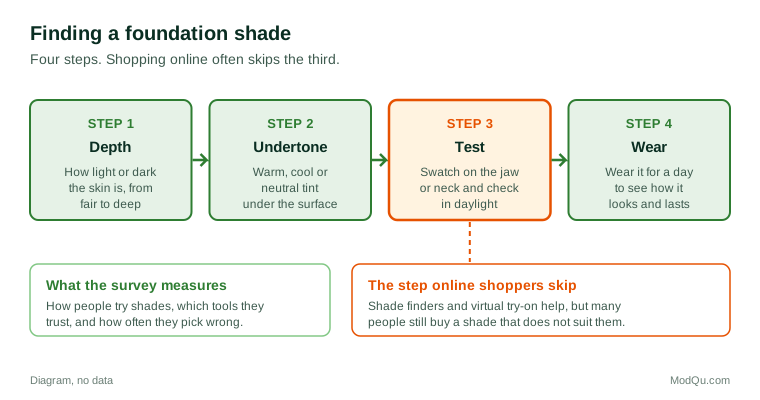
Trying a new product is one of the hardest parts of buying makeup, especially shades. A foundation that looks right in the bottle or on a screen can look different on skin and in daylight. People try new products in several ways:
- testers and samples in stores;
- shade matching by a consultant;
- online shade finders and virtual try-on tools that use a phone camera;
- sample sizes, minis and gift sets;
- reviews, swatches and tutorials posted by other users;
- return policies that accept used products.
Example (hypothetical figures)
A shopper buys three foundations online in one year at $42 each, trying to find a match. Two are the wrong shade and are not returned. Of the $126 spent, $84 went on products they no longer use. The next year they go to a store, get matched, and buy one bottle that suits them.
Questions that businesses want answered here include how often people buy a shade that does not suit them, which try-on methods they trust, and whether return policies affect where they shop.
Shade ranges and inclusion
For many years, people with deeper and very fair skin tones found few foundation and concealer shades that matched them, and drugstores often carried a narrow range. Many brands have since expanded their shade ranges, and shade range is now one of the things people compare. Undertone (warm, cool or neutral) matters as much as how light or dark a shade is.
Clean, natural, vegan and cruelty-free
Makeup labels carry many claims. Some have set meanings and others do not:
- "Clean" and "natural" have no regulated definition in Canada or the United States. Each brand uses its own list of ingredients it leaves out.
- "Vegan" usually means the product contains no animal-derived ingredients, such as beeswax, carmine or lanolin. Certification schemes exist but are voluntary.
- "Cruelty-free" usually means the product and its ingredients were not tested on animals. Canada banned cosmetic animal testing and the sale of cosmetics relying on new animal testing data through amendments to the Food and Drugs Act passed in 2023. Third-party logos have their own rules.
- "Hypoallergenic" and "dermatologist tested" suggest a product is less likely to cause reactions, but the testing behind them varies.
Example
A parent buys their teenager makeup labelled "clean" because they assume it is safer. When they read the ingredient list, they find it is very similar to a lower-priced product at the pharmacy. They decide the label tells them more about the brand's marketing than about safety.
People disagree about whether "clean beauty" helps shoppers or causes needless worry about safe ingredients. Health Canada's position is that cosmetics sold legally in Canada must be safe when used as directed, whatever the label says.
Costs, expiry and waste
Makeup ranges from a few dollars to well over fifty for a single item. Many people mix low- and high-priced products, spending more on items they use daily or that are hardest to match. Makeup also expires: an open jar symbol with a number such as "12M" shows how many months a product is meant to last after opening. Mascara is usually replaced most often because it can harbour bacteria.
Waste is a growing concern. Many products come in small, mixed-material packages that are hard to recycle, and half-used products are often thrown away. Refillable compacts, recycling programs run by stores and brands, and buying fewer products are some of the responses.
What people disagree about
Common debates include whether expensive makeup is better than lower-priced makeup, whether social media trends push people to buy too much, how young is too young to start wearing makeup, whether men's makeup is becoming mainstream, and whether virtual try-on tools are accurate. These are questions where survey results often split by age group.
Key terms
- FoundationA face product that evens out skin tone, in liquid, cream, stick or powder form.
- ConcealerA thicker product used to cover blemishes, redness or dark circles.
- UndertoneThe warm, cool or neutral tint beneath the surface of the skin.
- SwatchA small sample of a product applied to the skin to show its colour.
- PrimerA product applied before makeup to help it last or go on smoothly.
- Cruelty-freeA claim that a product and its ingredients were not tested on animals.
- Period after openingA symbol showing how many months a product lasts once opened.
- Setting sprayA mist used after makeup to help it stay in place.
Full glossary: cosmetic science terms on EditingTests.com.
Makeup and cosmetics vocabulary test
How well do you know the language of this topic? Try 8 quick questions. Your score is shown straight away and is not saved.
What the makeup and cosmetics survey asks
This survey is part of ModQu's Beauty and Personal Care survey. The makeup and cosmetics part takes about five minutes and covers:
- Which makeup products you use, and how often.
- Where you buy makeup, online and in stores.
- How you try new products and shades before buying.
- Whether you look for clean, vegan or cruelty-free products, and what those labels mean to you.
- How much you spend on makeup in a typical year.
- Where you get ideas: friends, consultants, videos or reviews.
After that you can choose to continue with other short parts of the Beauty and Personal Care survey, such as skin care or hair care and salons, or stop.
Ready to take part?
Your answers help show what people really think and do. Results are only ever reported as totals; no one can see your individual answers.
Start the surveyQuestions about this survey
Who can take part?
Adults who wear makeup.
Do I have to give my name?
No. You may be asked for your age group, region and similar details so results can be broken down, but not your name. ModQu never asks for passwords, card numbers or account numbers.
How are the results used?
Answers are combined into totals and percentages and published in ModQu reports. Individual answers are never shown.
Is the vocabulary test part of the survey?
No. It is optional and separate, and your score is not stored.