
Share your grooming routine
Tell us how often you visit a barber, which grooming products you use and what you spend. Your answers are combined with other people's and reported only as totals.
Start the barbers and men's grooming surveyAbout 5 minutes. No account needed. You can stop at any time.
What men's grooming covers
Men's grooming is the care men give to their hair, face and body to look and feel the way they want. It includes:
- Haircuts, at a barber shop, a unisex salon or at home.
- Beard and moustache care, including trimming, shaping and conditioning.
- Shaving, with razors, electric shavers or by a barber.
- Skin care, such as cleansers, moisturizers and sunscreen.
- Hair products, such as shampoo, styling wax, pomade, gel and hair dye.
- Body care, including deodorant, body wash and body hair trimming.
- Fragrance, such as aftershave and cologne.
Routines range from a quick wash and shave to multi-step care with several products. Age, culture, work, religion and personal style all influence what men do.
Barber shops and salons
Barber shops have a long history in many cultures, and in many places they are social spaces as well as places to get a haircut. Common services include:
- Haircuts with clippers and scissors.
- Fades, in which hair is cut very short at the sides and gradually longer towards the top.
- Beard trims and shaping, sometimes with a hot towel.
- Traditional wet shaves with a straight razor.
- Line-ups or edge-ups, which sharpen the hairline.
- Hair colouring and treatments, in some shops.
Men choose between traditional barbers, modern barber shops with booking apps, unisex salons and home haircuts. In many cities, walk-in barbers sit alongside shops that work by appointment only. Some barbers specialize in certain hair textures, which matters to many customers with curly or tightly coiled hair.
Example
A man in his twenties tries three barbers near his new job before he finds one who cuts his curly hair the way he likes. He now books the same barber every three weeks through an app and follows the shop's social media for new styles.
How often men get haircuts
The time between cuts depends mainly on the style. Very short styles and fades lose their shape quickly, so some men visit every two to three weeks. Longer styles may only need a trim every two or three months. Other factors include cost, the time available, the importance of appearance at work, and whether someone at home cuts their hair.
Many men learned to cut their own hair, or had a family member do it, during periods when barber shops were closed, and some continued afterwards to save money.
Beards and shaving
Facial hair choices vary widely, from clean-shaven to full beards. Popular options include stubble, short boxed beards, full beards, goatees and moustaches. Some men wear beards for religious or cultural reasons.
Shaving methods each have trade-offs:
- Cartridge razors: quick and widely sold, but replacement cartridges can be expensive.
- Safety razors: a single replaceable blade, cheaper blades, but more care needed.
- Electric shavers: fast and less likely to cause cuts, but may not shave as closely.
- Straight razors: very close shaves, usually used by barbers or experienced users.
- Trimmers: for keeping stubble or beards at a set length.
Common problems include razor burn and ingrown hairs, especially for men with curly facial hair. Beard care products include beard oil, balm, wash and combs.
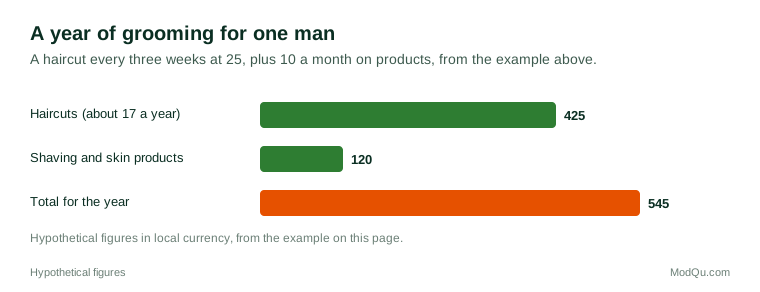
Example (hypothetical figures)
A man spends 25 in their local currency on a haircut every three weeks, or about 17 cuts a year, which comes to 425. He also spends 10 a month on shaving and skin products, or 120 a year. His yearly grooming spending is therefore about 545.
Skin care and products
Men's skin care has grown in many countries. Products sold specifically for men often have different packaging, scents and marketing, though many contain similar ingredients to products for anyone. Common items include:
- Face wash and cleansers.
- Moisturizers, sometimes with sun protection.
- Aftershave balms, for after shaving.
- Eye creams and serums, used by a smaller group.
- Lip balm.
Some men use products made for women or for everyone, often because they are cheaper or come in more choices. Others prefer products clearly labelled for men.
Costs and spending
What men spend on grooming varies by country, city and personal routine. Costs include:
- Haircuts, which can range from very low prices at simple barbers to high prices at premium shops.
- Beard trims and shaves, sometimes sold with haircuts as a package.
- Tips, where tipping is expected.
- Razors, blades and shavers.
- Hair and skin products.
- Trimmers and clippers for home use.
Some barber shops offer monthly memberships that include a set number of cuts.
Example
A retired man has been clean-shaven for forty years but decides to grow a beard. After two months he visits a barber for the first time in years to have it shaped, and buys a trimmer to keep it the same length at home.
Trends and debates
Several trends are changing men's grooming:
- Growth of barber culture, with styled shops, appointment apps and barbers who build a following online.
- More men using skin care, influenced by social media and changing ideas of masculinity.
- Home grooming tools, such as trimmers and clippers.
- Subscription razors and products, delivered by post.
- Interest in natural ingredients, beard oils and sensitive-skin products.
- Training and regulation of barbers, which in some countries requires a licence and in others does not.
People hold different views on whether men's products should be marketed separately, on how much grooming men should do, and on whether prices for men's and women's haircuts should differ.
What people and businesses want to know
Questions businesses want answered include how often men visit a barber, where they go, how they book, what they spend, which products they use, where they buy them and what would make them try a new product or shop.
Key terms
- FadeA haircut cut very short at the sides that gets gradually longer towards the top.
- Line-upSharpening the hairline and edges with clippers or a razor.
- ClippersAn electric tool with guards for cutting hair to a set length.
- Safety razorA razor that holds a single replaceable blade.
- Straight razorA single open blade used for very close shaves.
- Razor burnIrritation and redness after shaving.
- Ingrown hairA hair that curls back and grows into the skin.
- Beard oilAn oil used to soften facial hair and moisturize the skin underneath.
Full glossary: hairdressing terms on EditingTests.com.
Barbers and men's grooming vocabulary test
How well do you know the language of this topic? Try 8 quick questions. Your score is shown straight away and is not saved.
What the barbers and men's grooming survey asks
This survey is part of ModQu's Beauty and Personal Care survey. The barbers and men's grooming part takes about five minutes and covers:
- How often you have a haircut, and where: a barber, a salon or at home.
- How you choose and book your barber.
- Whether you have a beard or shave, and which tools you use.
- Which grooming and skin care products you use regularly.
- How much you spend on haircuts and products in a typical month.
- What would make you try a new barber or product.
After that you can choose to continue with other short parts of the Beauty and Personal Care survey, such as skin care or hair care and salons, or stop.
Ready to take part?
Your answers help show what people really think and do. Results are only ever reported as totals; no one can see your individual answers.
Start the surveyQuestions about this survey
Who can take part?
Men aged 16 and over.
Do I have to give my name?
No. You may be asked for your age group, region and similar details so results can be broken down, but not your name. ModQu never asks for passwords, card numbers or account numbers.
How are the results used?
Answers are combined into totals and percentages and published in ModQu reports. Individual answers are never shown.
Is the vocabulary test part of the survey?
No. It is optional and separate, and your score is not stored.
How long does a typical barber appointment take?
A simple clipper cut can take 15 to 20 minutes, while a detailed fade with a beard trim and hot towel can take 45 minutes or more.
Do barbers need a licence?
It depends on the country and region. Some require formal training and a licence, while others have no specific rules for barbers.