
Share your oral care routine
Tell us which toothbrush and products you use, whether you have whitened your teeth and where you shop. Your answers are combined with other people's and reported only as totals.
Start the oral care and teeth whitening surveyAbout 5 minutes. No account needed. You can stop at any time.
What oral care covers
Oral care is looking after the teeth, gums and mouth. It includes daily habits at home, such as brushing and cleaning between the teeth, and professional care from dentists and dental hygienists. Good oral care is linked by health bodies to fewer cavities and gum problems, and to general health and wellbeing. The World Health Organization has described oral diseases as among the most common health conditions worldwide.
Everyday oral care usually includes:
- Brushing, commonly recommended twice a day.
- Using a fluoride toothpaste, which health bodies in many countries recommend.
- Cleaning between the teeth, with floss, interdental brushes or water flossers.
- Mouthwash, used by some people as an extra step.
- Tongue cleaning, with a brush or scraper.
- Regular dental check-ups and cleaning, where available and affordable.
This page describes products and habits. It does not give dental advice; people with pain, bleeding gums or other problems usually see a dentist.
Manual and electric toothbrushes
People choose between two main kinds of toothbrush:
- Manual toothbrushes: cheap, widely available and easy to carry. They come with different bristle firmness, head sizes and handle shapes. Many dental bodies recommend soft bristles.
- Electric toothbrushes: powered brushes with rotating, oscillating or vibrating heads. Many have timers and pressure sensors. They cost more to buy and replacement heads add an ongoing cost.
Both kinds can clean teeth well when used properly, and many dental bodies say technique and time matter more than the type. Dental professionals commonly suggest replacing a brush or brush head every three months, or sooner if the bristles are frayed.
Example (hypothetical figures)
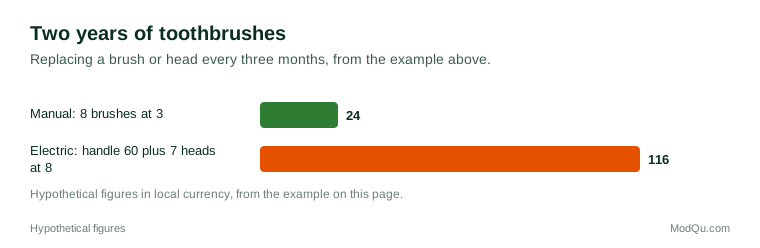
A person compares costs over two years. A manual brush costs 3 in their local currency and is replaced every three months, so 8 brushes cost 24. An electric brush costs 60, plus replacement heads at 8 each every three months, or 7 more heads costing 56, for a total of 116. The electric option costs 92 more over two years.
Toothpaste, floss and mouthwash
Toothpastes vary by purpose:
- Fluoride toothpaste, the most widely recommended type for preventing tooth decay.
- Sensitivity toothpaste, for people whose teeth hurt with hot, cold or sweet foods.
- Whitening toothpaste, which mainly removes surface stains.
- Toothpaste for gums, marketed to reduce gum problems.
- Natural or fluoride-free toothpaste, chosen by some people for personal reasons.
- Children's toothpaste, with different strengths and flavours.
Cleaning between the teeth reaches places a brush cannot. Options include string floss, floss picks, interdental brushes and water flossers. Many people find floss awkward and choose alternatives.
Mouthwash can freshen breath and some types contain fluoride or antibacterial ingredients. People use it for different reasons, and dental bodies vary in how strongly they recommend it.
Teeth whitening options
Teeth naturally vary in colour and can darken with age, and with tea, coffee, red wine and tobacco. Whitening aims to make teeth look lighter. The main options are:
- Whitening toothpastes, which remove some surface stains but do not change the natural colour of the tooth.
- Whitening strips and gels sold in shops, which contain a bleaching agent at lower strengths.
- Custom trays from a dentist, filled with whitening gel and worn at home.
- In-office whitening, done by a dental professional, often in one or two visits.
- Whitening pens, powders and light devices sold online, whose results vary.
Whitening does not change the colour of crowns, fillings or veneers, so people with dental work may see uneven results.
Example
A person preparing for a wedding tries over-the-counter whitening strips. Their teeth become slightly lighter, but a front filling stays the same colour and now stands out. A dentist explains that whitening does not change fillings and offers to replace it after the wedding.
Whitening rules and safety
Whitening products usually contain hydrogen peroxide or carbamide peroxide. Rules on the strength allowed in products sold to the public differ by country. In the European Union, for example, higher-strength products may only be supplied through dental professionals, and in the United Kingdom tooth whitening is treated as dentistry, so only registered dental professionals may carry it out. Other countries have different rules, and some have very few.
Common side effects people report include temporary tooth sensitivity and gum irritation. Concerns also arise about products bought from unregulated online sellers and about whitening offered by people without dental training, such as at some beauty salons or kiosks, where this is not allowed.
Access to dental care
Access to dentists varies widely across and within countries. In some places dental care is partly covered by public health systems or insurance; in others people pay the full cost themselves. Rural areas often have fewer dentists. Cost is one of the most common reasons people give for not visiting a dentist, and some people only go when they have pain. Fear of the dentist is another common reason.
Example
A student who moves to a new city has not seen a dentist for three years. They find that the nearest clinic offering lower fees has a long waiting list, so they visit a dental school clinic, where treatment is provided by supervised students at a reduced price.
Where people buy oral care products
Oral care products are sold in supermarkets, pharmacies, discount stores, online retailers and, for some products, directly by dentists. Many people buy toothpaste and brushes with their regular shopping and look for multi-buy offers. Electric brushes and whitening kits are often bought online or during sales. Some people choose subscription services that post brush heads on a schedule.
Trends and debates
Current trends and debates include:
- Electric and smart toothbrushes that connect to phone apps.
- Sustainable products, such as bamboo brushes, toothpaste tablets and recyclable tubes.
- Fluoride, including debates in some countries about fluoride in public water supplies.
- Cosmetic dentistry and social media, which have increased interest in very white, even teeth.
- Do-it-yourself whitening, and the risks of unregulated products.
What people and businesses want to know
Questions businesses want answered include which toothbrushes and products people use, how often they replace them, whether they clean between their teeth, whether they have tried whitening and how, what they spend, and where they buy oral care products.
Key terms
- FluorideA mineral added to many toothpastes to help prevent tooth decay.
- PlaqueA sticky film of bacteria that forms on teeth.
- TartarHardened plaque that usually needs professional cleaning to remove.
- Interdental brushA small brush for cleaning between the teeth.
- Water flosserA device that uses a stream of water to clean between the teeth.
- Hydrogen peroxideA bleaching agent used in many whitening products.
- Tooth sensitivityPain in the teeth caused by hot, cold or sweet things.
- Dental hygienistA professional who cleans teeth and helps prevent gum disease.
Full glossary: dental hygiene terms on EditingTests.com.
Oral care and teeth whitening vocabulary test
How well do you know the language of this topic? Try 8 quick questions. Your score is shown straight away and is not saved.
What the oral care and teeth whitening survey asks
This survey is part of ModQu's Beauty and Personal Care survey. The oral care and teeth whitening part takes about five minutes and covers:
- Which kind of toothbrush you use, and how often you replace it or its head.
- Which toothpaste and other products you use, such as floss or mouthwash.
- Whether you have whitened your teeth, and which method you used.
- Where you buy oral care products, and what you spend in a typical year.
- How often you visit a dentist or hygienist, and what affects this.
- What would make you switch brands or try a new product.
After that you can choose to continue with other short parts of the Beauty and Personal Care survey, such as skin care or hair care and salons, or stop.
Ready to take part?
Your answers help show what people really think and do. Results are only ever reported as totals; no one can see your individual answers.
Start the surveyQuestions about this survey
Who can take part?
Adults.
Do I have to give my name?
No. You may be asked for your age group, region and similar details so results can be broken down, but not your name. ModQu never asks for passwords, card numbers or account numbers.
How are the results used?
Answers are combined into totals and percentages and published in ModQu reports. Individual answers are never shown.
Is the vocabulary test part of the survey?
No. It is optional and separate, and your score is not stored.