
Share your hair removal habits
Tell us which hair removal methods you use, whether you have tried laser and what you spend. Your answers are combined with other people's and reported only as totals.
Start the hair removal surveyAbout 5 minutes. No account needed. You can stop at any time.
Why people remove hair
People remove hair from the face, legs, underarms, bikini area, back, chest and other parts of the body. Reasons vary:
- Cultural and religious practices, which in some traditions include removing certain body hair.
- Personal preference and appearance.
- Comfort, especially in hot weather.
- Sport, for example among swimmers and cyclists.
- Work requirements, in some jobs.
- Medical reasons, such as before surgery, or because of conditions that cause extra hair growth.
Attitudes to body hair differ widely by country, age, gender and generation, and more people now choose to keep some or all of their body hair. This page describes methods; it does not suggest that anyone should remove hair.
Temporary methods that cut hair at the surface
These methods remove hair at or just above the skin, so it grows back quickly, often within one to three days:
- Shaving with a razor: quick, cheap and painless for most people. Risks include cuts, razor burn and ingrown hairs.
- Electric shavers and trimmers: less chance of cuts, and trimmers can leave hair short instead of removing it.
- Depilatory creams: chemical creams that dissolve hair at the surface. They can irritate sensitive skin and have a strong smell, and many brands advise a patch test.
A common belief is that shaving makes hair grow back thicker or darker. Studies have not supported this; regrowth can feel coarser because the hair has a blunt tip.
Methods that remove hair from the root
These methods pull hair out from the root, so results usually last longer, often three to six weeks:
- Waxing: warm or cold wax is applied and pulled off, removing the hair. It is done at salons or at home with strips.
- Sugaring: a paste of sugar, lemon and water is used in a similar way to wax. It has a long history in the Middle East and North Africa.
- Threading: a twisted thread removes rows of hair, often used on the face.
- Epilators: electric devices with rotating tweezers that pull out hairs.
- Tweezing: removing hairs one at a time.
These methods can be painful, especially the first few times. Regular waxing can make regrowth seem finer for some people. Risks include redness, ingrown hairs and, rarely, burns from hot wax.
Example
A person who shaves their legs every two days switches to waxing at a salon before a summer holiday. The first appointment is uncomfortable, but the result lasts four weeks, and they start booking every month during the warmer season.
Laser and light treatments
Laser hair removal uses concentrated light to damage hair follicles so that they produce less hair. Intense pulsed light (IPL) uses a broader range of light in a similar way and is also sold as home devices.
Points people commonly consider include:
- Several sessions are needed, often six to eight or more, spaced weeks apart, because hair grows in cycles.
- Results are usually long-term reduction, not always complete or permanent removal, and some people need top-up sessions.
- Results depend on hair and skin colour. Light-based treatments work best on dark hair because they target pigment. Older devices were less suitable for darker skin; newer lasers are used on a wider range of skin tones, but settings matter.
- Blonde, red, grey and white hair often responds poorly.
- Side effects can include redness, swelling and, if done badly, burns or changes in skin colour.
Rules about who can operate lasers differ widely. In some countries only medical professionals may do so; in others trained technicians in beauty clinics may; and in some there are few rules.
Example (hypothetical figures)
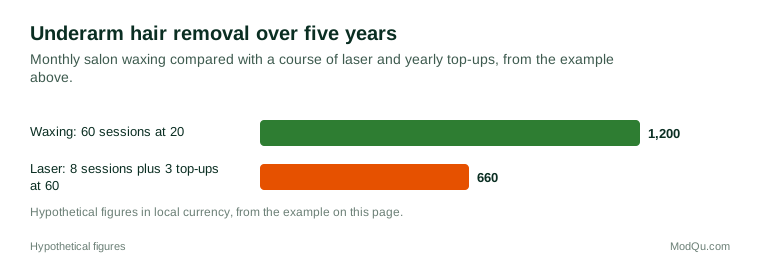
A person compares the cost of underarm hair removal over five years. Salon waxing at 20 in their local currency each month would cost 1,200. A course of 8 laser sessions at 60 each costs 480, plus one top-up session a year from the third year at 60, adding 180, for a total of 660. Laser would cost 540 less over five years, if it works as hoped for their hair type.
Electrolysis
Electrolysis passes a small electric current through a fine probe inserted into each hair follicle to destroy it. It treats one hair at a time, so it is slow and needs many sessions, but it can permanently remove hair and works on all hair colours. It is often used for small areas, such as the face, and for hair that does not respond to laser.
Salon or at home
People often combine methods. Home methods are cheaper and private, and can be done at any time. Salon and clinic treatments may give better results, reach difficult areas and use stronger equipment. Home IPL and laser-type devices have become widely sold; they are usually less powerful than professional machines, and results vary.
Example
A person who has used home wax strips for years buys a home IPL device. After three months of weekly use, hair on their legs grows back more slowly and finer, but the device has little effect on the light hair on their arms.
Skin problems and safety
Common problems linked to hair removal include:
- Ingrown hairs, which can cause bumps and irritation, especially with curly hair.
- Razor burn and folliculitis, inflammation around the hair follicles.
- Allergic reactions to creams or waxes.
- Burns from hot wax or poorly operated lasers.
- Changes in skin colour, particularly with light treatments on darker skin.
People with skin conditions, those taking certain medicines and pregnant people are often advised by practitioners to check with a health professional before some treatments, especially laser and IPL.
Trends and debates
Current trends include:
- More men removing body hair, and more products aimed at men.
- Home laser and IPL devices.
- Body hair acceptance, with more people choosing not to remove hair.
- Subscription razors and refillable options.
- Debates about the "pink tax", where products marketed to women are sometimes priced higher than similar products for men.
What people and businesses want to know
Questions businesses want answered include which hair removal methods people use, how often, whether at home or in a salon, whether they have tried laser or IPL and with what results, what they spend in a year, and what puts them off trying new methods.
Key terms
- Depilatory creamA chemical cream that dissolves hair at the skin's surface.
- WaxingRemoving hair from the root with warm or cold wax.
- SugaringRemoving hair with a paste made from sugar, lemon and water.
- EpilatorAn electric device that pulls out hairs with rotating tweezers.
- Hair follicleThe small structure in the skin from which a hair grows.
- Laser hair removalUsing concentrated light to damage hair follicles and reduce growth.
- IPLIntense pulsed light, a broad-spectrum light treatment for hair reduction.
- ElectrolysisUsing a small electric current to destroy individual hair follicles.
Full glossary: medical aesthetics terms on EditingTests.com.
Hair removal vocabulary test
How well do you know the language of this topic? Try 8 quick questions. Your score is shown straight away and is not saved.
What the hair removal survey asks
This survey is part of ModQu's Beauty and Personal Care survey. The hair removal part takes about five minutes and covers:
- Which hair removal methods you use, and on which parts of the body.
- How often you remove hair, and whether at home or at a salon or clinic.
- Whether you have tried laser, IPL or electrolysis, and how well it worked.
- How much you spend on hair removal in a typical year.
- Any problems you have had, such as ingrown hairs or irritation.
- How your attitude to body hair has changed over time.
After that you can choose to continue with other short parts of the Beauty and Personal Care survey, such as skin care or hair care and salons, or stop.
Ready to take part?
Your answers help show what people really think and do. Results are only ever reported as totals; no one can see your individual answers.
Start the surveyQuestions about this survey
Who can take part?
Adults.
Do I have to give my name?
No. You may be asked for your age group, region and similar details so results can be broken down, but not your name. ModQu never asks for passwords, card numbers or account numbers.
How are the results used?
Answers are combined into totals and percentages and published in ModQu reports. Individual answers are never shown.
Is the vocabulary test part of the survey?
No. It is optional and separate, and your score is not stored.