
Share how you use your library
Tell us when you last used a public library, whether you borrow e-books or audiobooks and which services you value most. Your answers are combined with other people's and reported only as totals.
Start the libraries surveyAbout 5 minutes. No account needed. You can stop at any time.
What public libraries are
A public library is a library open to everyone in a community, usually free to use and funded mainly by local governments, with support from provinces. In Canada, public libraries are governed under provincial laws, usually run by a library board, and are found in cities, towns, rural areas and First Nations communities. Many rural libraries belong to regional systems that share collections and services.
Public libraries differ from:
- academic libraries at colleges and universities;
- school libraries in elementary and secondary schools;
- special libraries in governments, hospitals, law firms and companies;
- national and archival libraries, such as Library and Archives Canada and provincial archives, which preserve published and historical records.
This page focuses on public libraries.
What libraries offer
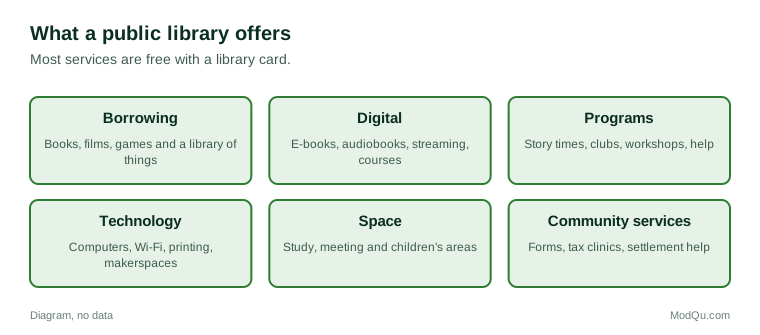
Libraries offer far more than books on shelves. Common services include:
- Borrowing: books, magazines, films, music, video games and, in many libraries, items such as laptops, Wi-Fi hotspots, musical instruments, tools, sewing machines, museum passes and seeds. These are sometimes called a library of things.
- Digital collections: e-books, e-audiobooks, digital magazines and newspapers, streaming films and online courses.
- Reference and research help: staff who help people find information, use databases and check sources.
- Programs: story times for young children, reading clubs, homework help, coding and science clubs, author talks, workshops, English and French conversation circles for newcomers, job search help and programs for older adults.
- Technology: free computers and internet, Wi-Fi, printing, scanning, and in some libraries makerspaces with 3D printers, recording studios and design software.
- Space: quiet study areas, meeting rooms, children's areas and places to spend time without having to buy anything.
- Community services: help with forms and government services, tax clinics, settlement services for newcomers, and in some libraries, social workers or health services.
- Local history collections and archives.
- Accessible formats, including large print, audiobooks and materials for people with print disabilities.
Most library cards are free for residents of the area the library serves.
How and why people use libraries
People use libraries in different ways at different stages of life:
- Families with young children for story times, picture books and a free place to go.
- Students for study space, internet, homework help and research.
- Readers of all ages for borrowing books, often in large numbers.
- Job seekers for computers, printing and help with résumés.
- Newcomers for language programs, settlement information and community connections.
- Older adults for reading, programs, technology help and social contact.
- People without a home or a computer for internet, warmth, washrooms and a safe place.
- Remote workers looking for a quiet space outside the home.
Some people visit every week; others have not used a library for years and may not know what has changed. Questions that libraries and businesses want answered here include how often people use the library, which services they use, and which they value most even when they do not use them.
Example
A parent of a three-year-old brings their child to a weekly story time at the local branch. Afterwards they borrow a stack of picture books and, from the library of things, a museum pass for the weekend. They say the library saves them a lot of money and is one of the few places with indoor space for a toddler in winter.
Digital borrowing: e-books and audiobooks
E-books and audiobooks are some of the fastest-growing parts of library collections. Borrowers use library apps or websites to borrow titles for a set period, after which the loan ends automatically.
Digital lending works differently from print in several ways:
- Libraries often license e-books from publishers rather than buying them outright. Licences may allow one borrower at a time, expire after a set time or number of loans, and cost more than a print copy.
- As a result, there are often holds (waiting lists) for popular titles, sometimes for months.
- Some content is available only in digital form, and some only in print.
- Audiobooks are popular with commuters, people with vision loss and people who prefer listening.
Many readers use both print and digital, choosing based on the book, their schedule and how long the holds list is.
Example (hypothetical figures)
A library buys a print copy of a popular novel for $25 and can lend it as long as it lasts. The e-book licence costs $60 and expires after 24 months. If each digital loan lasts 21 days and the title is always borrowed, it can be lent about 34 times in 24 months, which is about $1.76 per loan. If the print copy is lent 30 times before it wears out, it costs about $0.83 per loan.
Libraries as public space
Libraries are among the few indoor public spaces where people can stay without paying. That makes them important for many people, including those who are lonely, unhoused or lack quiet space at home. In heat waves, cold snaps and wildfire smoke, some libraries serve as cooling, warming or clean-air spaces.
It also creates challenges. Libraries may deal with security incidents, mental health and addiction crises, and conflicts between users. Some library systems have added social workers, outreach staff or security, which has led to debate about the library's role.
Example
An older adult who lives alone visits their branch three mornings a week to read the newspaper, attend a technology help session and chat with other regulars. When the branch closes for renovations for a year, they say they feel more isolated and start taking the bus to a branch farther away.
Funding and governance
Public libraries in Canada are funded mainly by municipalities, often with provincial grants, plus fundraising and friends-of-the-library groups. Budgets pay for staff, buildings, collections, technology and programs.
Libraries often face hard choices: opening hours, branch locations, the balance between print and digital, and how much to invest in new services such as makerspaces. Rising costs for digital licences and buildings add to the pressure.
Trends and what people disagree about
Libraries have changed a lot in recent decades. Many have removed overdue fines, saying fines kept some people away. Many have renovated buildings to add more open space, technology and community rooms. Use of digital collections has grown.
There are also debates:
- Purpose: should libraries focus on books and reading, or on being wider community hubs?
- Collections: who should decide what books a library holds, and how should challenges to particular titles be handled? Library associations support intellectual freedom, the right of people to access information and ideas.
- Digital lending: how publishers should price and license e-books to libraries.
- Funding: whether libraries are still worth public money when so much information is online, a view many library users strongly reject.
- Safety and social services: how much libraries should respond to social needs.
Key terms
- Public libraryA library open to everyone in a community, usually free and publicly funded.
- Library cardA card that lets a member borrow items and use online services.
- HoldA request to borrow an item when it becomes available.
- E-book licencePermission for a library to lend a digital book under set terms.
- Library of thingsA collection of non-book items, such as tools and equipment, for borrowing.
- MakerspaceA space with tools such as 3D printers for creating and learning.
- Interlibrary loanBorrowing an item from another library through your own.
- Intellectual freedomThe right to access information and ideas without censorship.
Full glossary: library systems terms on EditingTests.com.
Libraries vocabulary test
How well do you know the language of this topic? Try 8 quick questions. Your score is shown straight away and is not saved.
What the libraries survey asks
This survey is part of ModQu's Education and Learning survey. The libraries part takes about five minutes and covers:
- When you last used a public library, in person or online.
- Which library services you use, and how often.
- Whether you borrow e-books or audiobooks, and how you find holds and waiting times.
- Which library service you value most, even if you do not use it.
- What would make you use the library more.
- Your views on how libraries should be funded and what they should offer.
After that you can choose to continue with other short parts of the Education and Learning survey, such as choosing a college or university or online learning, or stop.
Ready to take part?
Your answers help show what people really think and do. Results are only ever reported as totals; no one can see your individual answers.
Start the surveyQuestions about this survey
Who can take part?
Adults.
Do I have to give my name?
No. You may be asked for your age group, region and similar details so results can be broken down, but not your name. ModQu never asks for passwords, card numbers or account numbers.
How are the results used?
Answers are combined into totals and percentages and published in ModQu reports. Individual answers are never shown.
Is the vocabulary test part of the survey?
No. It is optional and separate, and your score is not stored.
I have not used a library in years. Can I take part?
Yes. The survey asks non-users what keeps them away and what might bring them back.