
The Generation of Knowledge · History of knowledge
The Library of Alexandria and the Ancient Organisation of Knowledge
What we actually know about the Library of Alexandria, how its scholars collected, edited and catalogued the written knowledge of their world, why the story of its single fiery destruction is a myth, and what it still teaches about organising knowledge.
The Library of Alexandria is the most famous library that has ever existed, and one of the least documented. Founded in Egypt in the early third century BCE under the first Ptolemaic kings, it became a symbol of the ambition to gather all human knowledge in one place. Its loss has become a symbol of how knowledge can disappear. Historians now think that both the scale of the collection and the drama of its destruction have been exaggerated. Yet what the Library did, and how it did it, remains a remarkable early example of the organised production of knowledge.
Gathering the world's books
The Library was part of the Museum (Mouseion), a royal research institution in which scholars received salaries, meals and lodging to study and write (Fraser, 1972). Erskine (1995) argues that the Ptolemies supported it partly as an instrument of power: by collecting the literature of the Greek world, the new dynasty claimed to be its rightful heir.
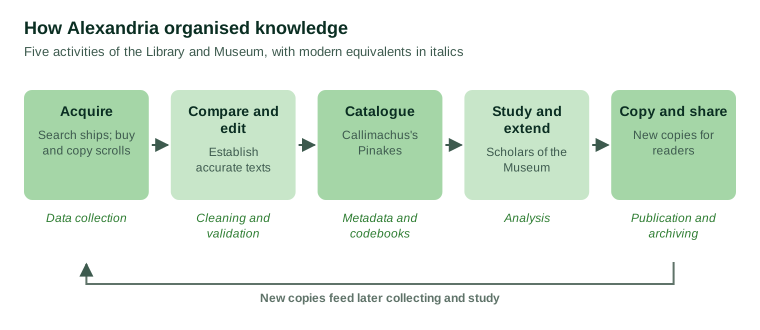
Ancient writers reported vigorous collecting. According to a story told by the physician Galen, ships entering Alexandria's harbour were searched for books, which were copied, with the copies returned to the owners and the originals kept (Casson, 2001). Ancient sources give figures for the collection ranging from tens of thousands to 700,000 scrolls. Bagnall (2002) examined these claims and concluded that they are not credible: the total body of Greek literature then in existence was probably far smaller, and the figures were repeated without evidence. The Library was large by ancient standards, but its legend outgrew its reality.
The institution was also more than a store of books. Its heads were leading scholars and poets, appointed by the king, and the Museum brought together people working in literature, mathematics, astronomy, geography and medicine. Casson (2001) notes that a second, "daughter" library was later established in the temple of Serapis, the Serapeum, giving the city two major collections. The combination of a large collection, salaried scholars and royal patronage made Alexandria the leading centre of Greek learning for much of the Hellenistic period (MacLeod, 2000).
Organising what was collected
The Library's lasting contribution lay less in the number of its scrolls than in what its scholars did with them. Casson (2001) describes three activities.
Editing. Homer's poems and other classics circulated in many differing copies. Alexandrian scholars such as Zenodotus and Aristarchus compared manuscripts, marked doubtful lines and produced standard editions. This was the beginning of textual criticism, the systematic attempt to establish an accurate text from imperfect sources.
Cataloguing. The poet and scholar Callimachus compiled the Pinakes ("tables"), a catalogue in 120 books that listed authors by genre with biographical notes and the opening words of each work. Blum (1991) describes it as the foundation of bibliography: a systematic guide that made a large collection usable.
Research. Scholars associated with the Museum made major advances. Eratosthenes, who became head librarian, estimated the circumference of the Earth. Russo (2004) argues that Hellenistic science in Alexandria reached a level of mathematical and experimental sophistication not matched again for many centuries.
The myth of a single destruction
Popular accounts often describe the Library vanishing in one great fire, blamed variously on Julius Caesar in 48 BCE, on Christian mobs in 391 CE or on Arab conquerors in 642 CE. Historians are sceptical of all three as the decisive event (MacLeod, 2000). The fire during Caesar's war may have destroyed books stored near the harbour, but scholarship in Alexandria continued afterwards. What seems most likely is a slow decline over centuries, as royal patronage ended, funding dwindled, political upheavals disrupted scholarly life and papyrus scrolls decayed without being recopied.
Lessons for organising knowledge
The real story of Alexandria is more instructive than the myth. Knowledge was lost not mainly through one catastrophe but through neglect: institutions lost support, and materials were not maintained. The same risk faces modern organisations, whose data and reports become unreadable when formats change, documentation is lost or no one is responsible for keeping them.
The Library's positive lessons are equally relevant. Collecting is not enough; knowledge becomes useful when it is checked, standardised and catalogued so others can find and trust it. The Alexandrian editors and cataloguers did, with scrolls, what good research organisations do with data: verify sources, document versions and maintain a guide to what is held. They also show the value of bringing specialists together around a shared collection, so that a geographer, a mathematician and an editor could draw on the same materials and on one another's expertise.
References
Bagnall, R. S. (2002). Alexandria: Library of dreams. Proceedings of the American Philosophical Society, 146(4), 348–362.
Blum, R. (1991). Kallimachos: The Alexandrian library and the origins of bibliography (H. H. Wellisch, Trans.). University of Wisconsin Press.
Casson, L. (2001). Libraries in the ancient world. Yale University Press.
Erskine, A. (1995). Culture and power in Ptolemaic Egypt: The Museum and Library of Alexandria. Greece & Rome, 42(1), 38–48. https://doi.org/10.1017/S0017383500025213
Fraser, P. M. (1972). Ptolemaic Alexandria. Clarendon Press.
MacLeod, R. (Ed.). (2000). The Library of Alexandria: Centre of learning in the ancient world. I. B. Tauris.
Russo, L. (2004). The forgotten revolution: How science was born in 300 BC and why it had to be reborn (S. Levy, Trans.). Springer. https://doi.org/10.1007/978-3-642-18904-3