
The Generation of Knowledge · History of knowledge
The Royal Society and the Institutionalisation of Science
How a small group of seventeenth-century London gentlemen created an institution for testing and publishing claims about nature, and how its practices of witnessing, registering, publishing and refereeing became the infrastructure of modern research.
On 28 November 1660, after a lecture at Gresham College in London, a group of twelve men agreed to form a society for "the promoting of Physico-Mathematicall Experimentall Learning". Within three years it had received royal charters and become the Royal Society of London for Improving Natural Knowledge. It is the oldest scientific academy in continuous existence. Its importance for the history of knowledge lies less in any discovery made by its members, distinguished as many were, than in the practices it developed for deciding which claims about nature deserved belief. Many of those practices, adapted and extended, still govern research today.
Take nobody's word for it
The Society adopted the motto Nullius in verba, usually translated as "take nobody's word for it". The phrase expressed a break with the habit of accepting claims because of the authority of ancient writers. Knowledge was to rest on experiment and observation, open to examination by others.
The early Society was strongly influenced by the ideas of Francis Bacon, who had called for a collective, experimental investigation of nature. Hunter (1989) describes how its founders tried to put this programme into practice, while also dealing with practical problems of funding, membership and organisation. Its first official history, by Thomas Sprat, presented the Society as a model of sober, cooperative and useful inquiry (Sprat, 1667).
Making experiments credible
A central problem for the new experimental science was trust. An experiment performed in one room was seen by a few people. Why should anyone else believe the report? Shapin and Schaffer (1985) showed how Robert Boyle and his colleagues addressed this problem through three "technologies".
The material technology was the apparatus itself, such as Boyle's air pump, which produced phenomena that could be shown to others. The social technology was the practice of performing experiments before witnesses at the Society's meetings, so that a matter of fact was established by the agreement of several competent observers. The literary technology was a style of writing that described experiments in such detail, including failures, that readers could become "virtual witnesses".
The credibility of witnesses mattered. Shapin (1994) argued that in seventeenth-century England, the word of a gentleman, whose honour depended on truthfulness, was trusted in a way that the word of a paid assistant was not. The Society's reliance on gentlemanly witnessing was effective, but it also shows how social status shaped what counted as knowledge.
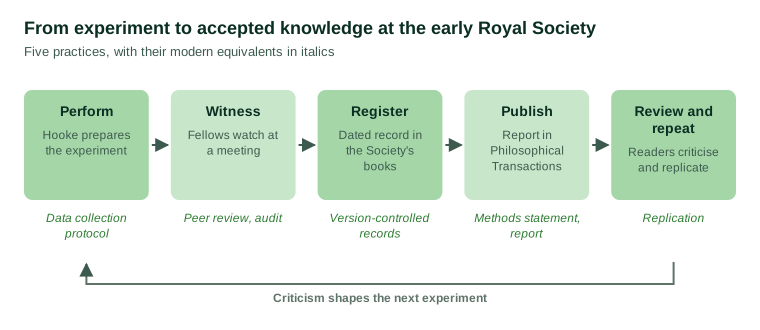
The Society also employed a curator of experiments, Robert Hooke, whose job was to prepare and perform experiments at each meeting. Hall (1991) describes how the demonstration of experiments was a regular part of the Society's business for its first decades, although the practice was hard to sustain and declined in the eighteenth century.
Registering and publishing
The Society kept registers and minute books in which experiments, observations and letters were recorded with dates. This served two purposes: it preserved knowledge, and it recorded who had first reported a finding, protecting the priority of discoverers and encouraging them to share their results rather than keep them secret.
In 1665 the Society's secretary, Henry Oldenburg, began publishing the Philosophical Transactions, which is now the oldest scientific journal in the world. At first it was Oldenburg's private venture, licensed by the Society. Fyfe et al. (2022) trace its history over 350 years, showing how it developed from a newsletter of correspondence into a formal journal. Johns (1998) emphasises that in early modern print culture the reliability of printed books could not be taken for granted, because piracy and unauthorised editions were common. A journal under the Society's licence offered readers a reason to trust what they read.
Limits and difficulties
The early Society was not a smooth success. Hunter (1989) shows that it struggled for money, since the king granted charters but little funding, and that many Fellows paid their subscriptions late or not at all. Membership included many gentlemen with only a passing interest in natural philosophy, alongside a small core of active investigators. Ambitious plans to compile complete "histories" of trades and natural phenomena, in the Baconian manner, were mostly left unfinished. The Society's achievements came less from a grand programme than from the steady routines of meeting, demonstrating, corresponding and recording. That is itself a lesson: institutions of knowledge often succeed through dull, reliable procedures rather than bold plans.
The origins of peer review
Modern researchers often assume that peer review dates from the earliest journals. The history is more complicated. Moxham and Fyfe (2018) show that when the Royal Society took formal responsibility for the Philosophical Transactions in 1752, it created a Committee of Papers that decided which papers to publish. Written reports on individual papers by named referees became routine only in the nineteenth century, and the modern system of anonymous external review spread mainly in the twentieth. Kronick (1990) found antecedents of peer review in several eighteenth-century learned journals. Zuckerman and Merton (1971) studied the referee system as an institution for maintaining standards and analysed patterns in its decisions.
A model for institutions of knowledge
The Royal Society was one of a number of academies founded in the seventeenth and eighteenth centuries. McClellan (1985) counted dozens across Europe by the late eighteenth century, forming an international network that exchanged publications and correspondence. Ben-David (1971) argued that these institutions helped create the social role of the scientist as a recognised and respected occupation. Merton (1938) argued that the values of seventeenth-century English society encouraged the growth of experimental science in this setting.
Lessons for producing trustworthy knowledge
The early Royal Society faced a problem that every knowledge-producing organisation faces: how to make claims credible to people who did not see the work done. Its answers remain instructive.
Report method in enough detail to be checked. Boyle's "literary technology" of detailed reporting is the ancestor of the methods section, the technical appendix and the survey methodology statement.
Use independent witnesses. The practice of performing experiments before others has become peer review, replication and external audit.
Record what was found, and when. The Society's registers are the ancestors of dated, version-controlled research records that show exactly what was known at each point.
Publish under a trusted name. A journal or organisation whose standards are known gives readers a reason to trust what it publishes, and a reputation to protect.
Watch whose word is trusted. The reliance on gentlemen witnesses is a reminder that credibility can be distributed unfairly. Modern institutions try to judge claims by evidence and method, not by the status of the person making them.
The motto Nullius in verba remains a sound principle for any organisation that sells evidence. Clients should not have to take the researcher's word for it; they should be shown the methods and data that make the findings worth believing.
References
Ben-David, J. (1971). The scientist's role in society: A comparative study. Prentice-Hall.
Fyfe, A., Moxham, N., McDougall-Waters, J., & Røstvik, C. M. (2022). A history of scientific journals: Publishing at the Royal Society, 1665–2015. UCL Press. https://doi.org/10.14324/111.9781800082328
Hall, M. B. (1991). Promoting experimental learning: Experiment and the Royal Society, 1660–1727. Cambridge University Press.
Hunter, M. (1989). Establishing the new science: The experience of the early Royal Society. Boydell Press.
Johns, A. (1998). The nature of the book: Print and knowledge in the making. University of Chicago Press.
Kronick, D. A. (1990). Peer review in 18th-century scientific journalism. JAMA, 263(10), 1321–1322. https://doi.org/10.1001/jama.1990.03440100021002
McClellan, J. E., III. (1985). Science reorganized: Scientific societies in the eighteenth century. Columbia University Press.
Merton, R. K. (1938). Science, technology and society in seventeenth century England. Osiris, 4, 360–632. https://doi.org/10.1086/368484
Moxham, N., & Fyfe, A. (2018). The Royal Society and the prehistory of peer review, 1665–1965. The Historical Journal, 61(4), 863–889. https://doi.org/10.1017/S0018246X17000334
Shapin, S. (1994). A social history of truth: Civility and science in seventeenth-century England. University of Chicago Press.
Shapin, S., & Schaffer, S. (1985). Leviathan and the air-pump: Hobbes, Boyle, and the experimental life. Princeton University Press.
Sprat, T. (1667). The history of the Royal-Society of London, for the improving of natural knowledge. J. Martyn and J. Allestry.
Zuckerman, H., & Merton, R. K. (1971). Patterns of evaluation in science: Institutionalisation, structure and functions of the referee system. Minerva, 9(1), 66–100. https://doi.org/10.1007/BF01553188