
The Generation of Knowledge · History of knowledge
The Encyclopédie and the Enlightenment Project
How Diderot and d'Alembert's Encyclopédie tried to map and share all human knowledge, how it classified the sciences and the trades, how it survived censorship, and what its ambitions still mean for anyone who organises knowledge for others.
Between 1751 and 1772, a group of French writers, scholars and craftsmen published one of the most ambitious works of the eighteenth century: the Encyclopédie, ou Dictionnaire raisonné des sciences, des arts et des métiers, an "Encyclopaedia, or Reasoned Dictionary of the Sciences, Arts and Trades". Edited by the philosopher Denis Diderot and, for its early volumes, the mathematician Jean le Rond d'Alembert, it eventually ran to seventeen volumes of text and eleven volumes of engraved plates, with more than seventy thousand articles (Lough, 1971). It was a reference work, a commercial venture and a manifesto for a new attitude to knowledge. Historians often treat it as the defining project of the Enlightenment.
This article explains where the Encyclopédie came from, how it organised knowledge, what made it controversial and how it was produced and sold. It closes with what the project suggests about organising knowledge for others today.
Origins: a translation that grew
The project began modestly. In 1745 the Paris bookseller André Le Breton obtained permission to publish a French translation of Ephraim Chambers's Cyclopaedia, a two-volume English dictionary of arts and sciences (Chambers, 1728). After false starts, the work was entrusted to Diderot and d'Alembert, who transformed it into something much larger and more original. Yeo (2001) shows that Chambers's work was itself part of a wave of English scientific dictionaries that tried to make new knowledge accessible to a wide public, and that the French editors inherited both its ambitions and its problems of selection and arrangement.
Mapping the tree of knowledge
In his Preliminary Discourse, published with the first volume in 1751, d'Alembert set out the project's philosophy (d'Alembert, 1751/1995). Knowledge, he argued following the empiricist philosophers John Locke and Francis Bacon, comes from the senses and is developed by the mind's faculties. The Encyclopédie adapted the classification of learning in Bacon's Advancement of Learning (Bacon, 1605/2000) into a "figurative system of human knowledge", a diagram that divided all knowledge into three great branches according to the faculty that produced it: memory, which yields history; reason, which yields philosophy, including the sciences; and imagination, which yields poetry and the fine arts.
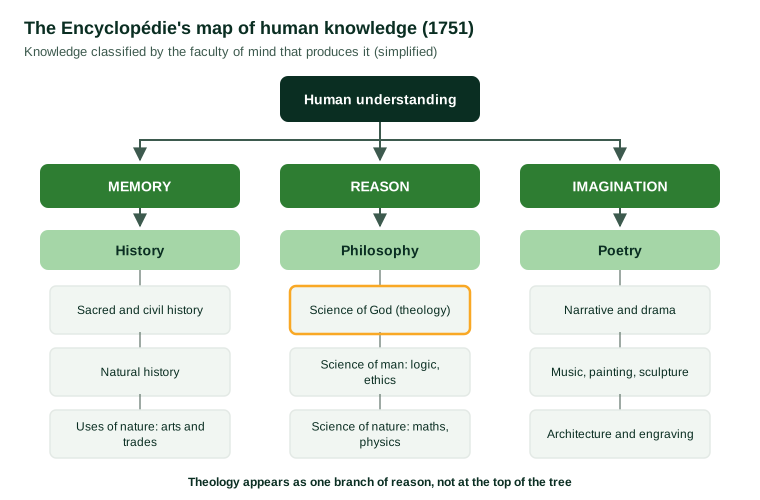
The diagram was more than a table of contents. Darnton (1984) argued that it was a strategic act: by drawing a new map of knowledge, the editors redrew the boundaries of authority. Theology appeared not at the summit, as the queen of the sciences, but as one branch of philosophy, a product of human reason like any other. Knowledge that could not be traced back to sensory experience and reasoning was implicitly placed under suspicion. To classify knowledge, Darnton suggested, is to exercise power over it.
Alphabet and cross-reference
Having proposed a systematic map, the editors arranged the articles alphabetically. This solved a practical problem, since readers could find entries easily, but it also broke up the systematic order. To restore connections, the Encyclopédie used a dense system of cross-references (renvois). In his own article "Encyclopédie", Diderot explained that cross-references could link related subjects, and could also be used to subvert official views, for example by pointing from a respectful article on a religious topic to one that undermined it (Darnton, 1984). The device made the work a network of knowledge rather than a list, an early version of the hyperlinked structure of modern online reference works.
What the articles contained
The articles varied enormously in length, quality and purpose. Some were short definitions; others were substantial essays on philosophy, politics, economics or the sciences. D'Alembert wrote many of the mathematical articles; Rousseau wrote on music and, in the article "Political economy", on government; the physician Théophile de Bordeu and others wrote on medicine; the economist François Quesnay contributed articles on agriculture and grain that set out early ideas of the Physiocrats (Lough, 1971). Diderot himself wrote thousands of entries on subjects from philosophy to the crafts.
The articles were not neutral summaries. Many advocated religious toleration, criticised arbitrary power, praised commerce and useful work, and treated established beliefs with polite scepticism. Because open criticism was dangerous, much of this was done indirectly: through the choice of topics, the tone of definitions, the use of irony and the cross-references. Readers learned to read between the lines. The work was at once a reference book and an argument about how knowledge, and society, ought to be organised.
Not everything in it was reliable by modern standards. Some articles repeated errors or were copied from earlier works with little checking, and quality varied between contributors. Yeo (2001) notes that encyclopaedists of the period were aware of the tension between comprehensiveness and accuracy, and between the speed demanded by publishers and the care needed to verify information. That tension has never gone away.
The trades and the plates
One of the Encyclopédie's most distinctive features was its attention to the mechanical arts and trades. Diderot visited workshops, interviewed artisans and commissioned detailed engravings of tools, machines and processes, from paper making and glass blowing to mining and weaving. Pannabecker (1998) describes how the editors developed visual conventions for representing technical processes, showing whole workshops, then breaking down tools and steps in sequence.
This was a statement of values. By placing the knowledge of craftsmen alongside that of philosophers, the Encyclopédie claimed that practical know-how was worthy of study and could be improved by being recorded, compared and spread. Mokyr (2002) treats this as a central example of the "Industrial Enlightenment", the effort to connect scientific understanding with practical technique, which he argues laid the foundations for the Industrial Revolution.
Collaboration and production
The Encyclopédie was a collective work. Kafker and Kafker (1988) identified around 140 contributors, including well-known writers such as Voltaire, Rousseau and Montesquieu, alongside physicians, engineers, administrators and craftsmen. The most prolific, the Chevalier Louis de Jaucourt, wrote many thousands of articles, often unpaid, in the later volumes. The project was a division of intellectual labour on a large scale, coordinated by editors who commissioned, revised and sometimes rewrote contributions.
It was also a business. Darnton (1979) traced the later history of the Encyclopédie as a publishing enterprise, through cheaper editions and reprints in quarto and octavo formats that sold many thousands of sets across Europe. Its readers included lawyers, officials, clergy, landowners and merchants in provincial towns, which shows how far the ideas of the Enlightenment reached beyond the Parisian elite. Squicciarini and Voigtländer (2015) used the distribution of subscriptions to one edition across French cities as a measure of the local presence of advanced knowledge, and found that cities with more subscribers later grew faster in industrial activity.
Censorship and survival
The project's criticism of religious and political authority made it a target. After the publication of the seventh volume in 1757, and amid a broader crackdown on critical writing, the French authorities revoked the work's royal privilege in 1759, and the Pope placed it on the Index of forbidden books. D'Alembert withdrew as co-editor. Diderot continued in semi-secrecy, and the remaining ten volumes of text were published together in 1765 with a false place of publication. Blom (2004) describes how the project survived only through the persistence of its editors and publishers and the quiet protection of sympathetic officials. Le Breton, fearing further trouble, secretly censored some of the final articles without Diderot's knowledge, which Diderot discovered with fury.
The Enlightenment project
The Encyclopédie expressed the core convictions of the Enlightenment: that knowledge should be based on evidence and reason rather than tradition and authority; that it should be shared widely; and that its spread would improve human life. Kant (1784/1996) famously described enlightenment as humanity's release from self-incurred immaturity, the inability to use one's own understanding without guidance from another. Diderot hoped the work would change the way ordinary educated people thought. Edelstein (2010) argues that the Enlightenment was partly defined by this self-conscious sense of living in an age when knowledge was spreading and could transform society.
Burke (2000) places the Encyclopédie at the end of a long early modern history of efforts to collect and classify knowledge, while Burke (2012) traces its successors through national encyclopaedias of the nineteenth century to the online encyclopaedias of the twenty-first. Headrick (2000) shows that the eighteenth century also produced many other "technologies of knowledge", such as classification systems, maps, statistics and dictionaries, which together created the information infrastructure of the modern world. Blair (2010) shows that the encyclopaedia itself grew out of centuries of experience in managing large quantities of information.
Lessons for organising knowledge
The Encyclopédie raises questions that anyone who organises knowledge for others still faces.
Every classification is a choice. Placing a topic in one category rather than another shapes how it is understood. Research organisations face the same issue when they define market segments, code open-ended answers or design the headings of a report. Classifications should be chosen deliberately and explained.
Practical knowledge deserves recording. The editors' attention to the trades is a reminder that valuable knowledge often lies with practitioners rather than theorists. Research that captures what customers, staff and suppliers know from experience can be as important as formal analysis.
Connections matter as much as entries. The system of cross-references turned a dictionary into a network. Modern knowledge bases and reports gain value when findings are linked to related evidence, definitions and earlier work.
Openness has enemies. The project survived censorship, but only just. Knowledge that challenges powerful interests can be suppressed. Independence and transparency are protections. So is a broad base of readers and supporters: the Encyclopédie survived partly because thousands of subscribers had paid for it and expected the remaining volumes.
Collaboration needs editing. A collective work is only as good as the coordination that holds it together. Diderot's role as editor, commissioning, checking and integrating contributions, is the model for any large knowledge project. Without editorial standards, a collaborative work becomes a pile of contributions of uneven quality; with them, it can become more than the sum of its parts.
The comparison with Wikipedia, the most ambitious encyclopaedia of the digital age, is natural. When Nature asked experts to compare samples of science articles in Wikipedia and the Encyclopaedia Britannica, it found that the two contained broadly similar numbers of serious errors (Giles, 2005). Like the Encyclopédie, Wikipedia is collective, cross-referenced, open to criticism and intended for a wide public. Both show that the organisation of knowledge is never merely technical: it reflects values about who may contribute, what counts as knowledge and who should have access to it.
References
Bacon, F. (2000). The advancement of learning (M. Kiernan, Ed.). Clarendon Press. (Original work published 1605)
Blair, A. M. (2010). Too much to know: Managing scholarly information before the modern age. Yale University Press.
Blom, P. (2004). Enlightening the world: Encyclopédie, the book that changed the course of history. Palgrave Macmillan.
Burke, P. (2000). A social history of knowledge: From Gutenberg to Diderot. Polity Press.
Burke, P. (2012). A social history of knowledge II: From the Encyclopaedia to Wikipedia. Polity Press.
Chambers, E. (1728). Cyclopaedia, or, an universal dictionary of arts and sciences (Vols. 1–2). J. and J. Knapton.
d'Alembert, J. le R. (1995). Preliminary discourse to the Encyclopedia of Diderot (R. N. Schwab, Trans.). University of Chicago Press. (Original work published 1751)
Darnton, R. (1979). The business of enlightenment: A publishing history of the Encyclopédie, 1775–1800. Harvard University Press.
Darnton, R. (1984). Philosophers trim the tree of knowledge: The epistemological strategy of the Encyclopédie. In The great cat massacre and other episodes in French cultural history (pp. 191–213). Basic Books.
Edelstein, D. (2010). The Enlightenment: A genealogy. University of Chicago Press.
Giles, J. (2005). Internet encyclopaedias go head to head. Nature, 438(7070), 900–901. https://doi.org/10.1038/438900a
Headrick, D. R. (2000). When information came of age: Technologies of knowledge in the age of reason and revolution, 1700–1850. Oxford University Press.
Kafker, F. A., & Kafker, S. L. (1988). The encyclopedists as individuals: A biographical dictionary of the authors of the Encyclopédie. Voltaire Foundation.
Kant, I. (1996). An answer to the question: What is enlightenment? In M. J. Gregor (Ed. & Trans.), Practical philosophy (pp. 11–22). Cambridge University Press. (Original work published 1784)
Lough, J. (1971). The Encyclopédie. Longman.
Mokyr, J. (2002). The gifts of Athena: Historical origins of the knowledge economy. Princeton University Press.
Pannabecker, J. R. (1998). Representing mechanical arts in Diderot's Encyclopédie. Technology and Culture, 39(1), 33–73. https://doi.org/10.2307/3107003
Squicciarini, M. P., & Voigtländer, N. (2015). Human capital and industrialization: Evidence from the Age of Enlightenment. The Quarterly Journal of Economics, 130(4), 1825–1883. https://doi.org/10.1093/qje/qjv025
Yeo, R. (2001). Encyclopaedic visions: Scientific dictionaries and Enlightenment culture. Cambridge University Press.