
Share what you clean with
Tell us which cleaning products you use most, whether you buy eco-friendly options and what makes you switch. Your answers are combined with other people's and reported only as totals.
Start the household cleaning products surveyAbout 5 minutes. No account needed. You can stop at any time.
What household cleaning products cover
Household cleaning products are used to remove dirt, grease, stains and germs from surfaces and items in the home. The main groups are:
- Dishwashing products: washing-up liquid, dishwasher tablets, rinse aid and dishwasher salt.
- Laundry products: detergents, stain removers and fabric softeners.
- Surface cleaners: all-purpose sprays, kitchen and bathroom cleaners, and glass cleaners.
- Toilet cleaners and bleach.
- Floor cleaners.
- Disinfectants, which claim to kill certain germs.
- Specialist products, such as oven cleaners, limescale removers, drain unblockers and furniture polish.
- Tools, such as cloths, sponges, mops, brushes and microfibre cloths.
Some households use many products; others manage with a few, or with simple ingredients such as vinegar and baking soda.
How cleaning products work
Most cleaning products combine a few kinds of ingredients:
- Surfactants, which help water lift grease and dirt from surfaces.
- Acids, such as citric acid, which dissolve limescale and mineral deposits.
- Alkalis, such as sodium carbonate, which cut through grease.
- Bleaches, such as sodium hypochlorite, which whiten and disinfect.
- Enzymes, often in laundry products, which break down stains such as food and blood.
- Solvents, which dissolve some marks and residues.
- Fragrances and colours, which do not clean but affect how people feel about a product.
Different jobs need different types. An acid is used for limescale in a kettle or shower, while an alkaline cleaner works better on oven grease.
Safety and labels
Many cleaning products can be harmful if swallowed, splashed in the eyes or mixed with other products. Common safety points include:
- Warning symbols: many countries use pictograms under the Globally Harmonized System of Classification and Labelling of Chemicals (GHS), such as a diamond with an exclamation mark or a corrosion symbol.
- Never mixing bleach with acids or ammonia, which can release dangerous gases. Health bodies in many countries warn about this.
- Ventilation when using strong products.
- Keeping products in their original containers and out of reach of children.
- Concentrated liquid capsules, such as laundry pods, which have caused poisonings in young children and led to rules on packaging in some places.
Example
A person cleaning a bathroom sprays a bleach-based cleaner on the toilet and then pours a limescale remover into the bowl. They notice a sharp smell, open the window and leave the room. Later they read on the label that the two products should not be used together.
Eco-friendly products
Many shoppers now look for cleaning products with a smaller environmental impact. Options include:
- Plant-based or biodegradable formulas.
- Refills and concentrates, which reduce packaging and transport.
- Refill stations in some shops, where people fill their own bottles.
- Tablets and sheets that are dissolved in water at home.
- Plastic-free packaging, such as cardboard or glass.
- Ecolabels, such as the EU Ecolabel and other national or independent schemes, which check products against environmental standards.
- Home-made cleaners, using vinegar, baking soda or lemon.
Some people find eco products work as well as standard ones; others find they need more effort or product. Claims such as "natural" or "green" are not always defined, and consumer bodies in several countries have acted against misleading environmental claims.
Example (hypothetical figures)
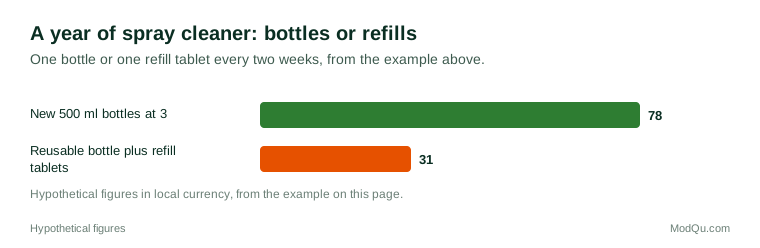
A household buys a 500 millilitre spray cleaner for 3 in their local currency every two weeks, costing 78 a year. They switch to a reusable bottle costing 5 and concentrated refill tablets at 1 each, using one tablet every two weeks, which costs 26 a year. Their first-year total is 31, a saving of 47.
Brand loyalty and switching
Cleaning products are bought often and in large numbers, so brand choices matter to manufacturers and shops. People often stay with a brand because:
- It works well for them.
- They like the scent.
- It is what their family used.
- They trust it to be safe.
- It is easy to find in their usual shop.
They switch because of:
- Price and offers, such as multi-buys and discounts.
- Store brands, which are often cheaper.
- A new product or scent.
- Environmental reasons.
- Allergies or sensitivities, for example to fragrances.
- Recommendations, including from social media cleaning accounts.
Example
A family has bought the same washing-up liquid for years. When the price rises, they try a supermarket's own brand and find it works as well. They keep buying the original brand only for laundry detergent, which they say they can tell the difference with.
Germs and disinfecting
Interest in disinfecting rose sharply during the COVID-19 pandemic. Disinfectants can be useful for some surfaces and situations, such as when someone in the home is ill or when preparing raw meat. Many health bodies note that for everyday cleaning, soap or detergent and water remove most dirt and many germs, and that overusing strong disinfectants is not always needed. Claims to kill a high percentage of germs usually refer to laboratory tests on particular germs.
Where people buy cleaning products
Cleaning products are bought mainly in supermarkets, discount stores, pharmacies and online. Bulk buying from warehouse clubs, buying large packs during sales, and subscriptions are common. In some countries, small local shops and markets sell products in smaller amounts or by refill.
Trends and debates
Current trends include:
- Social media cleaning content, which has made some products very popular quickly.
- Concentrates and refill systems.
- Fragrance-free and sensitive-skin products.
- Microfibre cloths, which some people use with water alone.
- Concerns about indoor air quality and chemicals released by some products.
- Debates about how much cleaning product is really needed.
What people and businesses want to know
Questions businesses want answered include which cleaning products people use most, how many they keep at home, whether they buy eco-friendly versions or refills, how loyal they are to brands, what makes them switch, how much they spend and where they shop.
Key terms
- SurfactantAn ingredient that helps water lift grease and dirt.
- LimescaleHard mineral deposits left by water, removed with acids.
- DisinfectantA product that kills certain germs on surfaces.
- EnzymeA substance in some detergents that breaks down stains such as food.
- ConcentrateA product with less water, diluted at home before use.
- EcolabelA label showing that a product meets environmental standards.
- GHS pictogramAn international warning symbol on hazardous products.
- Store brandA product sold under a shop's own name, often cheaper.
Full glossary: consumer packaged goods terms on EditingTests.com.
Household cleaning products vocabulary test
How well do you know the language of this topic? Try 8 quick questions. Your score is shown straight away and is not saved.
What the household cleaning products survey asks
This survey is part of ModQu's Household Life survey. The household cleaning products part takes about five minutes and covers:
- Which cleaning products you use most often, and how many different products you keep at home.
- Whether you buy eco-friendly products, refills or concentrates, and why.
- How loyal you are to cleaning brands, and what makes you switch.
- Where you buy cleaning products, and how much you spend in a typical month.
- Whether you make your own cleaners at home.
- What concerns you about cleaning products, such as safety, scent or packaging.
After that you can choose to continue with other short parts of the Household Life survey, such as cleaning and laundry or household chores and time use, or stop.
Ready to take part?
Your answers help show what people really think and do. Results are only ever reported as totals; no one can see your individual answers.
Start the surveyQuestions about this survey
Who can take part?
Adults who clean at home.
Do I have to give my name?
No. You may be asked for your age group, region and similar details so results can be broken down, but not your name. ModQu never asks for passwords, card numbers or account numbers.
How are the results used?
Answers are combined into totals and percentages and published in ModQu reports. Individual answers are never shown.
Is the vocabulary test part of the survey?
No. It is optional and separate, and your score is not stored.
Do home-made cleaners work?
Vinegar, baking soda and lemon can remove some dirt, grease and limescale, but they do not disinfect as reliably as products tested for that purpose.
How many cleaning products does a household need?
It varies. Some households manage with a general cleaner, washing-up liquid, a limescale remover and cloths, while others keep a product for each job.