
Share how your household cleans
Tell us who cleans in your home, what products you use and whether you pay for help. Your answers are combined with other people's and reported only as totals.
Start the cleaning and laundry surveyAbout 5 minutes. No account needed. You can stop at any time.
What cleaning and laundry cover
Household cleaning covers the regular jobs that keep a home tidy and hygienic, and the occasional deeper jobs that are done a few times a year. Laundry covers washing, drying, ironing and putting away clothes, towels and bedding.
Regular tasks usually include:
- Kitchen: dishes, counters, the stove, the sink and the fridge.
- Bathrooms: toilets, sinks, showers and tubs.
- Floors: sweeping, vacuuming and mopping.
- Surfaces: dusting and wiping.
- Garbage, recycling and compost.
- Laundry: sorting, washing, drying, folding and ironing.
Less frequent tasks include washing windows, cleaning the oven, shampooing carpets, cleaning out cupboards and the spring clean that many households still do once the weather warms.
Who does the cleaning
In most homes, one person does more of the cleaning than others. Surveys in Canada and other countries have long found that women, on average, spend more time on housework than men, although the gap has narrowed over the decades and varies widely between households. Roommates and families often have their own systems: rotas, a split by task, or one person doing most of it and others helping when asked.
Example
Three roommates share an apartment. They start with a weekly rota pinned to the fridge, but within a month one of them is doing most of the kitchen cleaning because they cannot stand a messy counter. They switch to a split by task: one does the kitchen, one the bathroom, and one the floors and garbage.
Who cleans is closely linked to the separate topic of household chores and time use, which looks at how all household work is shared.
Cleaning products and tools
Households use a wide range of products. Common ones include all-purpose sprays, dish soap, dishwasher detergent, bathroom and toilet cleaners, glass cleaner, floor cleaners, disinfectant wipes, bleach, and scouring powder. Tools include cloths, microfibre cloths, sponges, mops, brooms, vacuums and, increasingly, robot vacuums and steam cleaners.
There are two broad approaches:
- Many products: a different cleaner for each surface or room.
- Few products: one or two all-purpose cleaners, plus homemade options such as vinegar, baking soda and soap.
Household chemical products sold in Canada must carry hazard symbols and warnings under the Consumer Chemicals and Containers Regulations. A key safety rule is never to mix bleach with ammonia or with acids such as some toilet cleaners or vinegar, because this can release harmful gases.
Eco-friendly and refill options
Many people say they want cleaning products that are better for the environment. Options include concentrates that are diluted at home, refill stations in stores, laundry sheets and tablets with less packaging, plant-based ingredients, and reusable cloths instead of paper towels and disposable wipes.
Labels such as "green", "natural" and "eco" are not regulated terms in themselves. Independent certifications, such as the federal government's ecolabel programs or third-party schemes, have their own published standards. The Competition Bureau in Canada has warned businesses that environmental claims must be truthful and able to be backed up.
Example (hypothetical figures)
A household uses one bottle of all-purpose spray a month at $5.49. They switch to a concentrate that costs $9.99 and makes eight bottles when mixed with water in a reusable sprayer. Over eight months they spend $9.99 instead of $43.92, a saving of $33.93, and throw away one small bottle instead of eight.
Questions that businesses want answered include whether people pay more for eco-friendly products, which claims they trust, and whether they keep using them once they have tried them.
Laundry habits
Laundry habits differ in how often, how hot, and how much is done by machine. Most Canadian households have a washer and dryer, or use a shared laundry room in an apartment building or a laundromat. Common choices include:
- Water temperature: many detergents now work in cold water, which uses less energy than hot.
- Detergent type: powder, liquid, pods, sheets, and high-efficiency (HE) detergent for front-loading and HE machines.
- Drying: tumble dryer, drying rack or clothesline. Some condominium and community rules restrict outdoor clotheslines.
- Extras: fabric softener, dryer sheets, stain removers and laundry boosters.
- Ironing: done less than it once was, with many people choosing clothes that do not need it.
Example
A family of five with a shared laundry room in their building does laundry once a week, on Sunday, using four machines at once. Because the machines take coins and cards, they keep a jar of loonies and toonies by the door. When their building adds an app to pay and check which machines are free, they start doing smaller loads during the week.
Paying for help
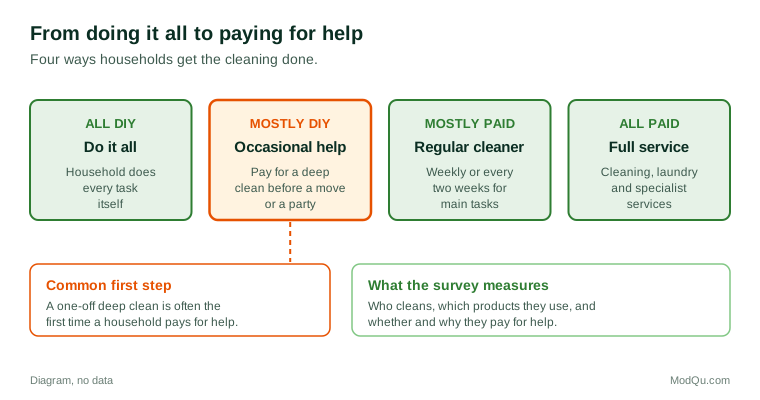
Some households pay for cleaning. The most common arrangements are:
- Independent cleaners who come weekly or every two weeks, often paid by the hour or per visit.
- Cleaning companies that send staff, carry insurance and handle scheduling.
- One-off deep cleans, often before or after a move, a party or a renovation.
- Specialist services for carpets, windows, ducts and upholstery.
- Laundry services: wash-and-fold, dry cleaning and pick-up and delivery.
People's reasons for paying include lack of time, health or mobility limits, ageing, a busy family schedule, or simply a wish not to spend weekends cleaning. Reasons for not paying include cost, privacy, not wanting a stranger in the home and a sense that they should do it themselves. People who hire someone directly may wonder about trust, insurance and whether they are an employer; anyone unsure is advised to look at Canada Revenue Agency guidance.
What people disagree about
Common debates include how often a home really needs cleaning, whether disinfecting surfaces every day is needed or excessive, whether eco-friendly products clean as well, how to share chores fairly, how much to pay a cleaner and whether to tip, and whether robot vacuums are worth the money. Views often differ between people who live alone and families with children or pets.
Key terms
- All-purpose cleanerA cleaner designed for use on many kinds of surface.
- ConcentrateA product sold in strong form to be diluted with water at home.
- DisinfectantA product that kills germs on surfaces, as opposed to simply removing dirt.
- HE detergentLow-sudsing detergent for high-efficiency washing machines.
- Microfibre clothA cloth of very fine synthetic fibres that picks up dust and dirt.
- Deep cleanA thorough clean of areas not covered in regular cleaning.
- Wash-and-foldA laundry service that washes, dries and folds clothes for a fee.
- Hazard symbolA warning picture on a product label showing a danger, such as poison or corrosive.
Full glossary: household cleaning supplies terms on EditingTests.com.
Cleaning and laundry vocabulary test
How well do you know the language of this topic? Try 8 quick questions. Your score is shown straight away and is not saved.
What the cleaning and laundry survey asks
This survey is part of ModQu's Household Life survey. The cleaning and laundry part takes about five minutes and covers:
- Who does most of the cleaning and laundry in your home.
- How often you do the main cleaning tasks.
- Which cleaning and laundry products you use, and whether you look for eco-friendly ones.
- Whether you pay for a cleaner or laundry service, how often and roughly what it costs.
- What would make you start or stop paying for help.
- Which cleaning tools you own, such as a robot vacuum or steam cleaner.
After that you can choose to continue with other short parts of the Household Life survey, such as household chores and time use or home services and trades, or stop.
Ready to take part?
Your answers help show what people really think and do. Results are only ever reported as totals; no one can see your individual answers.
Start the surveyQuestions about this survey
Who can take part?
Main or shared household cleaners.
Do I have to give my name?
No. You may be asked for your age group, region and similar details so results can be broken down, but not your name. ModQu never asks for passwords, card numbers or account numbers.
How are the results used?
Answers are combined into totals and percentages and published in ModQu reports. Individual answers are never shown.
Is the vocabulary test part of the survey?
No. It is optional and separate, and your score is not stored.