
Share how your household shares the work
Tell us how much time you spend on chores, who does what and what you would hand over. Your answers are combined with other people's and reported only as totals.
Start the household chores and time use surveyAbout 5 minutes. No account needed. You can stop at any time.
What counts as household work
Household work is the unpaid work people do to run a home and look after the people in it. It is often split into a few groups:
- Routine housework: cooking, washing dishes, cleaning, laundry and tidying.
- Shopping and errands: groceries, household supplies, pharmacy runs and returns.
- Home and yard upkeep: repairs, painting, lawn care, snow clearing and car care.
- Household management: paying bills, budgeting, booking appointments and planning meals.
- Care: looking after children, older relatives, people with illness or disability, and pets.
Some tasks happen every day, such as cooking and dishes. Others are weekly, such as laundry and groceries, and some are seasonal or occasional, such as clearing gutters or booking a furnace check. Many people underestimate the time spent on occasional tasks because they do not think of them as chores.
How time on chores is measured
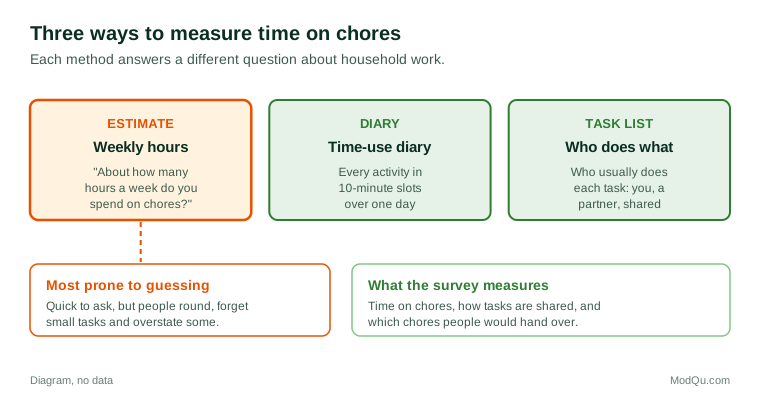
Statistics agencies measure household work with time-use surveys. In these, people record what they did over a day, often in a diary broken into short time slots, along with who they were with and where. Statistics Canada has run time-use surveys as part of its General Social Survey since the 1980s. Other countries run similar surveys, such as the American Time Use Survey in the United States.
Diaries are generally considered more accurate than simply asking people how many hours they spend on chores in a week. When people are asked to estimate, they often round, forget small tasks, or overstate tasks they feel they should do. Doing two things at once, such as watching a child while cooking, also makes time hard to count.
How households share chores
Households share work in many ways. Some split tasks equally, some divide by type (one person cooks, the other cleans), some divide by who has more time, and some leave it to whoever notices first. Studies across many countries, including Canada, have found that in different-sex couples women still do more routine housework and care on average, while men more often do outdoor and repair tasks. The gap has narrowed over time, and couples vary widely.
Example
A couple both work full time. When they write down every task for one week, they find one partner does almost all the cooking and grocery shopping, while the other does the dishes, laundry and garbage. They had each assumed they did more than half. Seeing the list, they agree the split is roughly fair but swap grocery shopping to save the cook time.
The example shows a pattern that time-use research has documented: each partner tends to estimate their own share as larger than their partner estimates it.
The mental load
Some household work is not physical. Remembering that the milk is running low, noticing a child has outgrown their boots, keeping track of birthdays, and planning meals all take thought and time. This is often called the mental load or cognitive labour. It is harder to measure than physical tasks because it happens in the background and is spread across the day.
Example
A parent keeps a running list on their phone of what the family needs: school forms to sign, a vet appointment, a gift for a birthday party, and a reminder to book winter tires. Their partner does as many physical chores, but says they had not noticed how much planning goes into the week until the list-keeper went away for a week.
Questions that businesses and researchers want answered include who plans and who does, and whether apps, shared calendars and shopping lists change how the load is shared.
Children and chores
Many families give children chores, both to share the work and to teach skills. Common ones include making their bed, setting the table, feeding pets and tidying their room, with older children doing laundry, cooking simple meals or mowing the lawn. Families differ on whether chores should be paid with an allowance, tied to privileges or expected without reward.
Paying someone else
Households can buy back time by paying for services that replace chores. Examples include cleaners, meal kits, grocery delivery, prepared meals, laundry services, dog walkers, lawn care and snow removal, and handyperson services. Some people also buy time-saving appliances such as dishwashers, robot vacuums and slow cookers.
Example (hypothetical figures)
A household spends about 3 hours each weekend cleaning. A cleaner would charge $120 for a visit every two weeks, covering about 6 hours of their cleaning a month for $240. That works out to $40 for each hour of their own time saved. They decide it is worth it for the bathrooms and floors but keep doing the rest themselves.
Which chore people would most like to hand over is one of the questions in this topic's survey. Answers vary widely between households, from scrubbing bathrooms to ironing to dealing with paperwork.
Time use and wellbeing
How people spend time affects how they feel. Time-use researchers often note that unpaid work and paid work together can leave little time for rest, especially for parents of young children and people caring for relatives while working. The term "time poverty" is sometimes used for having too little free time after paid and unpaid work.
Changes in work, such as working from home, have changed household routines. Some people say it makes it easier to fit in laundry and cooking during the day; others say the line between work and home has blurred and chores never end.
What people disagree about
Debates about chores include what a fair split looks like when partners work different hours, whether the mental load should count as work, whether children should be paid for chores, whether paying for help is a reasonable choice or a luxury, and whether unpaid household work should be counted in national economic statistics. Surveys on this topic need to ask about tasks in detail, because broad questions tend to produce answers shaped by what people feel they should say.
Key terms
- Time-use surveyA survey in which people record how they spend their time, often in a diary.
- Time-use diaryA record of activities over a day, broken into short time slots.
- Unpaid workWork done without pay, such as housework and caring for others.
- Mental loadThe planning and remembering needed to run a household.
- Stylized questionA survey question asking people to estimate usual time, such as hours per week.
- Secondary activitySomething done at the same time as a main activity, such as childcare while cooking.
- OutsourcingPaying someone else to do a task, such as cleaning or meal preparation.
- Time povertyHaving too little free time after paid and unpaid work.
Full glossary: consumer goods terms on EditingTests.com.
Household chores and time use vocabulary test
How well do you know the language of this topic? Try 8 quick questions. Your score is shown straight away and is not saved.
What the household chores and time use survey asks
This survey is part of ModQu's Household Life survey. The household chores and time use part takes about five minutes and covers:
- How many hours a week you spend on chores, by type of task.
- How chores are shared in your home, and whether you think it is fair.
- Who plans and remembers household tasks.
- Which chores children in your home do, if any.
- Which chores you pay someone else to do, and which you would most like to hand over.
- How working from home or other changes have affected your routine.
After that you can choose to continue with other short parts of the Household Life survey, such as cleaning and laundry or home services and trades, or stop.
Ready to take part?
Your answers help show what people really think and do. Results are only ever reported as totals; no one can see your individual answers.
Start the surveyQuestions about this survey
Who can take part?
Adults in shared households.
Do I have to give my name?
No. You may be asked for your age group, region and similar details so results can be broken down, but not your name. ModQu never asks for passwords, card numbers or account numbers.
How are the results used?
Answers are combined into totals and percentages and published in ModQu reports. Individual answers are never shown.
Is the vocabulary test part of the survey?
No. It is optional and separate, and your score is not stored.