
Share how you organize your home
Tell us how often you declutter, what storage you use and whether you have rented a storage unit. Your answers are combined with other people's and reported only as totals.
Start the home organisation and decluttering surveyAbout 5 minutes. No account needed. You can stop at any time.
What home organisation covers
Home organisation means arranging belongings so that a home is easier to use, clean and live in. Decluttering means reducing what is kept, by removing items that are no longer needed or wanted. The two often go together: people declutter first, then organize what remains.
The topic includes:
- Decluttering: sorting belongings and deciding what to keep, give away, sell, recycle or throw out.
- Storage: shelves, boxes, cupboards, wardrobes and under-bed storage.
- Systems and routines: labelling, regular tidying and rules for where things go.
- Services: professional organizers, removal and clearance services, and self-storage units.
- Digital organisation, such as photos and documents, which many people also find hard to manage.
Why clutter builds up
Clutter grows for many reasons, and usually for several at once:
- Buying more than is used, including impulse purchases and multi-buy offers.
- Gifts, which people may feel guilty about giving away.
- Sentimental items, such as children's drawings, letters and belongings of relatives who have died.
- "Just in case" items, kept in case they are needed later.
- Life changes, such as moving in with a partner, having children or inheriting a household's contents.
- Lack of time to sort things.
- Small homes, where even a modest number of things fills the space.
For a small number of people, difficulty discarding possessions is part of a recognized mental health condition called hoarding disorder, which can need specialist help. Most clutter, though, is an ordinary part of busy lives.
Example
A family with two young children finds that toys have spread into every room. They keep a few toys out and put the rest in labelled boxes in a cupboard, swapping the boxes every few weeks so the children have something different to play with.
Approaches to decluttering
People use several well-known approaches, often adapting them:
- Room by room: working through one room or area at a time.
- Category by category: gathering all items of one type, such as all clothes or all books, and sorting them together.
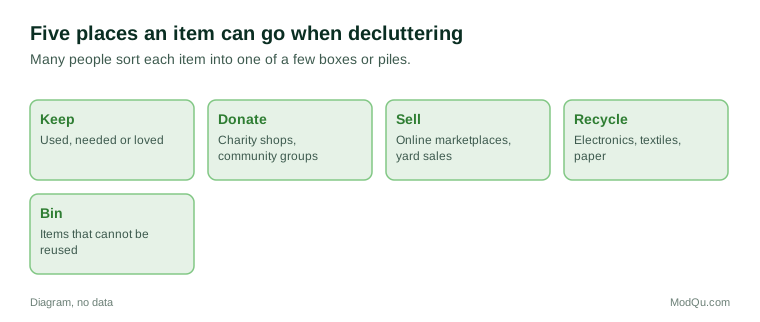
- Keep, donate, sell, recycle, bin: sorting each item into one of a few piles or boxes.
- Small daily steps: removing one item a day or spending ten minutes a day.
- One in, one out: removing one item for each new one brought in.
- Asking questions: whether an item has been used in the past year, whether it would be bought again, and whether it is worth the space it takes.
Many people find the decisions harder than the physical work, especially for sentimental items. Some take photographs of items before letting them go.
Storage products
Storage products are a large market in many countries. Common items include:
- Clear and labelled storage boxes.
- Shelving units and wall shelves.
- Drawer dividers and organizers.
- Under-bed storage.
- Over-the-door hooks and hangers.
- Vacuum storage bags for clothes and bedding.
- Kitchen and pantry organizers.
- Garage and shed storage, such as racks and hooks.
Some people point out that buying storage before decluttering can lead to storing things that are not needed.
Example (hypothetical figures)
A person buys 10 storage boxes at 8 each in their local currency and 2 shelving units at 45 each, a total of 170. They also sell 12 unwanted items online for an average of 15 each, receiving 180. The sales more than cover the storage they bought, leaving them 10 ahead.
Self-storage units
Self-storage is a service where people rent a lockable unit or locker, by the week or month, to store belongings outside their home. It is common in North America, Australia, parts of Europe and increasingly in Asia, and less common in many other regions. People use it:
- When moving home or between homes.
- During renovation.
- After a separation or a death in the family.
- When living in a small home.
- For business stock or equipment.
- For seasonal items, such as sports equipment.
Costs depend on location and size and can build up over time. Some people keep a unit far longer than planned and end up paying more in rent than the items are worth.
Example
After their mother moves into a care home, two siblings rent a small storage unit for her furniture while they decide what to do. Eighteen months later, they realize they have not visited it once, and they arrange to sell or donate most of the contents.
Where unwanted items go
When people let go of items, they use a range of routes:
- Giving to friends and family.
- Charity shops and donation points.
- Selling online, through marketplaces and local selling groups.
- Garage sales, yard sales and car boot sales.
- Free-to-collect listings and community sharing groups.
- Recycling centres, for electronics, textiles and other materials.
- Bulky waste collection, for large items such as furniture.
- Landfill, for items that cannot be reused or recycled.
Concerns are sometimes raised that donations of clothing and household goods from wealthier countries end up in markets or landfills in other countries.
Professional organizers
Professional organizers help people sort, declutter and set up storage. Their services may include one-off sessions, help with moving, downsizing for older people, and support after a bereavement. Some work by the hour and some offer packages. This kind of service is well established in some countries and new in others.
Trends and debates
Several ideas shape current discussion:
- Minimalism, which encourages owning fewer things.
- Swedish death cleaning, a term for decluttering later in life so that relatives do not face it.
- Organizing content on social media, showing neat homes and storage.
- Second-hand selling apps, which make it easier to sell unwanted items.
- Sustainability, including buying less and keeping items in use for longer.
People disagree about how much clutter matters. Some feel calmer in a tidy home; others are happy with a busier space and see possessions as part of their history.
What people and businesses want to know
Questions businesses want answered include how often people declutter, what prompts it, what they do with unwanted items, which storage products they have bought recently, whether they use professional help, and whether they have rented a storage unit and for how long.
Key terms
- DeclutteringReducing belongings by removing what is not needed or wanted.
- Home organisationArranging belongings so a home is easier to use and clean.
- One in, one outRemoving one item for each new item brought home.
- Self-storageRenting a lockable unit outside the home to store belongings.
- Professional organizerA person paid to help sort, declutter and arrange a home.
- MinimalismA lifestyle that aims to own fewer possessions.
- DownsizingMoving to a smaller home and reducing belongings to fit.
- Hoarding disorderA recognized mental health condition involving great difficulty discarding possessions.
Full glossary: self storage operations terms on EditingTests.com.
Home organisation and decluttering vocabulary test
How well do you know the language of this topic? Try 8 quick questions. Your score is shown straight away and is not saved.
What the home organisation and decluttering survey asks
This survey is part of ModQu's Household Life survey. The home organisation and decluttering part takes about five minutes and covers:
- How often you declutter, and what prompts it.
- Which rooms or kinds of items are hardest to keep organized.
- Which storage products you have bought in the last year, and what you spent.
- What you do with unwanted items: sell, donate, recycle or throw away.
- Whether you have rented a storage unit, why, and for how long.
- Whether you have used, or would use, a professional organizer.
After that you can choose to continue with other short parts of the Household Life survey, such as cleaning and laundry or household chores and time use, or stop.
Ready to take part?
Your answers help show what people really think and do. Results are only ever reported as totals; no one can see your individual answers.
Start the surveyQuestions about this survey
Who can take part?
Adults.
Do I have to give my name?
No. You may be asked for your age group, region and similar details so results can be broken down, but not your name. ModQu never asks for passwords, card numbers or account numbers.
How are the results used?
Answers are combined into totals and percentages and published in ModQu reports. Individual answers are never shown.
Is the vocabulary test part of the survey?
No. It is optional and separate, and your score is not stored.