
Share what you sleep on
Tell us how old your mattress is, where you bought it and how much you spent on bedding. Your answers are combined with other people's and reported only as totals.
Start the bedding and mattresses surveyAbout 5 minutes. No account needed. You can stop at any time.
What bedding and mattresses cover
The things people sleep on fall into a few groups:
- Mattresses, the main support for sleep.
- Bed bases and frames, such as slatted frames, box springs, divans and platforms.
- Mattress toppers and protectors, which add comfort or protect against spills and dust.
- Pillows, filled with materials such as foam, feathers, down, polyester or natural fibres.
- Duvets, comforters, quilts and blankets.
- Sheets and covers, in cotton, linen, polyester, bamboo-derived fabrics and blends.
Sleeping arrangements vary around the world. In Japan, for example, many people sleep on a futon mattress laid on the floor and folded away during the day. In many places people sleep on mats, hammocks or shared beds. This page focuses on mattresses and bedding bought for use at home.
Main types of mattress
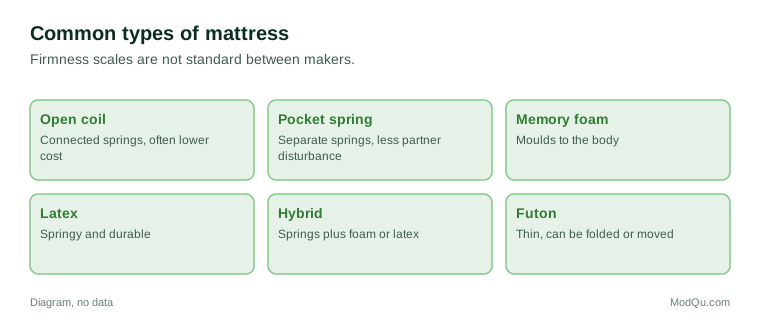
The most common mattress types are:
- Open coil or Bonnell spring: connected springs. Often lower cost, but movement can be felt across the bed.
- Pocket spring: individual springs in fabric pockets, which move separately and reduce partner disturbance.
- Memory foam: foam that moulds to the body. Some people find it holds heat.
- Latex: natural or synthetic latex foam, springy and durable.
- Hybrid: a combination of springs and foam or latex layers.
- Polyurethane foam: basic foam, often in lower-priced mattresses.
- Futon and roll-up mattresses: thinner mattresses that can be moved or folded.
Firmness is described on scales from soft to firm, but there is no single standard, so a "medium" mattress from one maker can feel different from another's. Preferences depend on body size, sleeping position, health and personal taste.
How people choose a mattress
People commonly weigh:
- Comfort and firmness, often tested by lying on mattresses in a shop.
- Support, especially for people with back or joint pain.
- Temperature, for those who sleep hot.
- Size, which varies by country: single, double, queen, king and other sizes are named and measured differently in different places.
- Partner disturbance.
- Price.
- Allergies, with some people choosing hypoallergenic materials.
- Reviews and recommendations.
- Materials and certifications, such as standards for foam emissions or organic fabrics.
Example
A couple shopping for a new mattress try several in a store. One prefers firm support for back pain; the other finds firm mattresses uncomfortable. They choose a pocket spring mattress with a softer topper on one side, after the store explains that it can be adjusted.
Buying in store or online
Mattresses have long been bought in furniture and bed stores, department stores and warehouse clubs. Since the 2010s, many brands sell mattresses directly online, often compressed and rolled into a box for delivery. Online sellers commonly offer:
- Trial periods, sometimes of 100 nights or more, during which the mattress can be returned.
- Free delivery and returns, with conditions.
- Warranties, often of several years.
People who buy in store value being able to try mattresses and get advice, but sales staff may push particular models. People who buy online value convenience and trial periods, but cannot try before buying. Many people use both, trying mattresses in a store and then comparing prices online.
How long mattresses last
There is no fixed lifespan, but mattress makers and sleep organizations often suggest replacing a mattress every seven to ten years, or sooner if it sags, has lumps or is uncomfortable. Many people keep mattresses much longer. Reasons for replacing include:
- Sagging or lumps.
- Waking up stiff or with aches.
- Sleeping better elsewhere, such as in a hotel.
- Allergies or hygiene concerns.
- Moving home or changing bed size.
- A new partner.
Example (hypothetical figures)
A person buys a mattress for 800 in their local currency and keeps it for 10 years, which is about 80 a year or about 0.22 a night. A cheaper mattress costing 300 that needs replacing after 4 years works out at 75 a year, similar to the more expensive one, though the comfort may differ.
Bedding and how often it is washed or replaced
Bedding needs regular washing and replacement. Common practices include:
- Sheets and pillowcases, which many people wash weekly or every two weeks, though habits vary widely.
- Pillows, which some sleep organizations suggest replacing every one to two years.
- Duvets and comforters, which are washed less often and replaced every few years.
- Mattress protectors, washed regularly to protect against spills and dust mites.
Some households have summer and winter bedding, such as duvets of different warmth ratings, which are often shown as tog ratings in the United Kingdom and some other countries.
Example
A student moving into shared housing buys a set of bedding in a sale: two sheets, a duvet cover, two pillows and a duvet. Six months later they realize they have washed the pillows only once and add a reminder on their phone to wash them each season.
Old mattresses and the environment
Mattresses are bulky and hard to dispose of. In many places a large share of used mattresses go to landfill. Options for disposal include:
- Retailer take-back services, sometimes for a fee, when buying a new mattress.
- Local authority bulky waste collections.
- Mattress recycling schemes, which separate steel springs, foam and fabric. Some countries and regions run recycling programs funded by a fee on new mattresses.
- Donation, though many charities do not accept used mattresses for hygiene reasons.
People are also increasingly interested in mattresses made with recycled or natural materials and with fewer chemical treatments.
Trends and debates
Current trends include:
- Boxed mattresses sold online.
- Cooling materials for people who sleep hot.
- Sleep technology, such as adjustable beds and mattresses with sensors.
- Sustainability and recycling.
- Marketing claims about sleep and health, which consumer bodies sometimes question.
- Price confusion, with frequent large discounts making it hard to know a fair price.
What people and businesses want to know
Questions businesses want answered include how old people's mattresses are, what type they have, where they bought them, how much they spent, what made them replace their last one, how often they replace pillows and bedding, and how they disposed of their old mattress.
Key terms
- Pocket springA mattress with individual springs in fabric pockets.
- Memory foamFoam that moulds to the shape of the body.
- Hybrid mattressA mattress combining springs with foam or latex layers.
- Mattress topperA removable layer on top of a mattress that changes its feel.
- Mattress protectorA cover that protects a mattress from spills and dust.
- Trial periodTime during which a mattress can be returned if unsuitable.
- Tog ratingA measure of how warm a duvet is, used in some countries.
- Dust mitesTiny creatures that live in bedding and can trigger allergies.
Full glossary: furniture manufacturing terms on EditingTests.com.
Bedding and mattresses vocabulary test
How well do you know the language of this topic? Try 8 quick questions. Your score is shown straight away and is not saved.
What the bedding and mattresses survey asks
This survey is part of ModQu's Household Life survey. The bedding and mattresses part takes about five minutes and covers:
- How old your mattress is, and what type it is.
- Where you bought it, in a store or online, and how much it cost.
- What made you replace your last mattress.
- How often you replace pillows, duvets and sheets, and what you spent last year.
- How you disposed of your old mattress.
- What matters most to you when choosing a mattress.
After that you can choose to continue with other short parts of the Household Life survey, such as cleaning and laundry or household chores and time use, or stop.
Ready to take part?
Your answers help show what people really think and do. Results are only ever reported as totals; no one can see your individual answers.
Start the surveyQuestions about this survey
Who can take part?
Adults.
Do I have to give my name?
No. You may be asked for your age group, region and similar details so results can be broken down, but not your name. ModQu never asks for passwords, card numbers or account numbers.
How are the results used?
Answers are combined into totals and percentages and published in ModQu reports. Individual answers are never shown.
Is the vocabulary test part of the survey?
No. It is optional and separate, and your score is not stored.