
Share your experience of pests at home
Tell us whether you have had a pest problem this year, what kind, and how you dealt with it. Your answers are combined with other people's and reported only as totals.
Start the pest control surveyAbout 5 minutes. No account needed. You can stop at any time.
What counts as a household pest
A household pest is an insect, animal or other organism that lives in or around a home and causes damage, spreads disease, or is simply unwanted. Which pests are common depends on climate, building type, location and season. Pests that are rare in one country can be a daily problem in another.
Common household pests around the world include:
- Rodents: mice and rats.
- Cockroaches.
- Ants, including species that nest indoors.
- Bed bugs, small insects that feed on human blood at night.
- Flies and mosquitoes.
- Termites and wood-boring insects, which damage wooden structures.
- Fleas, often brought in by pets.
- Moths, including clothes moths and pantry moths.
- Silverfish, spiders and other crawling insects.
- Larger animals, such as pigeons, squirrels, raccoons, possums or bats, depending on the region.
Why pests come indoors
Pests enter homes looking for food, water, warmth and shelter. Common reasons for an infestation include:
- Food left out, crumbs, and open bins.
- Leaking pipes and damp areas.
- Gaps around doors, windows, pipes and vents.
- Clutter, which gives hiding places.
- Second-hand furniture, luggage or clothing, which can carry bed bugs.
- Neighbouring buildings, especially in apartment blocks, where pests move between units.
- Seasonal changes, such as mice moving indoors in colder months.
Example
A tenant in an apartment block notices droppings under the kitchen sink. Neighbours on the same floor have seen mice too. The building manager arranges for a pest control company to treat several flats at once, because treating only one would not stop the problem.
Prevention
Many pest control professionals and public health bodies describe prevention as the most effective first step. Common measures include:
- Storing food in sealed containers and cleaning up spills and crumbs.
- Emptying bins regularly and using lids.
- Fixing leaks and reducing damp.
- Sealing gaps around pipes, doors and windows.
- Reducing clutter, especially cardboard and paper.
- Using screens on windows and doors, and bed nets in areas with mosquitoes.
- Checking second-hand items and luggage after travel.
- Keeping gardens tidy, removing standing water and trimming plants away from walls.
Do-it-yourself treatments
Many people first try to deal with pests themselves. Options include:
- Traps, such as snap traps, glue boards, live-catch traps and insect traps.
- Baits, which pests eat and carry back to the nest.
- Sprays and powders, sold in supermarkets and hardware shops.
- Plug-in devices, such as ultrasonic repellers, whose effectiveness is debated.
- Natural methods, such as essential oils, diatomaceous earth or vinegar, with mixed results.
- Washing and heat for bed bugs and fleas, such as hot washes and dryers.
Do-it-yourself treatments can work for small problems, but they may not reach nests, and incorrect use of chemicals can be dangerous to people, pets and wildlife. Product labels and local rules set how many products may be used.
Example (hypothetical figures)
A household with ants in the kitchen spends 12 in their local currency on bait stations and 8 on a spray. The ants return two weeks later, so they call a professional, who charges 90 for a visit and treatment. Their total spending is 110, of which 20 went on products that did not solve the problem.
Professional pest control
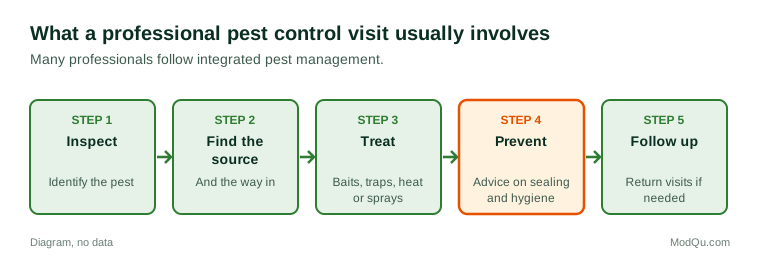
People often call a professional when a problem is large, keeps coming back, involves pests that can cause serious damage or health risks, or when they are unsure what the pest is. Professionals usually:
- Inspect the property and identify the pest.
- Find the source and the way in.
- Recommend and carry out treatment, such as baits, traps, sprays, heat treatment or fumigation.
- Advise on prevention.
- Return for follow-up visits if needed.
Many professionals use integrated pest management (IPM), an approach that combines prevention, monitoring and targeted treatment, and uses chemicals only when needed. In many countries pest control technicians must be trained or licensed, especially to use stronger pesticides. Some local authorities offer free or low-cost treatment for certain pests, such as rats, though this varies a great deal.
Bed bugs
Bed bugs deserve special mention because they are hard to remove and cause great distress. They hide in mattresses, bed frames, sofas and cracks, and spread through luggage, second-hand furniture and shared buildings. Signs include bites, small blood spots on sheets and tiny dark marks. Treatment often needs a professional and may involve heat treatment, repeated visits and a lot of preparation by the household, such as washing all bedding and clothes.
Example
A traveller returns from a trip and finds bites on their arms. A week later they see small dark spots on the mattress seam. A professional confirms bed bugs and carries out a heat treatment. The traveller now checks hotel beds and keeps luggage off the floor.
Safety and the environment
Pest control raises several safety and environmental concerns:
- Pesticide exposure for children, pets and people with health conditions.
- Secondary poisoning, when animals such as birds of prey or pets eat poisoned rodents.
- Glue traps, which some countries have restricted on animal welfare grounds.
- Harm to beneficial insects, such as bees.
- Resistance, as some pests become less affected by common chemicals.
Many countries regulate which pesticides can be sold to the public and which only to professionals. Some people prefer humane or non-chemical methods where possible.
Landlords, tenants and shared buildings
Who is responsible for pest control often depends on the cause, the lease and local law. In many places landlords are responsible for problems linked to the building, such as gaps or plumbing, while tenants may be responsible for problems they caused. In apartment buildings, pests can move between units, so building-wide treatment may be needed. Disputes over responsibility are common.
What people and businesses want to know
Questions businesses want answered include how many households had a pest problem in the past year, which pests, how they dealt with it, whether they used a professional, what it cost, whether the problem came back, and what worries people about pest control products.
Key terms
- InfestationA large number of pests living in a place.
- BaitFood mixed with a pesticide that pests eat and carry back to the nest.
- Integrated pest managementAn approach combining prevention, monitoring and targeted treatment.
- FumigationTreating a building or item with a gas to kill pests.
- Heat treatmentRaising the temperature of a room to a level that kills pests such as bed bugs.
- PesticideA substance used to kill or control pests.
- Secondary poisoningWhen an animal is poisoned by eating a poisoned pest.
- Bed bugA small insect that hides near beds and feeds on human blood at night.
Full glossary: biological control terms on EditingTests.com.
Pest control vocabulary test
How well do you know the language of this topic? Try 8 quick questions. Your score is shown straight away and is not saved.
What the pest control survey asks
This survey is part of ModQu's Household Life survey. The pest control part takes about five minutes and covers:
- Whether you have had a pest problem at home in the last year, and what kind of pest.
- How you first tried to deal with it, and what products you used.
- Whether you used a professional pest control service, and what it cost.
- Whether the problem came back.
- Who was responsible for dealing with it, for example you, a landlord or a building manager.
- What concerns you have about pest control products and methods.
After that you can choose to continue with other short parts of the Household Life survey, such as cleaning and laundry or household chores and time use, or stop.
Ready to take part?
Your answers help show what people really think and do. Results are only ever reported as totals; no one can see your individual answers.
Start the surveyQuestions about this survey
Who can take part?
Adults.
Do I have to give my name?
No. You may be asked for your age group, region and similar details so results can be broken down, but not your name. ModQu never asks for passwords, card numbers or account numbers.
How are the results used?
Answers are combined into totals and percentages and published in ModQu reports. Individual answers are never shown.
Is the vocabulary test part of the survey?
No. It is optional and separate, and your score is not stored.