
Share your hobby
Tell us whether you have taken up a new hobby, why, and how much time you give it. Your answers are combined with other people's and reported only as totals.
Start the hobbies for personal growth surveyAbout 5 minutes. No account needed. You can stop at any time.
What counts as a hobby for personal growth
A hobby is an activity done regularly in free time for enjoyment rather than for pay. Many hobbies also help a person grow: they build a skill, stretch the mind, improve health, provide calm or create new friendships. People often describe their hobbies this way, saying they took up painting to slow down, chess to keep their mind sharp or running to feel stronger.
The line between a hobby and other activities is not always clear. A hobby can turn into a side business, such as selling crafts or giving music lessons. Learning a language can be a hobby for one person and a job requirement for another. What makes something a hobby is that the person chooses it for its own sake.
The main kinds of hobbies
Hobbies chosen for growth fall into several broad groups:
- Creative: drawing, painting, photography, writing, pottery, knitting, sewing, woodwork, music, singing.
- Physical: running, cycling, swimming, dance, martial arts, yoga, hiking, climbing, team sports.
- Mental: chess and other strategy games, puzzles, reading, learning a language, coding, history or science study.
- Nature and practical: gardening, birdwatching, fishing, cooking, baking, home repair, keeping bees or chickens.
- Social and community: choirs, amateur theatre, volunteering, book clubs, community gardens.
- Collecting and making: model building, restoring furniture or vehicles, collecting stamps or coins.
Hobbies reflect where people live and what is available. Climate, cost, local traditions and space at home all shape the choice. A person in a small city apartment is less likely to keep chickens; a person in a cold climate may take up skating or cross-country skiing.
Why adults take up a new hobby
People give a range of reasons for starting a hobby:
- To learn something new or to master a skill.
- To relax and take their mind off work or worries.
- For physical or mental health, sometimes on a doctor's suggestion.
- To meet people, especially after moving, retiring or a change in relationships.
- To use a talent they set aside earlier in life.
- To fill time freed by retirement, children leaving home, or a change in work hours.
- Because friends or family do it.
- To create something they can see, keep or give.
Example
A newly retired bus driver takes up woodworking at a community workshop. They say they wanted something to do with their hands and a reason to leave the house most mornings. A year later they have built a bench, several boxes and a bookcase for a grandchild, and they meet the same group of four people at the workshop three times a week.
Time and money
Hobbies take time and often money. Time spent varies from a few minutes a day, such as language practice on a phone, to many hours a week for sports, music or building projects.
Costs range from almost nothing to a great deal:
- Low cost: walking, running, reading library books, drawing with pencils, many puzzles and games.
- Moderate cost: classes, club fees, basic equipment, materials.
- High cost: instruments, cameras, bicycles, travel to events, specialist tools, studio or workshop space.
Many people spend heavily at the start of a hobby and less later on, or stop and leave equipment unused.
Example (hypothetical figures)
A person takes up photography. In the first year they spend $900 on a used camera and lens, $240 on an evening course, $60 on a photo-editing subscription and $150 on prints and a small exhibition fee. That is $1,350 in total. They spend about 4 hours a week on it, roughly 200 hours over the year, which they calculate as just under $7 an hour.
Questions that businesses want answered here include which hobbies people have started recently, why, what they spend and how many hours a week they give them.
What people gain
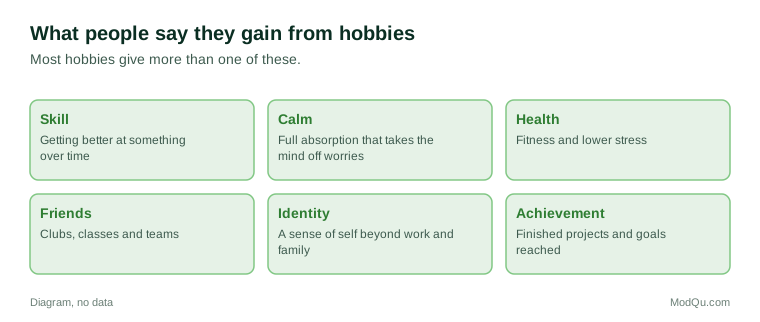
People who keep a hobby often report several benefits, shown in the figure below:
- Skill and mastery: the satisfaction of getting better at something over time.
- Calm and focus: many hobbies absorb attention fully, a state sometimes called flow, in which people lose track of time.
- Health: physical hobbies improve fitness; many hobbies reduce stress.
- Social connection: clubs, classes and teams create friendships, which matter for wellbeing at every age.
- Identity: being "a runner", "a gardener" or "a musician" gives a sense of who one is beyond work and family.
- Achievement: finished projects, races completed or pieces performed.
Research on older adults has linked mentally and socially active leisure with better wellbeing, though it is hard to tell how much is cause and how much is that healthier people are more able to take part.
Why people drop hobbies
Many new hobbies do not last. Common reasons include:
- Lack of time when work, study or family demands increase.
- Cost, especially of equipment, classes or travel.
- Slow progress, which can be discouraging after the first excitement fades.
- Injury or health problems.
- Losing the social side, such as a class ending or a friend moving away.
- Pressure: turning a hobby into a side business or setting strict goals can take the enjoyment out of it.
- Moving to a place without facilities or a group.
Example
An office worker joins an adult beginners' swimming class to overcome a fear of water. After the ten-week course ends, they try to keep swimming alone but go less and less. When a classmate suggests meeting at the pool every Saturday morning, they start going again and say having a regular partner made the difference.
Hobbies, technology and the online world
Technology has changed how people take up hobbies. Online videos teach skills from guitar to bread making. Apps track runs, practice and progress. Online groups connect people with rare interests across countries. At the same time, some people say screens crowd out time for hobbies, and that they feel pressure to share or perform their hobby online rather than simply enjoy it.
What people disagree about
- Should hobbies be productive? Some people see hobbies as a way to improve; others say the point is to do something just for fun, with no goal.
- Solo or social? Some prefer quiet solo hobbies; others value the group.
- Monetising hobbies: some welcome the chance to earn from a hobby; others find it spoils the enjoyment.
Key terms
- HobbyAn activity done regularly in free time for enjoyment rather than pay.
- PastimeAnother word for an activity that passes free time pleasantly.
- FlowA state of full absorption in an activity in which people lose track of time.
- MasteryBecoming skilled at something through practice over time.
- LeisureTime free from work and duties.
- Side hustlePaid work done alongside a main job, sometimes growing out of a hobby.
- Beginner plateauA period early in learning when progress seems to stall.
- Community workshopA shared space with tools and equipment that members can use.
Full glossary: adult education services terms on EditingTests.com.
Hobbies for personal growth vocabulary test
How well do you know the language of this topic? Try 8 quick questions. Your score is shown straight away and is not saved.
What the hobbies for personal growth survey asks
This survey is part of ModQu's Personal Development survey. The hobbies for personal growth part takes about five minutes and covers:
- Whether you have taken up a new hobby in the last year, and which one.
- Why you started it.
- How many hours a week you spend on it.
- What you spend on equipment, classes and materials.
- What you have gained, and what makes it hard to keep going.
- Which hobby you would like to try next.
After that you can choose to continue with other short parts of the Personal Development survey, such as self-improvement or productivity and time management, or stop.
Ready to take part?
Your answers help show what people really think and do. Results are only ever reported as totals; no one can see your individual answers.
Start the surveyQuestions about this survey
Who can take part?
Adults.
Do I have to give my name?
No. You may be asked for your age group, region and similar details so results can be broken down, but not your name. ModQu never asks for passwords, card numbers or account numbers.
How are the results used?
Answers are combined into totals and percentages and published in ModQu reports. Individual answers are never shown.
Is the vocabulary test part of the survey?
No. It is optional and separate, and your score is not stored.