
Share your view of your health system
Tell us how satisfied you are with your country's health system, its biggest problem and how it should be funded. Your answers are combined with other people's and reported only as totals.
Start the healthcare systems surveyAbout 5 minutes. No account needed. You can stop at any time.
What a health system includes
A health system is all the organizations, people and resources that provide and pay for health care in a country. It includes:
- primary care: family doctors, general practitioners, nurses and community clinics;
- hospitals, for emergencies, operations and specialist treatment;
- specialist care such as cancer, heart and mental health services;
- pharmacies and medicines;
- public health: vaccination, disease control, health promotion;
- long-term care for older and disabled people;
- dental, eye and hearing care, which are covered differently from other care in many countries.
The World Health Organization describes the goal of universal health coverage as everyone being able to use the quality health services they need without suffering financial hardship. It is part of the United Nations Sustainable Development Goals.
How health care is paid for
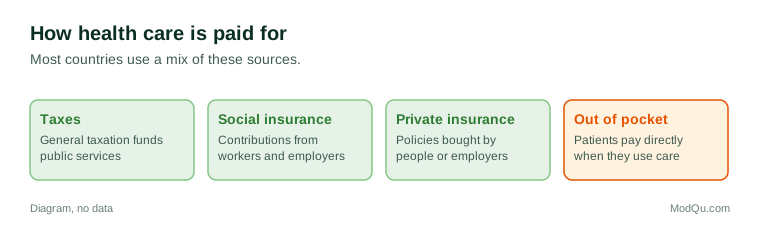
Countries pay for health care through a mix of sources:
- Taxes: governments fund care from general taxation, often providing services free or at low cost.
- Social health insurance: workers and employers pay contributions into insurance funds that pay for care.
- Private insurance: individuals or employers buy insurance policies.
- Out-of-pocket payments: patients pay directly for care, medicines or fees.
- Donor funding: in some lower-income countries, international aid pays for part of health care.
Most countries combine several of these. Health systems are often described by their main source of funding:
- Tax-funded national health services, such as those in the United Kingdom, Spain, Sweden and Brazil's Unified Health System.
- Social health insurance systems, such as those in Germany, France, the Netherlands and Japan.
- Single-payer insurance, where one public insurer pays for care delivered by many providers, as with provincial health insurance in Canada.
- Mixed or market-based systems, where private insurance plays a large role alongside public programs, as in the United States.
- Systems relying heavily on out-of-pocket payments, common in many lower-income countries.
Costs to patients
Even in systems with wide public coverage, patients may pay for some things: prescription charges, dental care, eye tests, glasses, physiotherapy, private rooms, or co-payments for visits. In systems with large out-of-pocket costs, a serious illness can push households into debt or poverty. The WHO and World Bank track catastrophic health spending, where health costs take a large share of a household's budget.
Example (hypothetical figures)
A household's monthly income is 2,000, in local currency. In one month, a family member needs a hospital test costing 300, medicines costing 120 and two specialist visits at 40 each. Their insurance covers half of the test. They pay 150 for the test, 120 for medicines and 80 for visits, a total of 350, which is 17.5% of that month's income.
Common problems people report
Surveys of patients in many countries find similar complaints, though their size varies:
- waiting times for appointments, tests, operations and emergency care;
- difficulty seeing a family doctor or specialist;
- costs of medicines, insurance and treatment;
- staff shortages, with overstretched doctors and nurses;
- distance, especially for rural residents;
- quality and safety concerns;
- poor coordination between services;
- long-term care that is hard to find or afford.
Example
A patient in a tax-funded system needs a knee operation. It is free, but the waiting time is many months. They are in pain and unable to work, so they consider paying for private treatment, which would be much faster but costs a large sum. They decide to wait, using physiotherapy and pain relief.
What people value
When asked what matters most, people commonly mention:
- being able to get care when they need it;
- not having to worry about cost;
- quality of treatment and good outcomes;
- respectful, caring staff;
- choice of doctor or hospital;
- clear information.
The balance between these differs between people and countries. Some value free access most; others value choice and speed. Many people are positive about the care they personally receive but more critical of the system as a whole.
Example
A person who recently had a heart procedure rates their own treatment highly: staff were kind and the operation went well. Asked about the health system overall, they rate it poorly, citing long waits in the emergency department and news about staff shortages.
Pressures on health systems
Health systems in many countries face rising demand from ageing populations and long-term conditions, new and costly treatments, and workforce shortages. Governments must decide how much to spend, how to raise the money and what to prioritize. The COVID-19 pandemic strained systems worldwide and left backlogs of delayed care in many countries.
What people disagree about
Health care is one of the most debated public issues. People disagree about:
- how much public money should go to health compared with other services;
- whether care should be free at the point of use or involve charges;
- the role of private insurance and private providers;
- whether taxes or insurance contributions should rise to fund care;
- how to cut waiting times;
- which treatments should be funded.
Questions that governments, health agencies and policy groups want answered include how satisfied people are with their health system, what they see as its biggest problem, how much they pay out of pocket, and whether more public money should go to health.
Mental health and long-term care
Mental health services and long-term care for older and disabled people are often described as the weakest parts of health systems. In many countries, they are funded separately from other care, rely heavily on families and charities, or involve large out-of-pocket costs. Waiting times for mental health treatment are a common complaint.
Key terms
- Health systemAll the organizations, people and resources that provide and pay for health care.
- Universal health coverageEveryone able to use needed health services without financial hardship.
- Primary careFirst-contact care, usually from a family doctor or clinic.
- Social health insuranceHealth insurance funded by contributions from workers and employers.
- Single-payer systemA system in which one public body pays for most health care.
- Out-of-pocket paymentMoney paid directly by a patient for care.
- Co-paymentA fixed amount the patient pays toward a service, with insurance paying the rest.
- Waiting listA list of patients waiting for treatment.
Full glossary: health policy terms on EditingTests.com.
Healthcare systems vocabulary test
How well do you know the language of this topic? Try 8 quick questions. Your score is shown straight away and is not saved.
What the healthcare systems survey asks
This survey is part of ModQu's Government and Public Services survey. The healthcare systems part takes about five minutes and covers:
- How satisfied you are with your country's health system overall.
- What you see as its biggest problem.
- How easily you can see a doctor, specialist or get hospital care.
- How much you pay out of pocket for care and medicines.
- Whether you have private health insurance.
- Whether more public money should go to health, and how it should be raised.
After that you can choose to continue with other short parts of the Government and Public Services survey, such as local services or trust in government, or stop.
Ready to take part?
Your answers help show what people really think and do. Results are only ever reported as totals; no one can see your individual answers.
Start the surveyQuestions about this survey
Who can take part?
Adults.
Do I have to give my name?
No. You may be asked for your age group, region and similar details so results can be broken down, but not your name. ModQu never asks for passwords, card numbers or account numbers.
How are the results used?
Answers are combined into totals and percentages and published in ModQu reports. Individual answers are never shown.
Is the vocabulary test part of the survey?
No. It is optional and separate, and your score is not stored.
Does the survey ask about my health conditions?
Only in general terms, such as whether you used health services recently. Any personal health question is optional.
Can people in any country take part?
Yes. Questions are written for all types of health system, and you answer about your own country.
Does ModQu give health advice?
No. This page describes health systems. For medical advice, contact a health professional.
Will my answers be shared with health services?
Results are reported for groups only, and ModQu does not ask for your name or health records.