
Share your daily routine
Tell us what your mornings look like, which habits you have tried to build and whether they lasted. Your answers are combined with other people's and reported only as totals.
Start the habits and routines surveyAbout 5 minutes. No account needed. You can stop at any time.
What habits and routines are
A habit is a behaviour that has been repeated so often in the same situation that it happens almost automatically. Brushing teeth before bed, checking a phone on waking and putting keys in the same place are common examples. Once formed, a habit needs little effort or decision.
A routine is a sequence of activities done in a regular order, such as a morning routine or a bedtime routine for children. A routine is often made up of several habits linked together. Routines give structure to the day and reduce the number of decisions a person has to make.
Not every regular behaviour is a habit. Something a person does every day on purpose, thinking about it each time, is a routine choice rather than a habit. The difference matters because habits keep going even when motivation is low, while deliberate choices depend on it.
How habits form
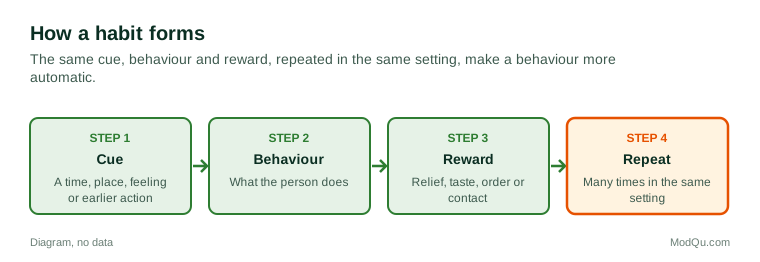
Researchers often describe habits as built around three parts, shown in the figure below:
- A cue: something that triggers the behaviour, such as a time of day, a place, a feeling or another action.
- The behaviour itself.
- A reward: something pleasant that follows, such as relief, a good taste, a sense of order or a bit of social contact.
When the same cue is followed by the same behaviour and reward many times, the link becomes stronger and the behaviour starts to happen with less thought. How long this takes varies widely between people and behaviours. Simple habits such as drinking a glass of water after breakfast can form faster than complex ones such as exercising.
Habits are tied to context. A person who always has a snack while watching television in the evening may find the urge disappears on holiday, when the setting is different, and returns when they get home.
Morning and evening routines
Daily routines differ widely with work, family, culture and climate, but most include a few common parts.
A morning routine might include waking at a set time, using the bathroom, washing or showering, prayer or quiet time, exercise, breakfast, checking messages or news, getting children ready and travelling to work or school. For some people the morning is rushed and fixed by a work or school start time; for others, such as retirees or remote workers, it is flexible.
An evening routine might include cooking and eating, cleaning up, family time, screens, preparing for the next day, washing and going to bed. Bedtime routines for children, such as a bath, a story and lights out at a set time, are widely recommended to help children settle.
Example
A remote worker used to start work in pyjamas as soon as they woke, checking email from bed. They felt tired and unfocused. They now get dressed, walk around the block and make coffee before opening their laptop. They say the short walk works as a signal that the workday has started, and they stop work at the same time each evening by closing the laptop and putting it in a drawer.
Building a new habit
People try to build many kinds of habits: exercise, reading, eating more vegetables, saving money, journaling, meditation, language practice, going to bed earlier, drinking more water or calling family regularly. Approaches that research and experience suggest help include:
- Start small. A two-minute version of the habit, such as one push-up or one page, is easier to repeat.
- Attach it to an existing habit. For example, stretching right after brushing teeth in the morning.
- Make the cue obvious. Putting running shoes by the door or a book on the pillow.
- Make it easy. Removing steps between the person and the behaviour.
- Track it. A calendar with crosses for each day done can help some people.
- Expect missed days. Missing once does not undo progress; the aim is to return the next day.
Example (hypothetical figures)
A person sets out to walk for 20 minutes after lunch every workday. Over the first eight weeks, which have 40 workdays, they walk on 31 days. In weeks one and two they walked 9 of 10 days; in weeks five and six, when meetings moved to lunchtime, only 5 of 10. They move the walk to just after their last meeting of the day and manage 9 of 10 in weeks seven and eight.
Breaking or changing an old habit
Stopping an unwanted habit, such as late-night snacking, scrolling on the phone in bed, nail biting or smoking, is often harder than starting a new one. Common approaches include:
- Removing or avoiding the cue, such as charging the phone outside the bedroom.
- Adding friction, such as logging out of an app so it takes longer to open.
- Replacing the behaviour, keeping the cue and reward but changing what happens in between, for example chewing gum instead of smoking after a meal.
- Changing the setting, which is why moving house or starting a new job can make change easier.
- Getting support from friends, groups or professionals. For addictions, professional help and recognised treatment programs are often needed.
Why new habits fade
Many habits that start well are gone within weeks. Common reasons include:
- the habit was too big to repeat on bad days;
- there was no clear cue, so it depended on remembering;
- the reward was too far away, as with exercise for long-term health;
- a disruption such as illness, travel or a holiday broke the chain and it never restarted;
- the person was trying to change too many things at once;
- the habit did not fit their real schedule or energy levels.
Example
A parent decides to get up at 5:30 to exercise before their children wake. It works for two weeks. Then a child starts waking at night, and the early alarm leaves the parent exhausted. They switch to a 15-minute workout while the children are in the bath, which fits the evening routine they already have.
Habits, technology and work
Phones and apps have become part of most daily routines. Many people check their phone within minutes of waking and before sleep. Apps are designed to bring people back, with notifications, streaks and rewards. The same techniques are also used by habit-tracking apps to help people build habits they want.
Employers are interested in habits too: how people organise their workday, whether they take breaks, how they use shared tools and how remote work has changed routines.
What people disagree about
- Routine or flexibility? Some people find fixed routines calming and productive; others find them dull and prefer variety.
- Willpower or design? Some see habit change mainly as a matter of discipline; others say changing the environment matters more.
- Are tech habits a problem? Views differ on whether frequent phone use is harmful or simply a new normal.
Questions that businesses want answered here include what people's daily routines look like, which habits they have tried to build, and what helped or got in the way.
Key terms
- HabitA behaviour repeated so often in the same situation that it happens almost automatically.
- RoutineA sequence of activities done in a regular order.
- CueSomething that triggers a habit, such as a time, place or feeling.
- RewardSomething pleasant that follows a behaviour and makes it more likely to be repeated.
- Habit stackingAttaching a new habit to one you already have.
- FrictionExtra steps that make a behaviour harder to do.
- StreakA run of consecutive days on which a habit was done.
- ContextThe setting, time and situation in which a behaviour happens.
Full glossary: behavioral science terms on EditingTests.com.
Habits and routines vocabulary test
How well do you know the language of this topic? Try 8 quick questions. Your score is shown straight away and is not saved.
What the habits and routines survey asks
This survey is part of ModQu's Personal Development survey. The habits and routines part takes about five minutes and covers:
- What your morning and evening routines look like.
- Which habits you have tried to build in the last year.
- Whether those habits lasted, and for how long.
- Which habits you have tried to break, and what helped.
- Whether you use apps, calendars or reminders to track habits.
- What most often gets in the way of a new habit.
After that you can choose to continue with other short parts of the Personal Development survey, such as self-improvement or productivity and time management, or stop.
Ready to take part?
Your answers help show what people really think and do. Results are only ever reported as totals; no one can see your individual answers.
Start the surveyQuestions about this survey
Who can take part?
Adults.
Do I have to give my name?
No. You may be asked for your age group, region and similar details so results can be broken down, but not your name. ModQu never asks for passwords, card numbers or account numbers.
How are the results used?
Answers are combined into totals and percentages and published in ModQu reports. Individual answers are never shown.
Is the vocabulary test part of the survey?
No. It is optional and separate, and your score is not stored.