
Share your view of green energy
Tell us whether your electricity comes from a green tariff, what you would pay and whether you trust green claims. Your answers are combined with other people's and reported only as totals.
Start the green energy suppliers surveyAbout 5 minutes. No account needed. You can stop at any time.
What a green energy tariff is
A green, renewable or clean energy tariff is an electricity plan that claims some or all of the electricity supplied is matched by electricity generated from renewable sources such as wind, solar, hydro or biomass. Some tariffs also cover gas, by offsetting emissions or adding biogas.
Whether households can choose depends on where they live. In some countries and regions, households choose from many suppliers and tariffs. In others, a single utility supplies everyone, and choices are limited to options the utility offers, such as a renewable add-on. In many places, households have no choice at all.
How green tariffs work
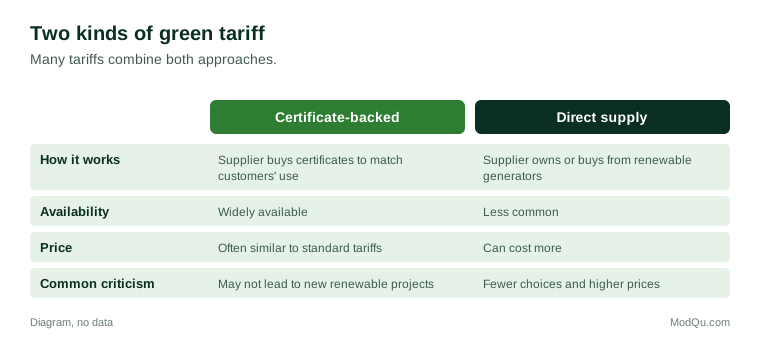
Electricity from all sources flows through the same grid, so the electrons reaching a home cannot be traced to a particular power station. Green tariffs therefore work through matching and certificates:
- Renewable energy certificates: when a renewable generator produces electricity, it can receive certificates (called by different names, such as guarantees of origin in Europe or renewable energy certificates in North America). Suppliers buy certificates to match the electricity their customers use.
- Direct contracts: some suppliers own renewable generators or buy power directly from them under long-term agreements.
- Utility programs: some utilities offer customers a share of power from a specific renewable project.
Critics point out that buying certificates separately from the electricity does not necessarily lead to new renewable capacity being built. Supporters respond that certificates create demand that supports renewable generators. Tariffs that buy directly from renewable generators, or that support new projects, are sometimes seen as stronger.
What green tariffs cost
Green tariffs may cost the same as standard tariffs, a little more, or occasionally less. Price depends on the supplier, the market, the type of green claim and wholesale prices. In some markets, green tariffs are now common and priced similarly to standard ones. Where they cost more, the premium varies widely.
Example (hypothetical figures)
A household uses 3,000 kilowatt-hours of electricity a year. A standard tariff costs 0.25 per kWh, in local currency, which is 750 a year. A green tariff costs 0.27 per kWh, which is 810 a year. The extra 60 a year works out at 5 a month.
How households choose
Households weigh several factors:
- price, often the deciding factor;
- what the green claim means, such as 100% renewable or partly renewable;
- trust in the supplier;
- customer service and billing;
- contract terms, such as fixed or variable prices and exit fees;
- recommendations from friends, comparison sites or consumer groups;
- local projects, such as community-owned wind or solar.
Example
A family switches to a tariff advertised as 100% renewable. They later read that the supplier buys certificates rather than generating renewable power itself. They stay with the supplier because the price is good, but say they would pay a little more for a tariff linked to new local wind farms.
Trust and greenwashing
Many people are unsure what green energy claims mean. Common questions include whether the energy is really renewable, whether it would have been generated anyway, and whether a tariff makes any difference to the environment.
Greenwashing means making misleading claims about environmental benefits. Regulators in several countries have issued guidance or acted on misleading environmental claims, including in energy. Consumer groups publish ratings of suppliers based on where their electricity comes from and how much they invest in renewables.
Signs people look for when judging green claims include:
- clear information about the sources of electricity;
- whether the supplier owns or contracts with renewable generators;
- independent certification or ratings;
- the supplier's fuel mix disclosure, which some countries require.
Example
A person compares two "green" tariffs. One supplier publishes a breakdown showing it buys most of its power directly from wind and solar farms. The other gives only a general statement. The person chooses the first, even though it costs slightly more, because the information is clearer.
Other ways to use green energy
Besides green tariffs, households can:
- install solar panels on their roof;
- join community energy schemes that own local wind or solar projects;
- use batteries to store solar power;
- use time-of-use tariffs to shift use to times when more renewable power is on the grid;
- reduce overall energy use.
In many countries, the share of renewable electricity on the national grid has grown, so even standard tariffs include a larger renewable share than before.
Where choice is limited
In places with a single utility, people's options depend on the utility's programs and on public policy. In many lower-income countries, the main issues are access to reliable electricity and its cost, and off-grid solar systems have brought power to many households without grid connections. Views on green energy in these settings often focus on reliability and price more than on the source.
What people disagree about
People disagree about whether green tariffs make a real difference, whether certificates should count, whether households should pay more for green power or whether governments should make all power cleaner, and how quickly grids should move to renewable sources. There are also debates about the costs of renewable energy, the use of land for wind and solar farms, and reliability.
Questions that utilities, energy suppliers, governments and environmental groups want answered include how many households use green tariffs, how much more they would pay for renewable energy, and how much they trust green energy claims.
Key terms
- Renewable energyEnergy from sources that are naturally replenished, such as wind, sun and water.
- Green tariffAn electricity plan claiming to be matched by renewable generation.
- Renewable energy certificateA record proving that a unit of electricity was generated from renewable sources.
- Guarantee of originThe European name for a renewable energy certificate.
- Fuel mix disclosureInformation showing the sources of a supplier's electricity.
- GreenwashingMaking misleading claims about environmental benefits.
- Community energyEnergy projects owned or run by local communities.
- AdditionalityWhether a purchase leads to new renewable generation that would not otherwise exist.
Full glossary: green energy terms on EditingTests.com.
Green energy suppliers vocabulary test
How well do you know the language of this topic? Try 8 quick questions. Your score is shown straight away and is not saved.
What the green energy suppliers survey asks
This survey is part of ModQu's Energy and Environment survey. The green energy suppliers part takes about five minutes and covers:
- Whether your electricity comes from a green or renewable tariff.
- Whether you can choose your energy supplier where you live.
- How much more you would pay for renewable energy.
- How much you trust green energy claims, and why.
- What information would help you judge a green tariff.
- Whether you use other options, such as solar panels or community energy.
After that you can choose to continue with other short parts of the Energy and Environment survey, such as home energy use and bills or solar power at home, or stop.
Ready to take part?
Your answers help show what people really think and do. Results are only ever reported as totals; no one can see your individual answers.
Start the surveyQuestions about this survey
Who can take part?
Adults who pay energy bills.
Do I have to give my name?
No. You may be asked for your age group, region and similar details so results can be broken down, but not your name. ModQu never asks for passwords, card numbers or account numbers.
How are the results used?
Answers are combined into totals and percentages and published in ModQu reports. Individual answers are never shown.
Is the vocabulary test part of the survey?
No. It is optional and separate, and your score is not stored.
Is solar power at home covered here?
It is mentioned, but solar panels at home have their own topic. This survey focuses on the tariffs and suppliers people choose.
Why does the survey ask about trust?
Many green claims cannot be checked by customers directly, so trust in suppliers and labels shapes whether people choose green tariffs.
What if I cannot choose my supplier?
You can still take part. The survey asks about the options available to you and your views on green energy.
Do I need to know my tariff name?
No. You can say whether you think it is green, standard or not sure.
Does the survey recommend suppliers?
No. ModQu does not recommend or rate energy companies.