
Share how you buy shoes
Tell us how many pairs you bought, where you bought them and what matters most to you. Your answers are combined with other people's and reported only as totals.
Start the footwear surveyAbout 5 minutes. No account needed. You can stop at any time.
What footwear covers
Footwear means anything worn on the feet: shoes, boots, sandals, slippers and specialist items such as safety boots or dance shoes. In most countries adults own several pairs for different purposes, although the number varies a great deal with income, climate, work and personal interest. Some people own two or three pairs and wear them until they fall apart. Others own dozens and choose a pair to match each outfit.
Footwear sits between clothing and equipment. A pair of shoes has to look right, but it also has to protect the foot, support the body for hours of walking or standing, and suit the weather and the ground. That is why the same person may buy fashion shoes on impulse but take great care over work boots or running shoes.
The main kinds of footwear
Most shoes people own fall into a few broad groups:
- Everyday casual shoes: trainers (sneakers), canvas shoes, loafers and slip-ons worn for daily errands and leisure.
- Formal and work shoes: leather lace-ups, court shoes (pumps), heels and polished boots for offices, ceremonies and events.
- Athletic shoes: running, walking, court, football and training shoes designed for a sport, with cushioning, grip or support suited to it.
- Boots: ankle boots, winter boots, rain boots and hiking boots, often chosen for climate and terrain.
- Sandals and open shoes: flip-flops, strap sandals and slides, which in hot climates may be the main everyday footwear all year.
- Safety and occupational footwear: steel or composite toe caps, slip-resistant soles and waterproof boots required in construction, factories, kitchens and hospitals.
- Indoor footwear: slippers and house shoes, common in homes where outdoor shoes are removed at the door.
Customs differ. In many parts of Asia, the Middle East, Northern Europe and Canada it is usual to take shoes off at home, so slippers or socks are worn indoors. In other places outdoor shoes are worn throughout the house.
How people choose shoes
When people are asked what matters most in a shoe, the answers usually come down to a few things that pull against each other:
- Comfort and fit: whether the shoe feels right after a full day, not only in the shop.
- Price: what the person can afford and what they think a fair price is.
- Style: how the shoe looks, whether it suits their clothes and whether it is in fashion.
- Durability: how long the sole, stitching and upper will last.
- Purpose: whether it suits work rules, a sport, the weather or a special event.
- Brand and reputation: trust built from past pairs, reviews or recommendations.
The balance changes with the purchase. People buying shoes for a wedding may put style first and accept some discomfort for one day. People who stand at work, such as nurses, cooks and retail staff, often put comfort and support ahead of everything else.
Example
A warehouse worker needs safety boots for a new job. The employer requires toe protection and slip-resistant soles. They try three pairs in a work-wear shop, walk around in each for several minutes and choose the heaviest but most comfortable pair, even though a lighter pair looked better.
Fit, sizes and comfort
Fit is the most common problem with shoes. Sizes are measured in different systems around the world, including European, UK, US and Japanese (centimetre-based) sizes, and conversion charts between them are approximate. Within one system, sizes also vary between makers, between styles from the same maker, and between shoes made in different factories.
Length is only one part of fit. Width, the height of the instep, the shape of the toe box, the arch and the heel all matter. Feet also change: they can swell during the day and in hot weather, and they tend to get longer and wider with age and after pregnancy. Many people have one foot slightly larger than the other.
Common advice from shoe fitters is to try shoes on later in the day, wear the socks normally worn with them, and walk on a hard floor rather than a carpet. Buying online makes fit harder to judge, which is one reason footwear has high return rates compared with many other goods.
Example
A shopper orders the same running shoe in their usual size and half a size up, planning to return one pair. The larger pair fits better because the newer version of the shoe has a narrower toe box than the pair they wore out. They return the smaller pair and note the change for next time.
Where people buy shoes
Shoes are sold through many channels:
- specialist shoe shops, where staff may measure feet and offer advice;
- department stores and clothing chains with a shoe section;
- sports shops for athletic footwear;
- supermarkets and discount stores for low-cost everyday shoes;
- markets and street vendors, an important source in many countries;
- the shoemaker's or brand's own website and online marketplaces;
- second-hand shops, resale websites and social media sales, especially for collectable trainers.
Many people mix channels. They might try shoes on in a shop and buy online, or buy a familiar model online once they know their size. Questions that businesses want answered include where people last bought shoes, why they chose that place, and whether they would buy shoes online without trying them first.
Cost, value and how long shoes last
Prices range from very cheap mass-produced pairs to handmade shoes costing many times more. People often judge value by cost per wear rather than by price alone.
Example (hypothetical figures)
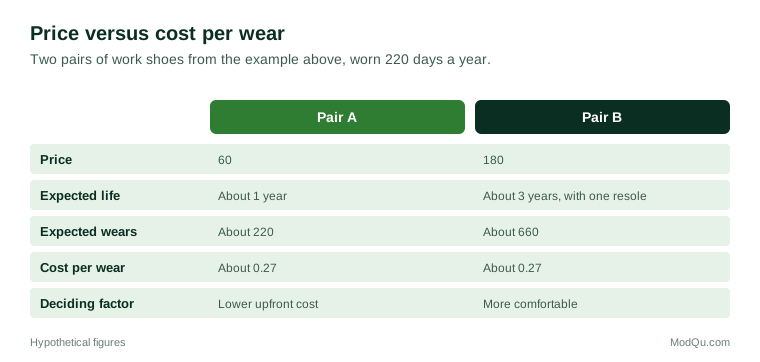
A commuter compares two pairs of leather work shoes. Pair A costs 60 and is expected to last one year of daily wear. Pair B costs 180 and can be resoled once, so it is expected to last three years. Worn on 220 working days a year, pair A costs about 0.27 per wear (60 ÷ 220) and pair B about 0.27 per wear as well (180 ÷ 660). The commuter chooses pair B because it is more comfortable, even though the cost per wear is about the same.
How long shoes last depends on how often they are worn, the materials, the climate and whether they are cared for. Rotating between two pairs lets leather and cushioning dry out between wears. Repairs such as new heels, soles or stitching can extend the life of good shoes, although shoe repairers are harder to find in some places than they once were. Athletic shoes are a special case: cushioning wears down with use even when the shoe still looks fine.
Trends and what people disagree about
Several changes are discussed often in footwear:
- Casual shoes at work and events. Trainers are now accepted in many offices and at some formal occasions where leather shoes were once expected.
- Comfort technology. Cushioned soles and lightweight materials from sports shoes have moved into everyday and even dress shoes.
- Collecting and resale. Limited releases of trainers are bought, collected and resold, sometimes for more than the original price.
- Sustainability. Shoes combine many materials glued together, which makes them hard to recycle. Some makers offer repairs, take-back schemes or recycled materials.
- Foot health. Podiatrists and other foot specialists discuss high heels, narrow toe boxes and very flat shoes. Advice differs from person to person, and people with foot conditions are usually advised to speak to a health professional.
People disagree about whether expensive shoes are worth the money, whether children need shoes fitted in a shop, and whether shoes should be worn indoors at all. A survey can show how those views differ by country, age and type of work.
Key terms
- UpperThe part of the shoe above the sole that covers the foot.
- OutsoleThe bottom layer of the sole that touches the ground.
- InsoleThe layer inside the shoe that the foot rests on, often removable.
- Toe boxThe front part of the shoe around the toes; its width and height affect comfort.
- LastThe foot-shaped form a shoe is built around, which sets its size and shape.
- ResolingReplacing a worn sole so the shoe can be worn for longer.
- Heel-to-toe dropThe difference in height between the heel and the front of the foot inside a shoe.
- Width fittingA size measure for how wide a shoe is, offered by some makers alongside length.
Full glossary: shoe manufacturing terms on EditingTests.com.
Footwear vocabulary test
How well do you know the language of this topic? Try 8 quick questions. Your score is shown straight away and is not saved.
What the footwear survey asks
This survey is part of ModQu's Fashion and Style survey. The footwear part takes about five minutes and covers:
- How many pairs of shoes you bought in the last year, and what kinds.
- Where you bought them: shops, online, markets or second-hand.
- What matters most to you: comfort, price, style, durability or brand.
- How often shoes do not fit, and whether you have returned shoes because of fit.
- How much you spend on footwear in a typical year.
- Whether you repair shoes or replace them when they wear out.
After that you can choose to continue with other short parts of the Fashion and Style survey, such as sportswear and athleisure or luxury goods, or stop.
Ready to take part?
Your answers help show what people really think and do. Results are only ever reported as totals; no one can see your individual answers.
Start the surveyQuestions about this survey
Who can take part?
Adults.
Do I have to give my name?
No. You may be asked for your age group, region and similar details so results can be broken down, but not your name. ModQu never asks for passwords, card numbers or account numbers.
How are the results used?
Answers are combined into totals and percentages and published in ModQu reports. Individual answers are never shown.
Is the vocabulary test part of the survey?
No. It is optional and separate, and your score is not stored.