
Share your experience of fishing or hunting
Tell us whether you fish or hunt, how often, and how much you spent on equipment last year. Your answers are combined with other people's and reported only as totals.
Start the fishing and hunting surveyAbout 5 minutes. No account needed. You can stop at any time.
What this topic covers
This page is about recreational fishing and hunting, meaning fishing and hunting done for leisure, food for the household, tradition or sport rather than as a business. It does not cover commercial fishing. Practices, rules and attitudes differ greatly between countries, regions and cultures, and for many Indigenous peoples and rural communities hunting and fishing are part of daily life and culture as well as a source of food.
This page describes the activities and the questions people ask about them. It does not give instructions on hunting, firearms or fishing methods.
Types of recreational fishing
Recreational fishing, often called angling, takes many forms:
- Coarse or freshwater fishing, in rivers, lakes, ponds and canals.
- Game fishing, for species such as trout and salmon, often with fly fishing.
- Sea fishing, from the shore, piers or boats.
- Ice fishing, through holes cut in frozen lakes, common in cold regions.
- Spearfishing, underwater, which is restricted or banned in some places.
- Catch and release, where fish are returned to the water after being caught.
- Fishing for food, where fish are kept and eaten within legal limits.
Many people fish alone for quiet and relaxation; others fish with family, friends or clubs, or enter competitions.
Example
A parent takes their teenager fishing at a local lake every Saturday morning during the summer. They buy day permits at a shop near the lake and release most of what they catch, keeping one or two fish to cook at home.
Types of recreational hunting
Recreational hunting also takes several forms, depending on the species, place and law:
- Big game hunting, such as deer, elk, moose, wild boar or antelope.
- Small game hunting, such as rabbits and hares.
- Bird hunting, such as ducks, geese, pheasants and grouse.
- Hunting with firearms, with bows, or in some places with trained dogs or birds of prey.
- Wildlife management hunting, where hunting is used to control populations that would otherwise damage crops or habitats.
- Guided and trophy hunting, where hunters pay for guided hunts, sometimes abroad.
Laws in some countries strictly limit or ban certain forms of hunting.
Who takes part and why
People who fish or hunt give a range of reasons:
- Being outdoors and enjoying nature.
- Relaxation and time away from screens and work.
- Food, including wild meat and fish.
- Tradition and family, passing skills between generations.
- Social contact, through clubs and groups.
- Challenge and skill.
- Conservation, through managing wildlife and supporting habitats.
Participation differs widely by country, region and setting. In many places, rural residents are more likely to hunt, while fishing is common in both towns and the countryside.
Licences, permits and seasons
Most countries regulate recreational fishing and hunting. Common rules include:
- Licences or permits, often bought from a government agency or authorized seller. Some countries require a test or course before a hunting licence is issued.
- Seasons, which limit when certain species may be taken, often to protect breeding periods.
- Bag limits, which set how many animals or fish one person may take.
- Size limits, for fish and some game.
- Protected species, which may not be taken at all.
- Firearms laws, which control who may own and use guns and how they are stored.
- Land access rules, which decide where people may hunt or fish, and whether permission from landowners is needed.
Licence fees in many countries help fund wildlife and fisheries management. Rules can be complex and change often, so participants usually check with the relevant authority each season.
Example
A hunter who moves to a different country finds that they must pass a written and practical exam before they can apply for a hunting licence there, even though they have hunted for many years at home. They join a course run by a local hunting association.
Equipment and spending
Equipment costs vary from very low to very high:
- Fishing: rods, reels, line, hooks, bait or lures, nets, tackle boxes, waders and, for some, boats.
- Hunting: firearms or bows, ammunition, clothing, boots, optics such as binoculars and scopes, safety gear and, in some places, dogs.
- Travel and access: fuel, accommodation, guides, day permits and club fees.
- Processing and storage: freezers and butchering services for meat.
Example (hypothetical figures)
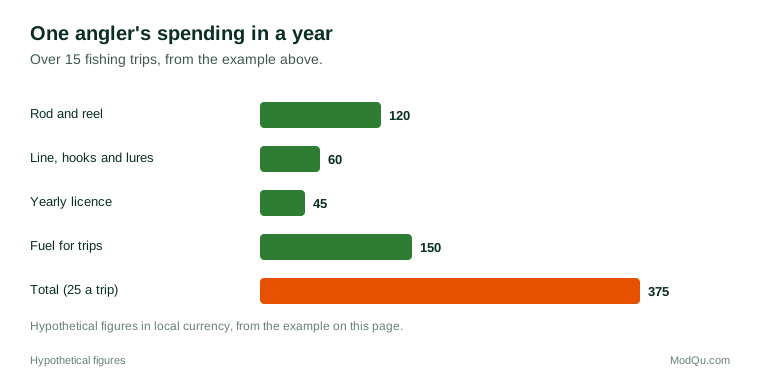
An angler spends 120 in their local currency on a new rod and reel, 60 on line, hooks and lures, 45 on a yearly licence and 150 on fuel for trips. Their total for the year is 375. They catch fish on 15 trips, so the cost is 25 a trip.
Safety
Both activities carry safety risks. For fishing these include drowning, slipping on rocks, weather changes, cold water and hooks. For hunting they include firearm accidents, falls from tree stands, getting lost and exposure to cold. Many countries require or encourage safety courses, high-visibility clothing during some hunting seasons, and wearing life jackets in boats. Hunters and anglers also face questions about lead ammunition and lead fishing weights, which some countries have restricted because of harm to wildlife.
Conservation and debates
Fishing and hunting are linked to conservation in complex ways:
- Supporters say licence fees and hunters' and anglers' groups help fund habitat protection and wildlife management, and that controlled hunting can keep populations in balance where natural predators are gone.
- Critics argue that killing animals for sport is wrong, that some hunting harms endangered species, and that trophy hunting in particular is hard to justify.
- Animal welfare concerns apply to methods, such as how quickly animals die and how fish are handled in catch and release.
- Overfishing in some rivers and lakes has led to stricter limits.
- Invasive species, which some anglers and hunters help remove.
Views often differ between rural and urban people and between countries. Surveys are one way to understand how people who take part, and those who do not, see these activities.
What people and businesses want to know
Questions businesses and public bodies want answered include how many people fish or hunt, how often, which types, where, whether they hold licences, how much they spend on equipment and trips, and how they and others view rules and conservation.
Key terms
- AnglingFishing with a rod and line for recreation.
- Catch and releaseReturning fish to the water after catching them.
- Fly fishingFishing with a light artificial fly as bait.
- Bag limitThe maximum number of animals or fish one person may take.
- Closed seasonA period when taking certain species is not allowed.
- GameWild animals or birds hunted for food or sport.
- WadersWaterproof boots or trousers worn when standing in water.
- Wildlife managementControlling animal populations and habitats to keep them in balance.
Full glossary: hunting wildlife management terms on EditingTests.com.
Fishing and hunting vocabulary test
How well do you know the language of this topic? Try 8 quick questions. Your score is shown straight away and is not saved.
What the fishing and hunting survey asks
This survey is part of ModQu's Leisure and Lifestyle survey. The fishing and hunting part takes about five minutes and covers:
- Whether you fish or hunt, which types, and how often.
- Where you go, and who you go with.
- Whether you hold a licence or permit, and how easy it was to get.
- How much you spent on equipment, licences and trips in the last year.
- Why you fish or hunt, and what you do with what you catch.
- How you view rules, conservation and debates about these activities.
After that you can choose to continue with other short parts of the Leisure and Lifestyle survey, such as gambling and lotteries or cannabis, or stop.
Ready to take part?
Your answers help show what people really think and do. Results are only ever reported as totals; no one can see your individual answers.
Start the surveyQuestions about this survey
Who can take part?
Adults.
Do I have to give my name?
No. You may be asked for your age group, region and similar details so results can be broken down, but not your name. ModQu never asks for passwords, card numbers or account numbers.
How are the results used?
Answers are combined into totals and percentages and published in ModQu reports. Individual answers are never shown.
Is the vocabulary test part of the survey?
No. It is optional and separate, and your score is not stored.