
Share how values affect what you buy
Tell us whether you choose brands for their values, whether you would pay more for an ethical brand and how you check their claims. Your answers are combined with other people's and reported only as totals.
Start the ethical and purpose-driven brands surveyAbout 5 minutes. No account needed. You can stop at any time.
What ethical and purpose-driven brands are
An ethical brand aims to reduce harm and treat people, animals and the environment fairly in how it makes and sells its products. A purpose-driven brand states a mission beyond making money, such as reducing waste, improving health or supporting a community, and says this guides its decisions.
Common areas of ethical and purpose claims include:
- Environment: lower carbon emissions, less plastic, recycled materials, protecting forests and water.
- Workers: fair wages, safe conditions and no child or forced labour in supply chains.
- Fair trade: fair prices and long-term deals for farmers and producers, often in lower-income countries.
- Animal welfare: no animal testing, higher welfare farming, vegan products.
- Community: donating a share of profits, employing people who face barriers to work, supporting local causes.
- Health: fewer harmful ingredients, honest nutrition claims.
- Governance: being owned by employees or a trust, or certified as meeting social and environmental standards.
Why people choose them
People who buy from ethical or purpose-driven brands give reasons such as:
- wanting their money to support things they believe in;
- avoiding harm, such as exploitation of workers or damage to nature;
- feeling better about what they buy;
- believing ethical products are better quality or healthier;
- wanting to send a message to other companies.
Example
A student stops buying a fast-fashion brand after reading about unsafe factories in its supply chain. She now buys second-hand clothes and occasionally new items from a brand that publishes its factory list and wages. She spends about the same in a year but buys fewer items.
The say-do gap
Many surveys find that a large share of people say they care about ethics and sustainability when shopping, but a much smaller share consistently buy ethical products. This difference is often called the say-do gap or attitude-behaviour gap. Reasons include:
- Price: ethical options often cost more.
- Availability: they may not be sold where people shop.
- Lack of information: it is hard to know which brands are better.
- Habit and convenience.
- Doubt: people are not sure claims are true.
- Social desirability: people may overstate their concern in surveys because it seems the right answer.
Example (hypothetical figures)
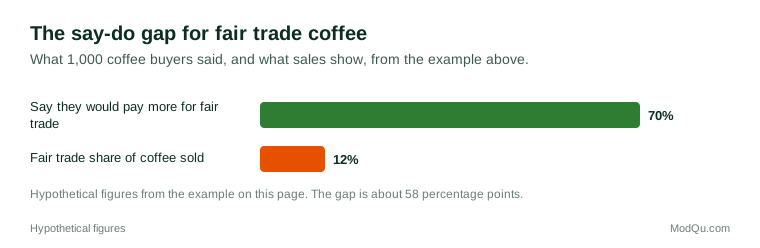
A survey of 1,000 coffee buyers finds that 70% say they would pay more for fair trade coffee. Sales data from the same region show that fair trade coffee makes up about 12% of coffee sold. If the 700 people who said they would pay more had all bought it, its share would be close to 70%, so the gap between saying and doing is about 58 percentage points.
Would people pay more?
People's willingness to pay more for ethical products varies by product, income and country. Many say they would pay a little more, often 5% to 10%, but fewer would pay much more. Willingness is often higher for food, personal care and clothing than for electronics or household basics. When budgets are tight, many people say they still care but cannot afford to act on it.
How people check claims
People use several ways to judge whether a brand's claims are real:
- Independent certifications and labels, such as fair trade, organic, forest stewardship and certified social enterprise standards.
- Reports and rankings by campaign groups and media.
- The brand's own reports on emissions, supply chains and wages.
- News coverage of problems or scandals.
- Reviews and social media.
- Specific, measurable claims, which people tend to trust more than vague ones such as "eco-friendly".
Many people say there are too many labels and that they do not know which to trust.
Greenwashing and purpose-washing
Greenwashing means making a product or company look more environmentally friendly than it is. Examples include vague claims such as "natural" or "green", highlighting one small improvement while ignoring larger harms, using green imagery, and making claims about future targets with no clear plan. Purpose-washing is a similar idea for social causes, such as running a campaign about equality while treating staff poorly.
Regulators in several countries and regions, including the United Kingdom and the European Union, have issued rules or guidance on environmental claims and have acted against misleading ones. Some advertising regulators have banned adverts that made unsupported green claims.
Example
A cleaning product's label says "eco" in large green letters and shows leaves and a globe. A reader looks for details and finds that the only change is a bottle made with 20% recycled plastic. She complains to the national advertising regulator, which later rules that the claim was misleading.
Brands taking public positions
Some brands take public positions on social and political issues. Supporters say brands have influence and should use it responsibly. Critics say brands should focus on their products, or doubt that their positions are sincere. Brands that take positions sometimes face boycotts from people who disagree, and also from people who agree but think the brand is not acting on its words.
Ethical choices beyond buying
For some people, ethical consumption means buying less rather than buying differently. Repairing, borrowing, renting, buying second-hand and keeping products for longer are all ways people try to reduce harm. Others focus on where they put their money, such as choosing a bank or pension fund based on its investments. Some people take part in campaigns that ask companies to change, or support laws that would require all companies to meet higher standards, which they see as more effective than individual choices.
What people disagree about
People disagree about whether companies should have a purpose beyond profit, whether ethical buying makes a real difference or whether laws are needed instead, whether ethical products should cost more, which certifications can be trusted, and whether brands should speak on social issues.
Questions that brand owners, certification bodies, campaign groups, regulators and retailers want answered include whether people choose brands for their values, which issues matter most to them, how much more they would pay, how they check claims and how much they trust ethical labels.
Key terms
- Ethical brandA brand that aims to reduce harm to people, animals and the environment.
- Purpose-driven brandA brand that states a mission beyond profit and says it guides decisions.
- Fair tradeA system aiming to give producers fair prices and long-term deals.
- Supply chainAll the steps and companies involved in making and delivering a product.
- GreenwashingMaking a product or company look greener than it is.
- Say-do gapThe difference between what people say they will buy and what they buy.
- CertificationIndependent confirmation that a product or company meets set standards.
- Carbon footprintThe greenhouse gas emissions caused by a product, activity or company.
Full glossary: brand strategy terms on EditingTests.com.
Ethical and purpose-driven brands vocabulary test
How well do you know the language of this topic? Try 8 quick questions. Your score is shown straight away and is not saved.
What the ethical and purpose-driven brands survey asks
This survey is part of ModQu's Brands and Advertising survey. The ethical and purpose-driven brands part takes about five minutes and covers:
- Whether you choose brands for their values, and which issues matter most to you.
- Whether you would pay more for an ethical brand, and how much more.
- How you check whether brands' claims are true.
- Which ethical labels and certifications you know and trust.
- Whether you have stopped buying from a brand because of how it behaves.
- How you feel about brands taking public positions on social issues.
After that you can choose to continue with other short parts of the Brands and Advertising survey, such as brand awareness or brand loyalty, or stop.
Ready to take part?
Your answers help show what people really think and do. Results are only ever reported as totals; no one can see your individual answers.
Start the surveyQuestions about this survey
Who can take part?
Adults.
Do I have to give my name?
No. You may be asked for your age group, region and similar details so results can be broken down, but not your name. ModQu never asks for passwords, card numbers or account numbers.
How are the results used?
Answers are combined into totals and percentages and published in ModQu reports. Individual answers are never shown.
Is the vocabulary test part of the survey?
No. It is optional and separate, and your score is not stored.