
Share how you choose appliances
Tell us whether you check energy labels, whether you have replaced an appliance to save energy and how much running costs matter. Your answers are combined with other people's and reported only as totals.
Start the energy-saving appliances surveyAbout 5 minutes. No account needed. You can stop at any time.
Which appliances use the most energy
The appliances that use most energy in a home depend on the climate, the home and how they are used. Common large users include:
- heating and cooling: space heaters, heat pumps, air conditioners and fans;
- water heating: electric water heaters and boilers;
- cold appliances: fridges and freezers, which run all day;
- washing and drying: washing machines, tumble dryers and dishwashers;
- cooking: ovens, hobs, kettles and microwaves;
- lighting;
- entertainment and computers, including devices left on standby.
In hot climates, air conditioning can be the largest use. In cold climates, heating dominates. Fridges matter everywhere because they never switch off.
Energy efficiency labels
Many countries require labels showing how efficient an appliance is and how much energy it uses. Labels differ:
- The European Union energy label rates appliances on a scale from A (most efficient) to G, and shows annual energy use. It was rescaled in 2021 for several product types, so many products that were rated A+++ under the old label moved to lower letters on the new one.
- Star rating labels, used in countries such as Australia, India and others, give more stars for more efficient products.
- Energy Star, a voluntary program started in the United States and used in several other countries, marks products that meet efficiency standards.
- Many countries also set minimum energy performance standards that ban the least efficient products from sale.
Labels usually show the expected annual energy use in kilowatt-hours (kWh), which can be used to estimate running costs.
Price now versus running cost later
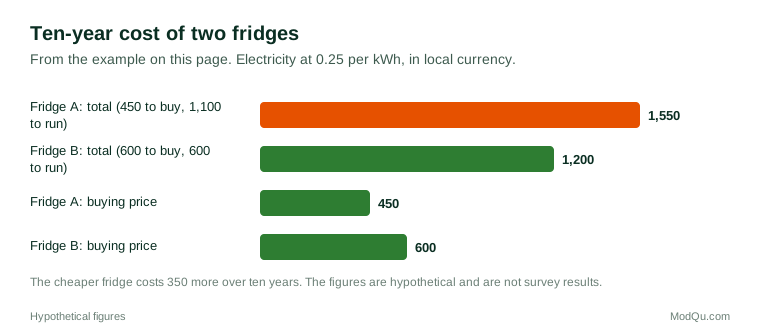
The total cost of owning an appliance is its buying price plus the cost of the energy it uses over its life, plus any repairs. A cheaper appliance may cost more overall if it uses more energy.
Example (hypothetical figures)
A shopper compares two fridges. Fridge A costs 450, in local currency, and uses 440 kWh a year. Fridge B costs 600 and uses 240 kWh a year. Electricity costs 0.25 per kWh, so Fridge A costs 110 a year to run and Fridge B costs 60. Over ten years, Fridge A costs 450 plus 1,100, which is 1,550, and Fridge B costs 600 plus 600, which is 1,200.
Many shoppers focus mainly on the price in the shop. Research on consumer decisions has found that people often give less weight to future running costs than to up-front price, especially when money is tight or when running costs are not clearly shown.
What people weigh when buying
Buyers usually consider:
- buying price and offers;
- size and features;
- brand and reliability;
- energy label and running cost;
- noise;
- water use, for washing machines and dishwashers;
- delivery, installation and removal of the old appliance;
- warranty and repair options;
- reviews and recommendations.
Example
A family in a hot climate buys an air conditioner. They compare a standard model with an inverter model that adjusts its speed instead of switching on and off. The inverter model costs more but uses less electricity in regular use. Because they run it most evenings for several months a year, they choose the inverter model.
When replacing an old appliance makes sense
Replacing a working appliance with a more efficient one saves energy, but making a new appliance also uses energy and materials. Whether replacement makes sense depends on how old and inefficient the current appliance is, how much it is used, and how long the new one will last.
Very old fridges, freezers and air conditioners are often much less efficient than new ones, so replacement can pay off. For appliances used rarely, the savings may be small. Repairing a working appliance is often the better choice for the environment if efficiency gains are small.
Using appliances efficiently
How appliances are used matters as much as which are bought. Common habits include:
- washing clothes at lower temperatures and with full loads;
- drying clothes on a line instead of a tumble dryer;
- keeping fridge doors closed and seals clean;
- boiling only the water needed;
- switching off devices at the wall instead of leaving them on standby;
- setting air conditioning a little higher and heating a little lower;
- using time-of-use tariffs to run appliances at cheaper times.
Help with costs
Governments and energy suppliers in many countries offer schemes to help households buy efficient appliances: rebates, discounts, trade-in programs for old appliances, tax relief or low-interest loans. Some programs target low-income households, who spend a larger share of income on energy and often have older appliances.
Example
A pensioner's 20-year-old freezer is still working, but their electricity bill is high. A local scheme offers a discount on a new efficient freezer if they hand in the old one for recycling. They take the offer and see their bill fall noticeably over the following months.
What people disagree about
People disagree about whether efficiency standards make appliances too expensive, whether labels are clear enough, whether replacing working appliances is wasteful, and whether governments should subsidize efficient appliances or let prices decide. Debates also cover the growing number of devices in homes, which can offset gains from more efficient individual appliances.
Questions that utilities, appliance makers, retailers and governments want answered include whether people check energy labels, whether they have replaced an appliance to save energy and how much running costs matter when they buy.
Key terms
- Energy labelA label showing how efficient an appliance is and how much energy it uses.
- Energy efficiencyUsing less energy to do the same task.
- Running costThe cost of the energy an appliance uses over time.
- Lifetime costBuying price plus running and repair costs over an appliance's life.
- Standby powerElectricity used by a device that is switched off but still plugged in.
- InverterTechnology that lets a motor run at varying speeds, often saving energy.
- Minimum energy performance standardA rule banning the sale of appliances below a set efficiency.
- RebateA partial refund of the price, often from a government or energy supplier.
Full glossary: appliance manufacturing terms on EditingTests.com.
Energy-saving appliances vocabulary test
How well do you know the language of this topic? Try 8 quick questions. Your score is shown straight away and is not saved.
What the energy-saving appliances survey asks
This survey is part of ModQu's Energy and Environment survey. The energy-saving appliances part takes about five minutes and covers:
- Whether you check energy labels when buying appliances.
- Which appliances you have bought or replaced recently.
- Whether you have replaced an appliance mainly to save energy.
- How much running costs matter compared with buying price.
- What you do to use appliances more efficiently.
- Whether you have used a rebate or discount scheme.
After that you can choose to continue with other short parts of the Energy and Environment survey, such as home energy use and bills or solar power at home, or stop.
Ready to take part?
Your answers help show what people really think and do. Results are only ever reported as totals; no one can see your individual answers.
Start the surveyQuestions about this survey
Who can take part?
Adults.
Do I have to give my name?
No. You may be asked for your age group, region and similar details so results can be broken down, but not your name. ModQu never asks for passwords, card numbers or account numbers.
How are the results used?
Answers are combined into totals and percentages and published in ModQu reports. Individual answers are never shown.
Is the vocabulary test part of the survey?
No. It is optional and separate, and your score is not stored.
Why does the survey ask about buying price and running cost separately?
People often weigh them differently, and knowing how much each matters helps explain buying decisions.
Do small appliances count?
Yes. Kettles, microwaves, fans and similar items are included alongside large appliances.
Do I need to know my appliances' energy ratings?
No. You can say whether you checked the label and what you remember.
Does the survey ask about heating systems?
It focuses on appliances, including heaters and air conditioners. Home heating systems are covered in a separate energy topic.
Can renters take part?
Yes. Renters often buy small appliances and can say how landlords' appliances affect their bills.