
Share your experience of emergency services
Tell us whether you have called emergency services, how quickly help arrived and how confident you are in them. Your answers are combined with other people's and reported only as totals.
Start the emergency services surveyAbout 5 minutes. No account needed. You can stop at any time.
What emergency services include
Emergency services respond to situations that threaten life, health, property or the environment. The main ones are:
- ambulance and emergency medical services, providing care at the scene and transport to hospital;
- fire and rescue services, dealing with fires, road crashes, floods, building collapses and hazardous materials;
- police, for crimes in progress and threats to safety;
- coastguard, mountain and search-and-rescue services;
- emergency management agencies that coordinate responses to disasters.
In some countries, volunteers provide much of the fire, ambulance or rescue cover, especially in rural areas. In others, services are run by national, regional or city governments, or by private and charitable organizations under contract.
Emergency numbers
Countries use different numbers for emergencies:
- 112 is the common emergency number across the European Union and is also used in many other countries. It works from mobile phones in many places worldwide.
- 911 is used in the United States, Canada and several other countries.
- 999 is used in the United Kingdom and several other countries.
- Some countries have separate numbers for police, fire and ambulance.
Many countries also offer text, video or app-based contact for people who are deaf or have speech difficulties, and some have non-emergency numbers for urgent but non-life-threatening matters.
What happens after a call
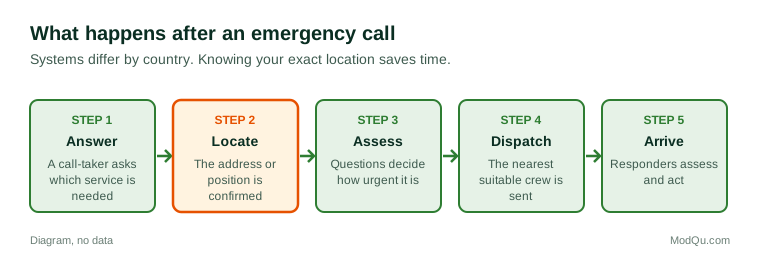
A typical emergency call goes through several stages:
- A call-taker answers and asks which service is needed and where.
- The location is confirmed, sometimes using automatic phone location data.
- The call-taker asks questions to judge urgency, often using a structured system.
- A dispatcher sends the nearest suitable crew or vehicle.
- The caller may be given instructions, such as how to do chest compressions, while waiting.
- Responders arrive, assess and act.
Calls are triaged: the most urgent, such as cardiac arrest or a house fire with people inside, get the fastest response. Less urgent calls may wait longer or be directed to other services, such as a nurse helpline.
Example
A person finds a neighbour collapsed and not breathing. They call the emergency number. The call-taker confirms the address, tells them an ambulance is on the way and talks them through chest compressions until paramedics arrive eight minutes later. The neighbour survives.
Response times
Response time is the time from a call to the arrival of help. Many services set targets, such as an average or maximum time for the most urgent calls, and publish results. Response times depend on:
- distance and road conditions;
- how many crews are available;
- demand at that moment;
- delays handing patients over at hospitals, which keep ambulances from returning to service;
- how quickly the location is identified;
- weather and traffic.
Rural areas usually have longer response times than cities because of distance. Some services use community first responders, volunteers trained to give basic care until an ambulance arrives.
Example (hypothetical figures)
An ambulance service aims to reach the most urgent calls in an average of 8 minutes. In one month it handles 1,200 such calls. In the city, the average is 7 minutes; in rural districts, it is 14 minutes. Because 900 calls come from the city and 300 from rural areas, the overall average is 8.75 minutes.
Pressures on emergency services
Emergency services in many countries report rising demand, staff shortages, ageing equipment and pressure from other parts of the system. Ambulances can be held at hospitals when emergency departments are full. Fire services increasingly respond to floods, wildfires and other weather events as well as fires. Some calls are for problems that could be handled by other services, such as mental health crises or minor injuries.
Confidence in emergency services
Public confidence in emergency services, especially fire and ambulance, is often high compared with other public services. It is shaped by:
- personal experience of calling for help;
- stories from family and friends;
- news reports of delays or failures;
- visible presence of stations and crews in the community;
- trust in government more generally.
Example
A resident's confidence falls after their elderly father waits several hours for an ambulance following a fall. The paramedics, when they arrive, are kind and skilled. The resident says they trust the crews but not the system's ability to send them quickly.
Prevention and preparedness
Many emergency services also work on prevention: fire safety visits, smoke alarm fitting, school talks, first aid and CPR training, water safety and road safety campaigns. Public knowledge of first aid and how to call for help can affect outcomes, especially for cardiac arrests, where early CPR and defibrillation make a large difference. Public-access defibrillators are now placed in many public places.
What people disagree about
People disagree about funding levels, whether to close or merge stations to save money, whether volunteers or paid staff should provide cover in rural areas, how to reduce non-urgent calls, and whether response targets measure the right things. Debates also cover who should respond to mental health crises.
Questions that governments, emergency agencies and policy groups want answered include how many people have called emergency services, how quickly help arrived, how satisfied they were and how confident they are in local services.
Using the right service
Emergency services ask the public to call emergency numbers only for real emergencies, such as a person not breathing, a fire, a serious crash or a crime in progress. For urgent but not life-threatening problems, many countries offer alternatives: health advice lines, urgent care clinics, pharmacists and non-emergency police numbers. Knowing which service to use helps keep ambulances and fire crews free for the most serious calls, though people in distress cannot always judge urgency, and services advise calling if in doubt.
Key terms
- Emergency numberA short phone number for calling emergency services, such as 112, 911 or 999.
- DispatcherA person who sends emergency crews to incidents.
- TriageSorting calls or patients by urgency.
- Response timeThe time from an emergency call to the arrival of help.
- ParamedicA trained health professional who gives emergency care outside hospital.
- Community first responderA volunteer trained to give basic care until an ambulance arrives.
- DefibrillatorA device that gives an electric shock to restart a heart in cardiac arrest.
- CPRCardiopulmonary resuscitation: chest compressions and sometimes rescue breaths.
Full glossary: emergency management terms on EditingTests.com.
Emergency services vocabulary test
How well do you know the language of this topic? Try 8 quick questions. Your score is shown straight away and is not saved.
What the emergency services survey asks
This survey is part of ModQu's Government and Public Services survey. The emergency services part takes about five minutes and covers:
- Whether you have called emergency services in the last two years, and for what.
- How quickly help arrived.
- How satisfied you were with the call and the response.
- How confident you are in local ambulance, fire and rescue services.
- Whether you know first aid or CPR, and where the nearest defibrillator is.
- What would improve emergency services where you live.
After that you can choose to continue with other short parts of the Government and Public Services survey, such as local services or trust in government, or stop.
Ready to take part?
Your answers help show what people really think and do. Results are only ever reported as totals; no one can see your individual answers.
Start the surveyQuestions about this survey
Who can take part?
Adults.
Do I have to give my name?
No. You may be asked for your age group, region and similar details so results can be broken down, but not your name. ModQu never asks for passwords, card numbers or account numbers.
How are the results used?
Answers are combined into totals and percentages and published in ModQu reports. Individual answers are never shown.
Is the vocabulary test part of the survey?
No. It is optional and separate, and your score is not stored.
Does the survey ask about police?
It focuses on ambulance, fire and rescue. Policing has its own topic.
Can I answer if I have never called for help?
Yes. Your confidence and views count even without direct experience.
Does this page tell me what to do in an emergency?
No. In an emergency, call your local emergency number and follow the call-taker's instructions.
Will my answers be shared with emergency services?
Results are reported for groups only, and ModQu does not ask for your name or address.