
Share your experience of charging
Tell us where you charge, how reliable public chargers are and whether charger access affects your car choice. Your answers are combined with other people's and reported only as totals.
Start the electric vehicle charging surveyAbout 5 minutes. No account needed. You can stop at any time.
Where people charge
Electric vehicle (EV) drivers charge in several kinds of places:
- At home, using a dedicated wall charger or, more slowly, a standard socket. This is the cheapest and most convenient option for people with a driveway or garage.
- At work, where employers provide chargers in staff car parks.
- At destinations such as supermarkets, shopping centres, hotels, gyms and car parks, where drivers charge while doing something else.
- On streets, from chargers fitted to lamp posts or kerbside posts, important for people without off-street parking.
- At rapid charging hubs, often on main roads and motorways, used for longer journeys or by drivers who cannot charge at home.
Drivers of plug-in hybrid cars, which have both a battery and a petrol or diesel engine, also charge, though they can drive without doing so.
Charging speeds
Charging speed is measured in kilowatts (kW). Faster chargers add more range in less time. Common levels include:
- Slow charging from a household socket, often adding only a few kilometres of range per hour.
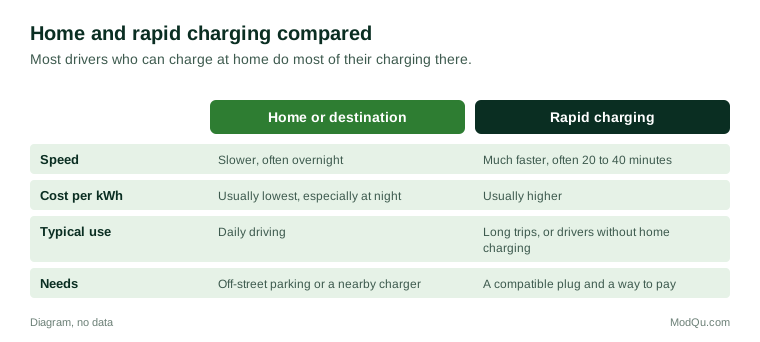
- Home and destination chargers, commonly around 7 kW for home and up to 22 kW at some destinations, usually able to fill most car batteries overnight.
- Rapid and ultra-rapid chargers, which use direct current (DC) at 50 kW or more, and in some cases over 150 kW, adding a large amount of range in 20 to 40 minutes.
The actual speed depends on the charger, the car's maximum charging rate, the battery's temperature and how full the battery is. Charging usually slows as the battery approaches full, which is why rapid charging is often quoted to 80%.
Plugs and payment
Different regions use different plug standards, and a car's charging port determines which chargers it can use. Adapters exist for some combinations but not all. Drivers usually check charger maps or apps to find compatible chargers.
Paying for public charging can involve several methods: contactless bank cards, apps, membership cards, subscription plans or, at some sites, free charging. Many drivers have several apps for different networks, which they find frustrating. Some countries now require new public chargers to accept contactless card payment and to show prices clearly.
What charging costs
The cost of charging depends on electricity prices, where and when people charge, and the charger's speed.
- Home charging is usually the cheapest, especially on time-of-use tariffs that offer lower prices at night.
- Workplace and destination charging may be free, discounted or priced like public charging.
- Public rapid charging usually costs more per kilowatt-hour, sometimes much more, because of equipment, grid connection and demand charges.
Example (hypothetical figures)
A driver covers 1,000 kilometres a month in a car that uses 18 kilowatt-hours (kWh) per 100 kilometres, so they need about 180 kWh a month. At home on a night tariff of 0.10 per kWh, in local currency, that costs 18. At a public rapid charger costing 0.50 per kWh, the same energy costs 90.
Problems drivers report
Common complaints about public charging include:
- chargers that are broken or not working as described;
- chargers occupied by other cars, or blocked by petrol cars;
- queues at busy times, such as holiday weekends;
- confusing or high prices;
- needing several apps or accounts;
- chargers in poorly lit or isolated places;
- slower charging than advertised;
- too few chargers in rural areas and some neighbourhoods.
Example
A driver on a long trip plans a stop at a motorway rapid charger. On arrival, two of the four chargers are out of order and the other two have queues. They wait 35 minutes before starting to charge. On the return trip they choose a different hub with more chargers, which adds 10 minutes of driving but avoids the wait.
Reliability has become a focus for drivers' groups and governments. Some countries have set targets for charger uptime and require operators to share live data on whether chargers are working.
Living without home charging
People who live in flats, terraced houses or homes without off-street parking face a different experience. They rely on street, destination and rapid chargers, which usually cost more and take more planning. This is one of the most common reasons people give for not buying an EV.
Example
A person living in a flat with no parking bay wants an electric car. The nearest street charger is a ten-minute walk away and often in use. They decide to wait until their building's management installs shared chargers in the car park, which is under discussion.
Landlords, building managers and local authorities make many of the decisions about charger installation for people in these homes. Some countries have introduced a "right to charge" for residents, or grants for installing chargers in shared buildings.
Charger access and buying decisions
Access to charging is one of the main factors people weigh when deciding whether to buy an EV, along with price, range and the availability of models. People who can charge at home tend to see charging as easy. People who cannot often see it as the main barrier. Experience also changes views: many EV drivers report that charging worries before buying were greater than the problems they actually met.
Charging and the electricity grid
More EVs mean more demand for electricity. Grid operators and energy suppliers encourage charging at off-peak times, using time-of-use tariffs and smart chargers that schedule charging automatically. Some trials explore vehicle-to-grid technology, where car batteries send power back to the grid or the home at busy times.
What people disagree about
People disagree about who should pay for public chargers, how fast networks should be built, whether rural areas are being left behind, and whether prices at public chargers are fair compared with home charging. There are also debates about the use of street space for chargers and about whether governments should require chargers in new buildings.
Questions that utilities, charging operators, car makers and governments want answered include where drivers charge, how reliable public chargers are, what charging costs them, and whether charger access would affect a decision to buy an electric car.
Key terms
- Electric vehicleA vehicle powered by an electric motor and a rechargeable battery.
- Plug-in hybridA car with both a battery that can be charged and a petrol or diesel engine.
- Kilowatt (kW)A measure of power, used to describe charging speed.
- Kilowatt-hour (kWh)A unit of energy, used to measure battery size and electricity use.
- Rapid chargerA public charger using direct current to charge much faster than home chargers.
- Time-of-use tariffAn electricity price that changes with the time of day.
- Smart chargingCharging that is scheduled automatically, often for cheaper or quieter times.
- Range anxietyWorry about running out of battery before reaching a charger.
Full glossary: electric vehicle charging networks terms on EditingTests.com.
Electric vehicle charging vocabulary test
How well do you know the language of this topic? Try 8 quick questions. Your score is shown straight away and is not saved.
What the electric vehicle charging survey asks
This survey is part of ModQu's Energy and Environment survey. The electric vehicle charging part takes about five minutes and covers:
- Whether you drive an electric or plug-in hybrid car, or are considering one.
- Where you usually charge: home, work, street, destination or rapid hub.
- How reliable and easy to use public chargers are near you.
- What charging costs you, and how you pay.
- Problems you have had with charging.
- Whether charger access would affect a decision to buy an electric car.
After that you can choose to continue with other short parts of the Energy and Environment survey, such as home energy use and bills or solar power at home, or stop.
Ready to take part?
Your answers help show what people really think and do. Results are only ever reported as totals; no one can see your individual answers.
Start the surveyQuestions about this survey
Who can take part?
Drivers of electric or hybrid cars and people considering one.
Do I have to give my name?
No. You may be asked for your age group, region and similar details so results can be broken down, but not your name. ModQu never asks for passwords, card numbers or account numbers.
How are the results used?
Answers are combined into totals and percentages and published in ModQu reports. Individual answers are never shown.
Is the vocabulary test part of the survey?
No. It is optional and separate, and your score is not stored.
Can I answer if I do not own an electric car?
Yes. People considering an electric car, and people who have decided against one, are both included.
Does the survey ask which charging networks I use?
It may ask what kinds of chargers you use and how you pay, but results are reported by type, not by company.
Does charging a plug-in hybrid count?
Yes. Plug-in hybrid drivers answer the same charging questions.