
Share your experience of owning a dog
Tell us how many dogs you have, what you spend on them and whether you have used a trainer. Your answers are combined with other people's and reported only as totals.
Start the dog ownership surveyAbout 5 minutes. No account needed. You can stop at any time.
What dog ownership involves
Owning a dog is a long commitment. Many dogs live 10 to 15 years, and small breeds often live longer than large ones. Day to day, a dog needs:
- food and fresh water;
- exercise and time outdoors, often several walks a day;
- company, because dogs are social animals and many find long periods alone stressful;
- training and boundaries;
- grooming, from brushing to nail trimming;
- health care, including vaccinations, parasite treatment and check-ups;
- a safe place to sleep and somewhere secure outdoors.
Around the world, dogs are kept in many ways: as family pets indoors, as yard or guard dogs, as working dogs on farms, and as free-roaming community dogs that are fed by several households. Laws on licensing, microchipping, leashes and dangerous breeds differ widely between countries and cities.
Choosing a dog
People choose dogs for different reasons, and the right dog depends on the owner's home and routine. Common factors include:
- Size and space: a large dog in a small flat needs more planning.
- Energy level: working and sporting breeds often need a lot of exercise and mental activity.
- Grooming needs: long or curly coats need regular care.
- Temperament with children and other pets.
- Health: some breeds are prone to particular problems, such as breathing difficulties in flat-faced breeds.
- Cost of buying and keeping the dog.
- Source: adopting from a shelter or rescue, buying from a breeder, or taking a dog from friends or family.
Mixed-breed dogs are common in many countries, and many shelter dogs are adults whose personalities are already known.
Example
A couple who both work in an office want a dog. They like an energetic herding breed but realize it would be alone most of the day. They adopt a calm older mixed-breed dog from a shelter instead and pay a dog walker to visit at lunchtime on office days.
Walking and exercise
Walks are the centre of daily life for many dogs and owners. Exercise needs vary by breed, age and health, from short strolls for older small dogs to long runs for young working breeds. Owners also use:
- off-leash parks and areas where dogs can run freely;
- games such as fetch and tug;
- puzzle toys and scent games for mental exercise;
- dog sports such as agility, flyball and scent work;
- doggy day care and dog walkers when they are at work.
Many owners say regular walks also help their own fitness and help them meet neighbours.
Training and behaviour
Training helps dogs live safely with people and other animals. Common goals include coming when called, walking on a loose lead, toilet training, not jumping on people and staying calm when left alone.
Methods have changed over time. Many trainers and vets now recommend reward-based training, which uses treats, praise and play to encourage good behaviour, rather than punishment. Owners learn through puppy classes, group obedience classes, private trainers, books and online videos.
Common behaviour problems include pulling on the lead, barking, chewing, fear of noises such as fireworks, reactivity towards other dogs, and separation anxiety, where a dog becomes distressed when left alone. Serious problems may need a qualified behaviourist or a vet, since pain and illness can cause behaviour changes.
Example
A young dog barks and scratches at the door whenever the owner leaves. The owner contacts a trainer, who suggests practising very short absences and building up slowly, and leaving a puzzle feeder. After several weeks the dog can be left for two hours without distress.
What a dog costs
Owners are often surprised by the total cost. Typical costs include:
- buying or adopting the dog;
- food and treats;
- vaccinations, parasite treatments and vet visits;
- pet insurance, where available, or savings for vet bills;
- grooming;
- equipment such as a lead, collar, bed, crate and toys;
- dog walkers, day care, kennels or pet sitters;
- licences and registration where required.
Example (hypothetical figures)
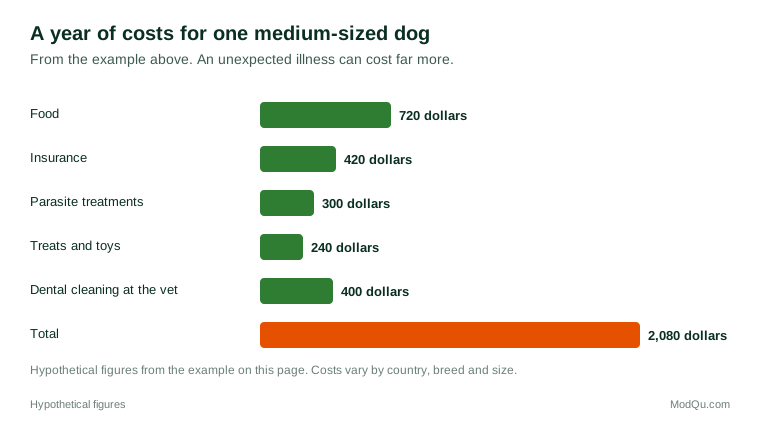
A medium-sized dog's owner spends 60 dollars a month on food, 25 on parasite treatments, 35 on insurance and 20 on treats and toys. That is 140 dollars a month, or 1,680 dollars a year. In the same year a dental cleaning at the vet costs 400 dollars, bringing the total to 2,080 dollars.
Costs vary greatly by country, breed and size, and an unexpected illness or injury can cost far more than a year of routine care.
Getting older together
Dogs' needs change with age. Puppies need socialization, toilet training and several small meals a day. Adult dogs need steady routines and exercise. Senior dogs may slow down, gain weight, lose hearing or sight, and develop joint problems, dental disease or other illnesses. Owners often switch to softer food, shorter walks, ramps and more frequent vet checks.
Many owners say the hardest part of having a dog is its decline and death, and deciding when to end suffering through euthanasia. Vets and pet bereavement services offer support at this stage.
Common problems for owners
Owners often mention:
- finding time for walks with long working hours;
- finding rental housing that accepts dogs;
- vet costs, especially emergency treatment;
- care when travelling;
- behaviour problems;
- conflict with neighbours over barking or mess.
Dogs in the community
Dogs affect people who do not own them, too. Issues include dog bites, dog waste in public places, noise, and access to parks and beaches. In some regions, free-roaming dogs raise concerns about rabies, which is still present in many countries; vaccination and sterilization programmes are used to control it. Many cities have rules on leashes, cleaning up after dogs and which areas dogs may use.
What people disagree about
Dog ownership raises several debates:
- whether some breeds should be restricted or banned;
- whether breeding for certain looks causes health problems that should be limited by law;
- whether dogs should be allowed in more shops, cafés and public transport;
- which training methods should be used;
- how to manage free-roaming dogs humanely.
Questions pet food brands, vets, insurers and retailers want answered include how many dogs people have, what they spend, how they care for and train them, and which services they use.
Key terms
- BreedA group of dogs with similar looks and traits, bred over generations.
- Mixed breedA dog whose parents are of different or unknown breeds.
- Reward-based trainingTraining that encourages good behaviour with treats, praise or play.
- Separation anxietyDistress a dog shows when left alone.
- MicrochipA small implanted chip with an ID number that links a pet to its owner.
- RecallA dog's response to being called back.
- Dog day careA service that looks after dogs during the day.
- AgilityA dog sport in which dogs run an obstacle course.
Full glossary: animal health terms on EditingTests.com.
Dog ownership vocabulary test
How well do you know the language of this topic? Try 8 quick questions. Your score is shown straight away and is not saved.
What the dog ownership survey asks
This survey is part of ModQu's Pets and Animals survey. The dog ownership part takes about five minutes and covers:
- How many dogs you have, their sizes and ages.
- Where your dog came from: breeder, shelter, friend or other.
- How much you spend on your dog in a typical month, and on what.
- How often you walk your dog and who else helps.
- Whether you have used a trainer, class or behaviourist.
- What you find hardest about owning a dog.
After that you can choose to continue with other short parts of the Pets and Animals survey, such as pet ownership or veterinary care, or stop.
Ready to take part?
Your answers help show what people really think and do. Results are only ever reported as totals; no one can see your individual answers.
Start the surveyQuestions about this survey
Who can take part?
Dog owners.
Do I have to give my name?
No. You may be asked for your age group, region and similar details so results can be broken down, but not your name. ModQu never asks for passwords, card numbers or account numbers.
How are the results used?
Answers are combined into totals and percentages and published in ModQu reports. Individual answers are never shown.
Is the vocabulary test part of the survey?
No. It is optional and separate, and your score is not stored.