
Share whether origin matters to you
Tell us whether you check where products are made, whether you prefer locally made goods and which countries you trust for quality. Your answers are combined with other people's and reported only as totals.
Start the country of origin and "made in" labels surveyAbout 5 minutes. No account needed. You can stop at any time.
What country of origin means
Country of origin is the country where a product was made, grown or produced. It is usually shown on a "made in" label, on the packaging or in the product description online. For food, it may show where an ingredient was grown or where an animal was raised.
The idea is simple, but many modern products are made from parts and materials from many countries. A phone may be designed in one country, use components from several others and be assembled in yet another. Rules decide which country can be named on the label, usually the place where the product was last substantially transformed, though the exact tests differ by country and product.
How origin affects what people think
Researchers have studied the "country of origin effect" for decades: people's views of a product are affected by where it comes from. Countries can become linked with particular strengths in people's minds, for example:
- precision engineering and cars from some countries;
- fashion, design, food and wine from others;
- electronics and technology from others again.
These links can help or hurt a product. They change over time: some countries once associated with cheap, low-quality goods are now known for advanced technology and high quality. They also differ between people and countries, and are often based on reputation rather than personal experience.
Example
Two bottles of olive oil sit side by side at the same price. One says "Product of Italy" and the other names a country the shopper does not associate with olive oil. The shopper picks the first. Reading the back label later, she finds it says "blended and bottled in Italy from olives of several countries".
Why people check origin
People give several reasons for checking where products are made:
- Quality: they believe some countries make better products in certain categories.
- Safety: concerns about food safety standards or product safety rules.
- Supporting the local economy and jobs in their own country or region.
- Ethics: concerns about working conditions or environmental standards in some places.
- Environment: wanting goods transported shorter distances.
- Politics: boycotting or supporting particular countries.
- Authenticity: wanting a product from its traditional home, such as a regional cheese or wine.
Many people say origin matters to them, but in practice they check it mainly for food and a few other categories, and price and convenience often win.
Buying local
Preference for locally made goods is common in many countries, and governments often run "buy local" or "made in" campaigns. People are often willing to pay a little more for local food, especially fresh produce, meat and dairy. For clothing, electronics and household goods, fewer people check origin, and local options may not exist or may cost much more.
Example (hypothetical figures)
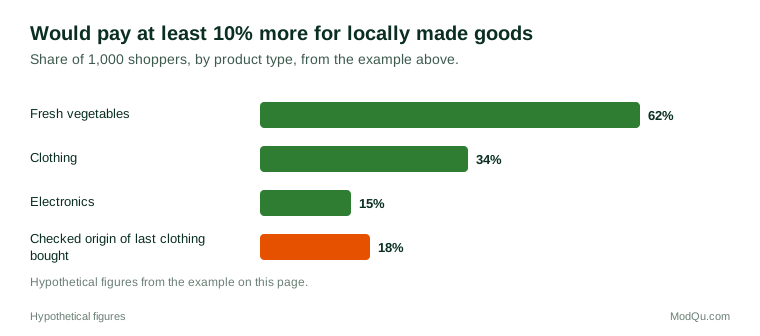
A survey asks 1,000 shoppers how much more they would pay for locally made goods than for imported ones of similar quality. For fresh vegetables, 62% would pay at least 10% more. For clothing, 34% would. For electronics, 15% would. Asked whether they had checked the origin of the last item of clothing they bought, only 18% said yes.
What labels really mean
Labels can be harder to read than they look:
- "Made in" usually means the place of last substantial transformation, not where all parts came from.
- "Product of" for food may mean grown and processed there, or only processed there, depending on local rules.
- "Packed in" or "bottled in" only says where packing happened.
- "Designed in" says nothing about where the product was made.
- Flags and national colours on packs may suggest a link to a country without stating the origin.
- Geographical indications protect names of products tied to a place, such as certain cheeses, wines and spirits, which can only use the name if made in that region by set methods.
Rules on origin labels vary by country. Some require origin labels for fresh meat, fish, fruit and vegetables but not for processed foods. Misleading origin claims are illegal in most countries.
Origin and trust in different markets
In some markets, imported brands from certain countries carry prestige and are seen as safer or better. In others, people strongly prefer domestic brands out of national pride or trust. In countries with past food safety scandals, origin can be a major factor in choosing baby food, dairy and meat. Origin can also become political: during trade disputes or conflicts, some consumers boycott products from particular countries.
Example
After a dispute between two countries is widely reported, a supermarket chain in one of them puts small flags on shelf labels to show which products are domestic. Some shoppers welcome it; others say they never cared about origin and find the flags divisive. Sales of domestic products rise for a few months and then return to normal.
Online shopping and origin
Buying online has made it easier to buy products from far away and harder to know where they come from. Many marketplace listings do not show country of origin clearly, and the seller's location may differ from where the product was made. Some countries now require online sellers to show origin information.
Origin in food and restaurants
Food is where origin matters most to many people. Shoppers often look for the origin of meat, fish, fruit, vegetables, honey and dairy, for reasons of freshness, safety, animal welfare and support for farmers. Some restaurants and markets name the farms and regions their ingredients come from. Labels such as "local" have no fixed legal meaning in many places, so a shop may use it for products from the same town, region or country. People often say they would like clearer rules on what counts as local.
What people disagree about
People disagree about whether buying local really helps the economy or the environment, whether origin is a good guide to quality, whether country-of-origin labels should be required for more products, and whether boycotts based on origin are fair. Many people also question whether paying more for local goods is realistic for households on tight budgets.
Questions that brand owners, retailers, exporters, trade bodies and governments want answered include whether people check where products are made, for which products, whether they prefer local goods, how much more they would pay, and which countries they trust for quality.
Key terms
- Country of originThe country where a product was made, grown or produced.
- Made in labelA label stating a product's country of origin.
- Substantial transformationThe processing that gives a product its new identity, used to decide its origin.
- Country of origin effectThe influence of a product's origin on how people judge it.
- Geographical indicationA protected name for a product tied to a place and method.
- Buy local campaignA campaign encouraging people to buy goods made in their own country or region.
- BoycottRefusing to buy products as a form of protest.
- Domestic productA product made in the buyer's own country.
Full glossary: international trade terms on EditingTests.com.
Country of origin and "made in" labels vocabulary test
How well do you know the language of this topic? Try 8 quick questions. Your score is shown straight away and is not saved.
What the country of origin and "made in" labels survey asks
This survey is part of ModQu's Brands and Advertising survey. The country of origin and "made in" labels part takes about five minutes and covers:
- Whether you check where products are made, and for which kinds of products.
- Whether you prefer locally made goods, and how much more you would pay for them.
- Which countries you trust for quality in different categories.
- Whether you have avoided products from a particular country, and why.
- Whether you understand labels such as "made in", "product of" and "packed in".
After that you can choose to continue with other short parts of the Brands and Advertising survey, such as brand awareness or brand loyalty, or stop.
Ready to take part?
Your answers help show what people really think and do. Results are only ever reported as totals; no one can see your individual answers.
Start the surveyQuestions about this survey
Who can take part?
Adults.
Do I have to give my name?
No. You may be asked for your age group, region and similar details so results can be broken down, but not your name. ModQu never asks for passwords, card numbers or account numbers.
How are the results used?
Answers are combined into totals and percentages and published in ModQu reports. Individual answers are never shown.
Is the vocabulary test part of the survey?
No. It is optional and separate, and your score is not stored.