
Share how you take part
Tell us whether you have signed petitions, attended local meetings or joined community groups, and why. Your answers are combined with other people's and reported only as totals.
Start the civic participation surveyAbout 5 minutes. No account needed. You can stop at any time.
What civic participation includes
Civic participation covers the actions people take to influence decisions, help their community or have a say in how things are run. It includes formal political actions and everyday community activity. Common forms are:
- Voting in national, regional and local elections, and in referendums where they are held.
- Signing petitions, on paper or online.
- Contacting officials, such as writing to an elected representative or a local council.
- Attending public meetings, consultations, town halls or school board meetings.
- Joining groups, such as residents' associations, tenants' unions, parent associations or neighbourhood watch.
- Volunteering for charities, sports clubs, religious groups or community events.
- Protest and campaigning, including marches, boycotts and organized campaigns.
- Serving in roles such as a school governor, jury member, community council member or election worker.
Some countries add forms of direct democracy, such as citizens' assemblies, where a randomly selected group of residents studies an issue and makes recommendations, or participatory budgeting, where residents vote on how to spend part of a public budget.
Why people take part
People give many reasons for getting involved:
- a specific local problem, such as a planned road, a school closure or unsafe crossing;
- a sense of duty or a belief that taking part is what good citizens do;
- wanting to meet neighbours and feel part of a community;
- being asked by a friend, neighbour or colleague, which is one of the strongest predictors of taking part;
- skills, time and confidence that make it easier to speak up.
Example
A parent learns that the bus route their children use to get to school will be cut. They sign an online petition, then go to a council meeting for the first time and speak for two minutes. They meet three other parents there, form a group, and the route is kept with fewer stops. The parent later joins the residents' association.
The example shows how one issue can lead to wider involvement. Research on participation has long found that people who take part in one way are more likely to take part in others.
Why people do not take part
Common reasons for not taking part include:
- Time: long working hours, shift work, child care and caring for relatives.
- Doubt that it makes a difference: a sense that decisions are already made.
- Not knowing how: when meetings are held, how to submit a comment, who to contact.
- Barriers: meetings in inaccessible buildings, at inconvenient times, or only in one language.
- Distrust of politicians or institutions.
- Fear: in some countries, protest or criticism of officials carries real risks.
People with higher incomes, more education and longer residence tend to participate more in many countries, so the voices heard in public meetings are not always representative of the whole community. That is one reason governments look for other ways to hear from residents, such as surveys, online consultations and citizens' assemblies.
Petitions
Petitions are one of the easiest forms of participation. Online platforms, including official petition sites run by some parliaments and governments, let anyone start a petition and collect signatures. In some countries a petition that reaches a set number of signatures must receive a government response or be considered for debate. Rules on thresholds and responses vary.
Petitions are popular because they take little time, but people disagree about their effect. Some petitions lead to real changes; many receive a standard reply. Supporters say even unsuccessful petitions show what people care about.
Example (hypothetical figures)
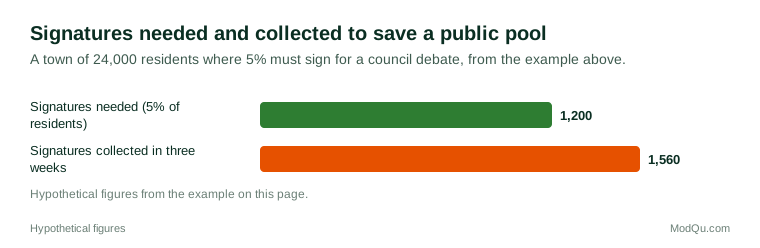
A town of 24,000 residents runs a petition to save a public pool from closure. It needs 1,200 signatures, or 5% of residents, for the council to debate it. The campaign collects 1,560 signatures in three weeks, 30% more than the threshold. At the debate, the council agrees to keep the pool open for two more years while it seeks funding.
Local meetings and consultations
Local councils, planning departments, school boards and health authorities often hold public meetings or consultations before making decisions. People can usually attend, ask questions or submit written comments. Some now stream meetings online and accept comments by email or through websites.
Attendance at local meetings is often low, except when an issue directly affects residents. The people who attend are often older, own their homes and have lived in the area for a long time. Councils sometimes try to widen involvement by holding meetings at different times, offering child care or translation, or holding events in community centres and markets rather than council chambers.
Residents' and community groups
Residents' groups bring together people who live in the same street, building or neighbourhood. They may organize clean-ups and social events, raise concerns with landlords or councils, run community gardens, or respond to planning proposals. Tenants' associations focus on the rights of renters in a building or estate. Neighbourhood watch groups focus on crime and safety.
Membership in such groups has fallen in some countries over recent decades, a trend that some researchers link to longer commutes, television and online life. In other places, new groups have formed through messaging apps and social media, which make it easier to organize but sometimes harder to sustain.
Example
A building with 80 flats has no tenants' group until the heating fails for two weeks in winter. A resident sets up a group chat, and within a day 50 households join. They collect photos and temperature readings, send a joint letter to the landlord and contact the local housing office. The heating is fixed, and the group continues as a tenants' association.
Participation online
Online tools have changed how people take part. People can sign petitions, comment on consultations, join local discussion groups and contact representatives in minutes. Critics say this can encourage low-effort actions that feel like participation without leading to change, sometimes called "slacktivism". Supporters point out that online actions often lead to offline ones and help people who cannot attend meetings.
What people disagree about
People disagree about whether voting should be compulsory, as it is in some countries; whether online petitions matter; how much weight a small group of vocal residents should have in local decisions; and whether protest is always a legitimate form of participation. They also disagree about whether governments should do more to bring in people who rarely take part.
Questions that governments, foundations, community organizations and media want answered include how many people have signed a petition, attended a meeting or joined a group in the last year, what stops others, and what would make them more likely to take part.
Key terms
- Civic participationTaking part in community and public life to influence decisions or help others.
- PetitionA formal request signed by many people and sent to an authority.
- Public consultationA process in which an authority asks residents for views before deciding.
- Residents' associationA group of people living in the same area who act on shared concerns.
- Citizens' assemblyA randomly selected group of residents who study an issue and make recommendations.
- Participatory budgetingResidents deciding how part of a public budget is spent.
- ReferendumA public vote on a single question.
- Compulsory votingA rule that eligible citizens must vote or face a penalty.
Full glossary: public affairs terms on EditingTests.com.
Civic participation vocabulary test
How well do you know the language of this topic? Try 8 quick questions. Your score is shown straight away and is not saved.
What the civic participation survey asks
This survey is part of ModQu's Communities and Society survey. The civic participation part takes about five minutes and covers:
- Whether you voted in the most recent local and national elections.
- Whether you have signed a petition, contacted an official or attended a public meeting in the last year.
- Whether you belong to a residents', tenants', parent or community group.
- What stops you from taking part more often.
- Whether you think taking part makes a difference.
- Which changes would make you more likely to take part.
After that you can choose to continue with other short parts of the Communities and Society survey, such as neighbourhoods and community life or loneliness and social connection, or stop.
Ready to take part?
Your answers help show what people really think and do. Results are only ever reported as totals; no one can see your individual answers.
Start the surveyQuestions about this survey
Who can take part?
Adults.
Do I have to give my name?
No. You may be asked for your age group, region and similar details so results can be broken down, but not your name. ModQu never asks for passwords, card numbers or account numbers.
How are the results used?
Answers are combined into totals and percentages and published in ModQu reports. Individual answers are never shown.
Is the vocabulary test part of the survey?
No. It is optional and separate, and your score is not stored.