
Inquiry · Public and formal inquiry
Public Inquiries: Purpose, Process and Impact
Public inquiries are set up after disasters, scandals and system failures to find out what happened, why, and what must change. This article explains their purposes and procedures, what research shows about their impact, and the lessons they hold for any organisation investigating its own failures.
After a major disaster or scandal, the demand for answers is intense. Families want to know why their relatives died; the public wants to know whether it could happen again; governments want to show that they are taking the matter seriously. In many countries, the response is a public inquiry: an independent investigation, usually led by a judge or other senior figure, with powers to obtain evidence and a duty to report publicly. Public inquiries have investigated oil rig explosions, contaminated water supplies, hospital failures, police conduct and fires in public housing. They are among the most thorough and visible forms of inquiry in public life. This article explains what they are for, how they work, what difference they make and what any organisation can learn from them.
What public inquiries are for
Jason Beer (2011), in a detailed legal study of public inquiries in the United Kingdom, identified several purposes that inquiries commonly serve. Figure 1 groups them into three. The first is to establish the facts: to produce an authoritative account of what happened, often where accounts conflict or have been concealed. The second is to explain and learn: to identify why events happened, which systems failed and what should change to prevent a recurrence. The third is to account and restore trust: to determine responsibility, give those affected a chance to be heard and reassure the public that the matter has been examined independently.
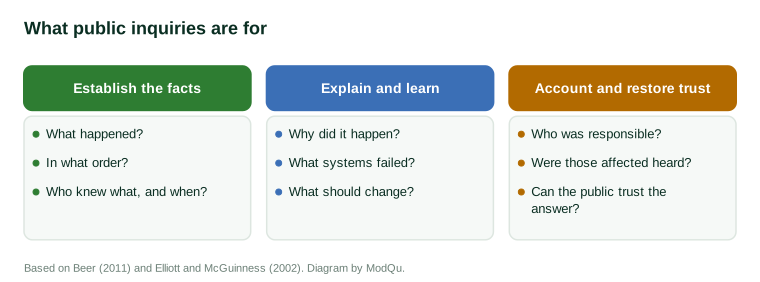
These purposes can conflict. Dominic Elliott and Martina McGuinness (2002) argued that inquiries are expected to do several things at once, including finding the truth, allocating blame, providing catharsis for victims and producing lessons for the future, and that the balance between these aims shapes how an inquiry is conducted and what it achieves. An inquiry focused on blame may make witnesses defensive and less willing to reveal what they know, which can make learning harder.
Inquiries also serve political purposes. Raanan Sulitzeanu-Kenan (2010) studied when British governments appointed commissions of inquiry and found that they were more likely to do so when they faced public blame for a crisis, suggesting that inquiries can be used to show responsiveness or to defer criticism. Sandra Resodihardjo (2006) described the inquiry as a "double-edged sword" for governments: it can deflect immediate pressure, but its report may later produce damaging findings that the government cannot control.
How public inquiries work
Most countries have legal frameworks for inquiries. In the United Kingdom, the Inquiries Act 2005 allows ministers to establish an inquiry, appoint its chair and set its terms of reference, and gives the inquiry powers to require evidence and witnesses. In Canada, the federal Inquiries Act and provincial equivalents give commissioners similar powers. Ed Ratushny (2009) describes how Canadian inquiries have developed their own body of practice, and Scott Prasser (2006) describes the long tradition of royal commissions and inquiries in Australia.
Figure 2 shows the typical course of an inquiry.
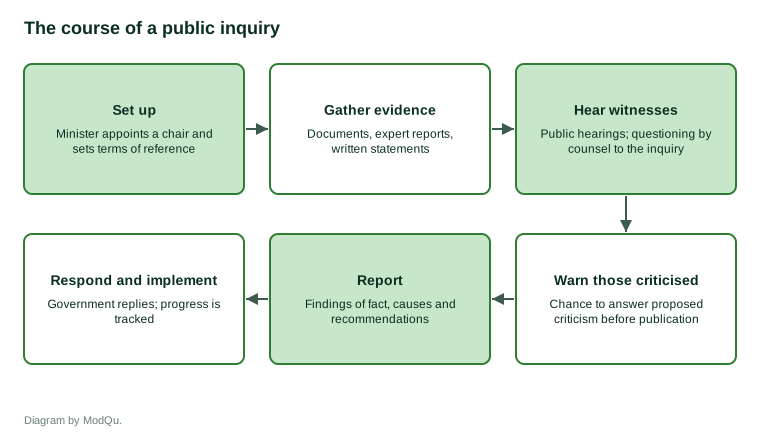
Set-up. The terms of reference define what the inquiry must examine. They are critical: a narrow mandate can exclude the most important causes, while an excessively broad one can make the inquiry unmanageable.
Evidence gathering. Inquiries collect large volumes of documents and written statements, commission expert reports and sometimes hold seminars on technical or policy issues.
Hearings. Public hearings are usually inquisitorial rather than adversarial. Questions are put mainly by counsel to the inquiry, a lawyer whose role is to help the chair establish the facts, rather than by opposing parties trying to win a case. Core participants, such as bereaved families and organisations under scrutiny, may be legally represented and may suggest questions.
Fairness to those criticised. Inquiries are not courts and do not determine legal liability, but their findings can severely damage reputations. In the United Kingdom, the Royal Commission on Tribunals of Inquiry (1966), chaired by Lord Salmon, set out principles of fairness for those whose conduct is examined, including the right to be informed of allegations and to respond. Modern inquiries typically send warning letters to people they propose to criticise, giving them a chance to answer before the report is published.
Report. The final report sets out findings of fact, conclusions about causes and recommendations. Long inquiries often publish interim reports.
Response and implementation. The government responds, and ideally the implementation of recommendations is tracked over time.
Designing the terms of reference
Because the terms of reference determine what an inquiry can examine, drafting them is one of the most consequential steps. Several questions help. Does the scope include the systems and decisions that allowed the failure, or only the event itself? Does it reach the bodies responsible for oversight, such as regulators and government departments, or only the organisation where the failure occurred? Is the inquiry asked to make findings about individual responsibility, about systemic causes or both? Is there a realistic timetable, with provision for interim reports if urgent lessons emerge?
The Walkerton Inquiry illustrates a useful design. It was divided into two parts. The first examined what had happened in Walkerton and why; the second, drawing on expert papers and public consultation, examined how the safety of drinking water across the province could be ensured in future (O'Connor, 2002). Separating the factual investigation from the forward-looking policy review allowed each to proceed with methods suited to it, and meant that the policy recommendations rested on a clear understanding of the failure. Organisations commissioning their own reviews can use the same approach: first establish what happened, then ask what must change.
Examples
Several inquiries illustrate what the process can achieve.
The inquiry into the Piper Alpha disaster, in which an explosion on a North Sea oil platform killed 167 men in 1988, was led by Lord Cullen (1990). It found that the explosion resulted from a failure of the permit-to-work system during maintenance, and that weaknesses in the operator's safety management had allowed the disaster to escalate. Its recommendations transformed offshore safety regulation, moving from prescriptive rules to a requirement that operators demonstrate how they manage major hazards.
In Canada, the Walkerton Inquiry, led by Justice Dennis O'Connor (2002), investigated the contamination of a town's water supply in 2000, which killed seven people and made thousands ill. It found failures by the operators of the water system and by provincial regulators, including cuts to environmental monitoring. Its recommendations led to new legislation on drinking water safety in Ontario. The earlier Krever Commission (Krever, 1997) investigated the contamination of Canada's blood supply with HIV and hepatitis C, and led to the reorganisation of the blood system.
The Mid Staffordshire NHS Foundation Trust Public Inquiry, led by Robert Francis (2013), examined appalling standards of care at a hospital in England. It concluded that the failures arose not only from the hospital's management but from a wider culture in the health system that prioritised targets and finance over patient care, and that warning signs had been ignored by many bodies. It made 290 recommendations, many concerned with openness, candour and the culture of care.
Some inquiries have taken a very long time. The Bloody Sunday Inquiry into the shooting of civil rights marchers in Northern Ireland in 1972 took twelve years and published its report in 2010 (Saville et al., 2010). It concluded that the people shot had posed no threat, overturning the findings of an earlier inquiry, and prompted a formal apology from the British Prime Minister. The Hillsborough Independent Panel (2012), which reviewed documents relating to the deaths of 96 football supporters in 1989, used a different model: rather than holding hearings, it examined and published hundreds of thousands of documents. Its findings led to new inquests and changed the official account of the disaster. The Grenfell Tower Inquiry, into a fire in a London tower block in 2017 that killed 72 people, published its final report in 2024, identifying failures by government, regulators, manufacturers and contractors over many years (Moore-Bick, 2024).
What difference do inquiries make?
Despite their thoroughness, inquiries often have less impact than expected. Emma Norris and Marcus Shepheard (2017), reviewing public inquiries in the United Kingdom, found that governments rarely tracked whether recommendations had been implemented, and that there was no systematic follow-up. Alastair Stark (2020) studied why inquiry recommendations are left unimplemented and identified several reasons: recommendations that are vague or costly, a loss of political attention once the report is published, resistance from organisations that would have to change and a lack of mechanisms to monitor progress.
Stark (2019) also examined whether inquiries produce genuine policy learning. He found that they can, but that learning depends on how inquiries are designed and on whether governments take ownership of their recommendations. Thomas Birkland (2006) studied policy change after disasters and found that disasters open windows for change, but that change is more likely when the lessons identified fit with existing policy ideas and when advocates are ready to press for them.
Boin et al. (2008) described the period after a crisis as a contest over meaning, in which governments, opponents, victims and the media compete to define what went wrong and who is to blame. Inquiries are a key arena in this contest. Andrew Brown (2004) analysed the report of an inquiry into a hospital scandal and showed how it constructed an authoritative account of events that served to restore confidence in the institutions involved, while placing responsibility on particular individuals. The account produced by an inquiry is therefore not simply a neutral record; it is shaped by the inquiry's purposes and by the pressures surrounding it.
Inquiries and the blame game
Christopher Hood (2011) studied how governments and officials manage blame, and found that avoiding blame often shapes institutional behaviour as much as seeking credit. Officials may delegate risky decisions to arm's-length bodies, follow procedures that protect them rather than serve the public, and present information in ways that deflect responsibility. Public inquiries take place within this blame game. Organisations under examination may provide documents selectively, coordinate witness accounts or frame events in ways that shift responsibility elsewhere. Effective inquiries anticipate this. They use their legal powers to obtain complete records, test oral accounts against contemporaneous documents and look for patterns across many witnesses rather than relying on any single account.
The blame game also affects what inquiries recommend. Recommendations that assign responsibility to identifiable individuals are easier to make and to report than recommendations that challenge the incentives, budgets or culture of whole systems, which may implicate senior decision makers and require costly change. Yet the research on organisational accidents suggests that systemic recommendations are usually the ones that matter most.
How failures develop
Inquiry reports repeatedly find that disasters were preceded by warnings. Diane Vaughan (1996), in her study of the decision to launch the space shuttle Challenger in 1986, described the normalisation of deviance: engineers and managers came to accept small anomalies in the performance of the shuttle's seals as normal, because previous flights with the same anomalies had returned safely. Each acceptance made the next one easier, until a known risk was treated as acceptable. Andrew Hopkins (2008), analysing the explosion at the BP Texas City refinery in 2005, which killed 15 workers, found that the company had focused on measures of personal safety, such as slips and falls, while neglecting indicators of process safety, such as equipment failures, that would have revealed the risk of a major accident.
These studies point to a recurring task for inquiries: to explain not only what went wrong on the day, but why warning signs were missed or tolerated over months or years. Turner's (1978) incubation period and Reason's (1997) latent conditions provide frameworks for this analysis. They also suggest questions that organisations can ask before disaster strikes. What anomalies have we come to accept as normal? Which of our measures would show a major risk building up, rather than only minor incidents? Who has raised concerns that were not acted on?
Alternatives to a full public inquiry
A full statutory inquiry is not the only option. Some countries and sectors have developed specialised investigation bodies that focus on learning rather than blame. Accident investigation agencies in aviation, rail and shipping investigate incidents to identify safety lessons, and their reports are typically not used to establish legal liability. This separation encourages witnesses to speak openly, because what they say will not be used against them. Health systems in several countries have adopted similar models for investigating patient safety incidents.
Other alternatives include independent panels that review documents rather than holding hearings, as the Hillsborough Independent Panel did, and non-statutory reviews that can be set up quickly without the formal procedures of a statutory inquiry. Each involves trade-offs. Panels and reviews are faster and cheaper, but may lack the power to compel evidence. Learning-focused investigations encourage candour, but may leave victims feeling that no one has been held to account. The choice of model should follow from which purposes matter most in the particular case.
Common criticisms
Public inquiries are frequently criticised for their cost and duration. Long inquiries can delay accountability and learning, and the people responsible may have moved on by the time the report appears. Inquiries can also become legalistic, with large numbers of lawyers and procedural disputes slowing the process. Their findings may be overtaken by events, or recommendations may be addressed to organisations that no longer exist in the same form.
There is also a tension between learning and blame. Barry Turner (1978) showed that disasters typically develop over long periods through an accumulation of unnoticed or misunderstood events, which he called the incubation period. James Reason (1997) argued that organisational accidents result from the interaction of many latent conditions, such as poor design, inadequate training and production pressure, with the immediate actions of front-line staff. An inquiry that focuses on finding individuals to blame may miss these systemic causes, while one that focuses only on systems may leave victims feeling that no one has been held accountable.
Lessons for organisational inquiries
Public inquiries offer lessons for any organisation investigating a serious failure of its own:
- Independence. Findings are more credible when the investigator is independent of those whose decisions are being examined.
- Clear and adequate terms of reference. The scope should be wide enough to reach underlying causes, including the organisation's culture and its oversight.
- Hearing those affected. Customers, staff and others directly affected often know things that documents do not record.
- Fairness. People whose conduct is criticised should have a chance to respond before findings are published.
- Systems, not only individuals. Look for the latent conditions that allowed the failure to happen, not only the immediate actions that triggered it.
- Timeliness. A thorough report delivered too late loses much of its value. Interim findings can allow urgent changes to be made sooner.
- Specific recommendations with owners. Each recommendation should say who is responsible for acting on it and by when.
- Follow-up. Track implementation and report on it publicly.
A hypothetical example
A regional water company experiences a contamination incident that makes hundreds of customers ill. Its board commissions an independent review led by an external engineer, with terms of reference covering not only the immediate cause but the company's monitoring, maintenance budgets and reporting culture. The review gathers maintenance records, interviews operators and managers, and holds sessions at which affected customers describe their experience. It finds that a faulty valve was the immediate cause, but that warnings from operators about ageing equipment had been deprioritised for years because of budget targets. Before publication, managers named in the draft are given a chance to respond. The final report makes twelve specific recommendations, each assigned to a named executive with a deadline, and the board publishes a progress report every six months until all have been addressed.
Conclusion
Public inquiries are a distinctive form of inquiry, combining the search for facts with public accountability and the attempt to learn from failure. At their best, as in the inquiries into Piper Alpha and Walkerton, they produce authoritative accounts of what happened and recommendations that change practice for decades. At their worst, they take years, cost a great deal and produce recommendations that are never implemented. The research suggests that their impact depends on clear terms of reference, a focus on systemic causes, specific and owned recommendations and sustained follow-up. These lessons apply equally to the smaller inquiries that organisations conduct into their own failures.
References
Beer, J. (2011). Public inquiries. Oxford University Press.
Birkland, T. A. (2006). Lessons of disaster: Policy change after catastrophic events. Georgetown University Press.
Boin, A., McConnell, A., & 't Hart, P. (Eds.). (2008). Governing after crisis: The politics of investigation, accountability and learning. Cambridge University Press. https://doi.org/10.1017/CBO9780511756122
Brown, A. D. (2004). Authoritative sensemaking in a public inquiry report. Organization Studies, 25(1), 95–112. https://doi.org/10.1177/0170840604038182
Cullen, W. D. (1990). The public inquiry into the Piper Alpha disaster (Cm 1310). HMSO.
Elliott, D., & McGuinness, M. (2002). Public inquiry: Panacea or placebo? Journal of Contingencies and Crisis Management, 10(1), 14–25. https://doi.org/10.1111/1468-5973.00177
Francis, R. (2013). Report of the Mid Staffordshire NHS Foundation Trust Public Inquiry (HC 947). The Stationery Office.
Hillsborough Independent Panel. (2012). Hillsborough: The report of the Hillsborough Independent Panel (HC 581). The Stationery Office.
Hood, C. (2011). The blame game: Spin, bureaucracy, and self-preservation in government. Princeton University Press.
Hopkins, A. (2008). Failure to learn: The BP Texas City refinery disaster. CCH Australia.
Krever, H. (1997). Commission of Inquiry on the Blood System in Canada: Final report. Public Works and Government Services Canada.
Moore-Bick, M. (2024). Grenfell Tower Inquiry: Phase 2 report. Grenfell Tower Inquiry.
Norris, E., & Shepheard, M. (2017). How public inquiries can lead to change. Institute for Government.
O'Connor, D. R. (2002). Report of the Walkerton Inquiry. Ontario Ministry of the Attorney General.
Prasser, S. (2006). Royal commissions and public inquiries in Australia. LexisNexis Butterworths.
Ratushny, E. (2009). The conduct of public inquiries: Law, policy, and practice. Irwin Law.
Reason, J. (1997). Managing the risks of organizational accidents. Ashgate.
Resodihardjo, S. L. (2006). Wielding a double-edged sword: The use of inquiries at times of crisis. Journal of Contingencies and Crisis Management, 14(4), 199–206. https://doi.org/10.1111/j.1468-5973.2006.00496.x
Royal Commission on Tribunals of Inquiry. (1966). Report of the Royal Commission on Tribunals of Inquiry (Cmnd 3121). HMSO.
Saville, M., Hoyt, W., & Toohey, J. (2010). Report of the Bloody Sunday Inquiry. The Stationery Office.
Stark, A. (2019). Public inquiries, policy learning, and the threat of future crises. Oxford University Press.
Stark, A. (2020). Left on the shelf: Explaining the failure of public inquiry recommendations. Public Administration, 98(3), 609–624. https://doi.org/10.1111/padm.12647
Sulitzeanu-Kenan, R. (2010). Reflection in the shadow of blame: When do politicians appoint commissions of inquiry? British Journal of Political Science, 40(3), 613–634. https://doi.org/10.1017/S0007123410000049
Turner, B. A. (1978). Man-made disasters. Wykeham.
Vaughan, D. (1996). The Challenger launch decision: Risky technology, culture, and deviance at NASA. University of Chicago Press.