
Inquiry · Public and formal inquiry
Citizen Assemblies and Deliberative Inquiry
A citizens' assembly brings together a randomly selected group of people to learn about an issue, deliberate and make recommendations. This article explains how assemblies work, what the evidence shows about the quality of their reasoning, and their limits.
Most ways of finding out what the public thinks, such as opinion polls and consultations, record views people already hold. A citizens' assembly asks a different question: what would ordinary people conclude if they had the time, information and support to think a problem through? Assemblies select members at random, give them evidence from experts and advocates, and ask them to deliberate and recommend. They have become a widely used form of deliberative inquiry.
How assemblies work
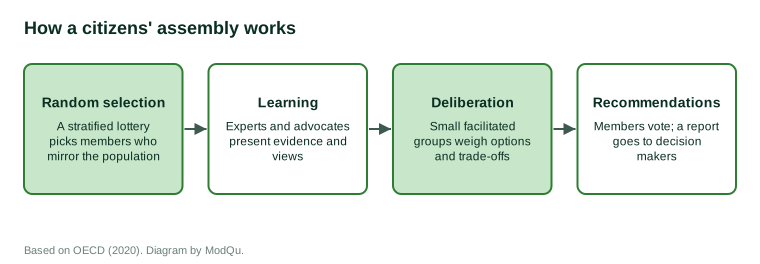
A typical assembly follows the stages in Figure 1. Members, often between 50 and 150 people, are chosen by a stratified lottery so that the group reflects the population by characteristics such as age, gender, region and education. They meet over several weekends, hear from experts and advocates with different views, discuss options in small facilitated groups and vote on recommendations.
The Organisation for Economic Co-operation and Development (OECD, 2020) collected nearly 300 examples of such processes and described a "deliberative wave" in their use. Notable examples include the British Columbia Citizens' Assembly on electoral reform (Warren & Pearse, 2008) and the Irish Citizens' Assembly of 2016–2018, whose recommendations on abortion led to a referendum that changed the constitution (Farrell et al., 2019).
What the evidence shows
James Fishkin (2009) developed the related deliberative poll, in which a random sample is surveyed, brought together to deliberate and surveyed again. Fishkin and Luskin (2005) reported that participants' knowledge increased substantially and that their views often changed in ways that reflected the information and arguments they had encountered.
Deliberation does not always improve reasoning. Cass Sunstein (2002) showed that discussion among like-minded people tends to push groups towards more extreme positions. Assemblies are designed to counter this through diverse membership, balanced evidence and trained facilitation, and studies of well-run assemblies have generally found that members' views become more informed rather than more polarised (Fishkin & Luskin, 2005).
Design choices that matter
The quality of an assembly depends on several design decisions. The question must be clear and genuinely open; an assembly asked to endorse a decision already made will lose the trust of its members and the public. The evidence presented must be balanced, which usually means an advisory group with differing views selects the speakers. Facilitation must ensure that quieter members are heard and that no individual dominates. And the commissioning body should say in advance how it will respond to the recommendations. The OECD (2020) set out good-practice principles covering each of these points, including transparency about the process and enough time for members to learn and deliberate.
Limits
Assemblies are costly and slow. Their recommendations carry no formal authority unless governments commit in advance to respond, and some have been ignored. Small groups cannot represent every view, and the choice of experts and framing of the question can shape the outcome. Members may also defer to the most confident speakers in their group, or to the experts, rather than reaching independent judgements. And because an assembly involves only a small number of people, its legitimacy depends on the wider public understanding and trusting how members were chosen and how the process was run.
For organisations, the principle carries over: a representative group, given good evidence and time to deliberate, can reach considered judgements that a quick survey cannot capture. A hypothetical example: a city transport authority planning to reduce car traffic in its centre surveys residents and finds strong opposition to charges. It then convenes a small assembly of randomly selected residents, who hear evidence on congestion, air quality, costs and the experience of other cities. After deliberation, the assembly supports a charge combined with better bus services and exemptions for some groups. The survey recorded first reactions; the assembly showed what informed residents would accept, and why.
References
Farrell, D. M., Suiter, J., & Harris, C. (2019). 'Systematizing' constitutional deliberation: The 2016–18 citizens' assembly in Ireland. Irish Political Studies, 34(1), 113–123. https://doi.org/10.1080/07907184.2018.1534832
Fishkin, J. S. (2009). When the people speak: Deliberative democracy and public consultation. Oxford University Press.
Fishkin, J. S., & Luskin, R. C. (2005). Experimenting with a democratic ideal: Deliberative polling and public opinion. Acta Politica, 40(3), 284–298. https://doi.org/10.1057/palgrave.ap.5500121
OECD. (2020). Innovative citizen participation and new democratic institutions: Catching the deliberative wave. OECD Publishing. https://doi.org/10.1787/339306da-en
Sunstein, C. R. (2002). The law of group polarization. Journal of Political Philosophy, 10(2), 175–195. https://doi.org/10.1111/1467-9760.00148
Warren, M. E., & Pearse, H. (Eds.). (2008). Designing deliberative democracy: The British Columbia Citizens' Assembly. Cambridge University Press. https://doi.org/10.1017/CBO9780511491177