
Inquiry · Philosophy of inquiry
Communities of Inquiry
The idea that knowledge is built by groups who question together runs from Peirce to modern classrooms and online courses. This article explains what a community of inquiry is and what makes one work.
Charles Sanders Peirce believed that no individual can reach the truth alone. Reality, he argued, is what a community of inquirers would eventually agree on, and the very idea of reality "essentially involves the notion of a community, without definite limits, and capable of a definite increase of knowledge" (Peirce, 1868, p. 155). The phrase community of inquiry grew from this idea. Today it names both a philosophical view of how knowledge is produced and a practical approach to teaching and collaboration.
A philosophical idea
For Peirce, the community was essential because individual inquirers are fallible. Each brings particular assumptions and blind spots, and errors are corrected when others check, test and challenge one another's conclusions. John Dewey extended the idea to democratic life, arguing that a public can solve its shared problems only if its members inquire together, communicate freely and have access to the results (Dewey, 1927). Helen Longino (1990) later argued that the objectivity of science itself is a social achievement: it depends on criticism from people with different perspectives, recognised forums for that criticism, shared standards and responsiveness to criticism. A lone scientist, however careful, cannot be objective in this sense.
Communities of inquiry in the classroom
In the 1970s, the philosopher Matthew Lipman turned the idea into an educational method. In Philosophy for Children, a class reads a short story that raises a puzzle, such as what makes something fair. Pupils propose questions, choose one to discuss and build on one another's ideas, while the teacher models good questioning and keeps the inquiry focused (Lipman, 2003). The aim is not to reach a right answer supplied by the teacher but to develop pupils' capacity to reason together.
Evidence on outcomes is encouraging but mixed. A systematic review by Trickey and Topping (2004) found consistent moderate gains on measures of reasoning and cognitive ability across ten controlled studies. A large randomised trial in English primary schools reported small positive effects on pupils' reading and mathematics, while noting limitations such as schools dropping out of the trial (Gorard et al., 2015).
Communities of inquiry online
A second, independent use of the term comes from online education. Garrison et al. (1999) proposed that meaningful learning in online courses depends on three overlapping elements (Figure 1). Cognitive presence is the extent to which participants construct meaning through sustained reflection and discussion. Social presence is the ability of participants to present themselves as real people and build trust. Teaching presence is the design, facilitation and direction that keep the inquiry purposeful.
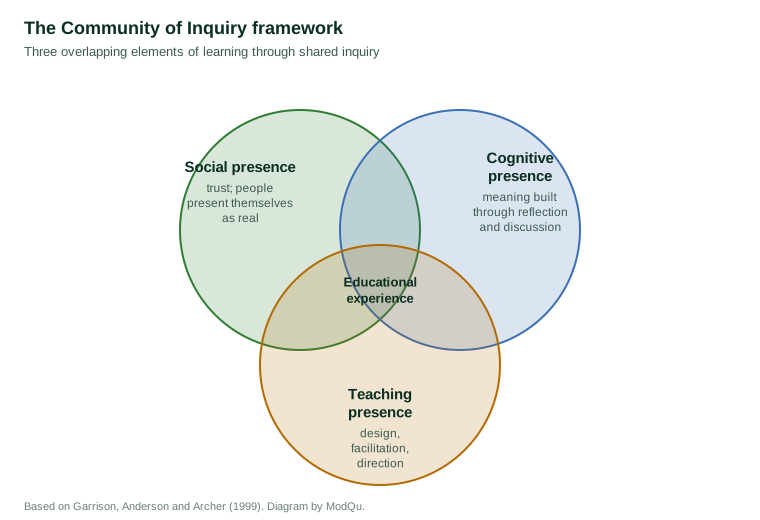
The framework has become one of the most widely used models in research on online and blended learning. Garrison and Arbaugh (2007) reviewed the research it generated and found good support for the three elements, while noting that cognitive presence often stalls at the stage of exploring ideas and rarely reaches resolution without strong teaching presence.
Beyond the classroom
The same idea describes how knowledge is built in research and in organisations. Peer review, replication and open publication are the formal machinery by which the scientific community checks individual claims, and Longino's (1990) conditions explain why they matter: a claim that has been examined by people with different assumptions is more trustworthy than one that has only been examined by its author. In commercial research, a project team that includes the analyst, the client and someone who knows the customers well is more likely to notice a flawed interpretation than any one of them alone. Dewey's (1927) point applies here too. A group can inquire well only if its members share the evidence, communicate freely and are prepared to act on what the inquiry finds. Teams in which information is held back, or in which junior members are expected to agree with senior ones, have the outward form of a community of inquiry without its substance.
What makes a community of inquiry work
Across philosophy, classrooms and online courses, the same conditions recur:
- A genuine shared question. Members must care about the problem, not just perform discussion.
- Freedom to disagree. Errors are found only if people can challenge one another without penalty.
- Shared standards of evidence. Disagreement is productive only when members agree on what counts as a good reason.
- Facilitation. Someone needs to keep the inquiry moving towards an answer and prevent it from drifting.
These conditions apply equally to research teams, project groups and organisations that want to learn. A group of people asking questions together is not automatically a community of inquiry; it becomes one when its members treat one another's views as material to be tested, and their own as open to the same scrutiny.
References
Dewey, J. (1927). The public and its problems. Henry Holt.
Garrison, D. R., Anderson, T., & Archer, W. (1999). Critical inquiry in a text-based environment: Computer conferencing in higher education. The Internet and Higher Education, 2(2–3), 87–105. https://doi.org/10.1016/S1096-7516(00)00016-6
Garrison, D. R., & Arbaugh, J. B. (2007). Researching the community of inquiry framework: Review, issues, and future directions. The Internet and Higher Education, 10(3), 157–172. https://doi.org/10.1016/j.iheduc.2007.04.001
Gorard, S., Siddiqui, N., & See, B. H. (2015). Philosophy for Children: SAPERE evaluation report and executive summary. Education Endowment Foundation.
Lipman, M. (2003). Thinking in education (2nd ed.). Cambridge University Press. https://doi.org/10.1017/CBO9780511840272
Longino, H. E. (1990). Science as social knowledge: Values and objectivity in scientific inquiry. Princeton University Press.
Peirce, C. S. (1868). Some consequences of four incapacities. The Journal of Speculative Philosophy, 2(3), 140–157.
Trickey, S., & Topping, K. J. (2004). 'Philosophy for children': A systematic review. Research Papers in Education, 19(3), 365–380. https://doi.org/10.1080/0267152042000248016